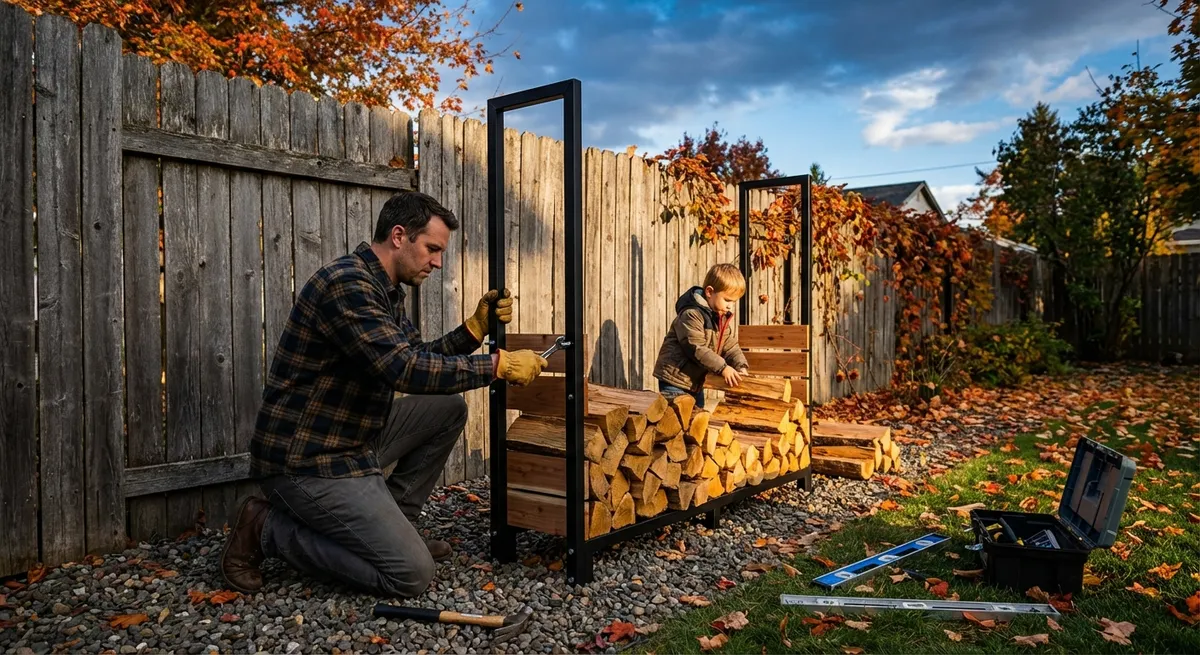
A pile of firewood on the ground looks messy, rots fast, and attracts pests. A simple DIY firewood rack keeps logs dry, organized, and ready to burn—without spending big money on store‑bought units. This project is beginner‑friendly, uses basic tools, and can be adjusted to fit almost any backyard or patio. Below, you’ll find a straightforward guide with clear steps, measurements you can adapt, and practical tips to help your rack stay solid through every season.
Plan the Size and Choose the Best Location
Before you cut a single board, decide how much wood you actually need to store and where it should live.
Think about how you use firewood: occasional weekend fires, or steady use all winter. A common “face cord” (about 4 ft high x 8 ft long) is a good reference size. Pick a spot at least a foot away from your house or shed wall; you don’t want bugs and moisture right against your siding. Look for fairly level ground with some air movement so the wood can dry, and avoid low spots where water pools. If possible, orient the long side of the rack so prevailing winds blow through the stack, which speeds drying. Check any local codes or HOA rules about firewood storage; some areas require minimum clearances from structures or property lines. Once you’ve got the size and location in mind, sketch a simple rectangle to match your space—this helps you calculate materials and avoid extra trips to the store.
Gather Materials and Tools That Handle the Weather
A firewood rack fights weather year‑round, so choosing the right materials matters more than looks.
For the frame, pressure‑treated 2x4s or 2x6s are a solid, budget‑friendly choice because they resist rot better than regular framing lumber. If you want a lower‑maintenance option and higher budget, consider metal fence posts or galvanized steel pipe for uprights paired with wood rails. Use exterior‑grade deck screws or structural screws; they hold better outdoors than standard drywall or interior screws, and they’re less likely to rust. For the base, concrete pavers, treated 4x4s laid flat, or composite deck boards keep your firewood off the dirt and help airflow under the stack. Plan to have a drill/driver, circular saw or miter saw, tape measure, speed square, level, and safety gear (eye and hearing protection). If you’re cutting pressure‑treated lumber, avoid breathing sawdust and wash up afterward; modern treated wood is safer than older formulas but still something to handle with care.
Step 1: Build a Solid, Elevated Base
The base is what keeps your firewood from wicking moisture from the ground, so don’t skip or rush this part.
Start by marking out the footprint of your rack with stakes or chalk—say 8 ft long and 16–20 in deep for a typical stack. Scrape away grass and high spots so the area is fairly level; it doesn’t have to be perfect, but big humps will twist the frame. Lay down concrete pavers or solid bricks in two parallel rows running the length of the rack, spaced about 12–16 in apart. Use a short 2x4 and a level to check each paver row; add or remove soil under them until they sit flat and level from side to side. Next, cut two pressure‑treated 2x4s to match your full rack length and set them on top of the pavers as “skids.” Secure the skids to the pavers with construction adhesive rated for exterior masonry if you want extra stability, or leave them floating if you may move the rack later. Finally, measure diagonally from corner to corner of your skid rectangle; if both diagonals match, the base is square and ready for the next step.
Step 2: Attach Vertical Supports for the Sides
These upright posts keep your wood stack from tumbling over—get them plumb and sturdy now, and the rack will feel solid for years.
Decide how tall you want your stack; 4 ft is a good, safe height that’s easy to reach. Cut four pressure‑treated 2x4s or 2x6s to about 48–52 in, allowing a little extra height so wood doesn’t roll off the top. At each corner of your base, stand a post upright, lined up with the outer edge of the skid. Use a speed square at the base and a level along the post to get it roughly plumb. Drill two or three pilot holes through the post into the skid, then fasten with 3–3½ in exterior screws. Repeat this on all four corners. For added strength on longer racks (over 8 ft), add one or two intermediate posts along the length on each side, spaced evenly, attaching them the same way. As you go, recheck each upright with your level from both directions; a few extra minutes making them straight will make stacking easier later.
Step 3: Add Cross Bracing and Side Rails
A bare frame will hold wood, but bracing and rails keep the structure from racking (twisting) and the logs from spilling.
Cut horizontal rails (2x4s) to run between the posts on each side, one near the bottom and one near the top. Mount the bottom rails 3–4 in above the base so air can move under the first row of logs. Predrill and screw through the posts into the ends of each rail. To stiffen the frame, add diagonal braces from the bottom of one corner post to the top of the adjacent post on the same side. These can be narrower off‑cuts; just make sure they sit flush and are well‑screwed into both posts and rails. Repeat on the opposite side so the frame can’t sway forward or backward. If you plan to stack wood quite high, consider a simple center rail running down the length of the rack to support the middle of the pile and keep it from bowing out. Step back and gently push the frame from different angles; if it doesn’t wobble, you’ve hit the right level of bracing.
Step 4: Protect the Top and Encourage Airflow
Keeping rain and snow off the top of the stack extends the life of your firewood and your rack.
You can keep this simple: cut a piece of exterior‑grade plywood slightly longer and wider than your rack and rest it on the top of the posts as a roof. For better durability, paint or seal the plywood edges and top with an exterior wood sealer. If you want a more permanent top, add short 2x4 blocks on top of each post to create a slight slope, then fasten corrugated metal or polycarbonate roofing panels over them, letting the roof overhang the front and back by at least 2 in. Avoid wrapping the entire rack in a tarp; that traps moisture and slows drying. Instead, cover only the top third of the stack or just the roof and leave the sides exposed. Make sure there’s at least a couple of inches between the top of your wood pile and the roof so air can still move across the top layer. This balance of shelter and airflow is what keeps wood seasoned and ready to burn cleanly.
Step 5: Stack Firewood Safely and Maintain the Rack
How you load the rack matters for safety, drying time, and how long your work lasts.
Start by placing the first row of logs bark‑side down across the width of the rack, with small gaps between pieces to allow air movement. At each end of the rack, you can build simple “bookend” stacks by alternating log direction every row (one row front‑to‑back, the next row side‑to‑side) to create a locking pattern that resists tipping. Stack wood no higher than your posts and avoid leaning it hard against one side; a gentle inward lean toward the center of the rack is more stable. Keep the shortest or odd‑shaped pieces for the top layer instead of trying to wedge them into the middle. Once or twice a year, inspect the rack for loose screws, sagging rails, or rot, and replace any damaged boards before they fail. If the ground under the rack settles or sinks, shim under the pavers with gravel or sand to re‑level the base. With basic upkeep and sensible stacking, your rack should handle many seasons of firewood without a major rebuild.
Conclusion
A backyard firewood rack doesn’t need to be fancy or expensive to work well. With a level base, solid uprights, basic bracing, and thoughtful airflow, you can keep your logs dry, organized, and easy to reach whenever you’re ready to light a fire. This project is approachable for most DIYers with basic tools, and once you’ve built one, you can easily adapt the design for a second rack, a smaller porch version, or even a compact indoor log holder. Take your time on layout and structure, and you’ll end up with a simple upgrade that quietly makes every fire night easier.
Sources
- U.S. Department of Energy – Wood and Pellet Heating - Covers efficient and safe use of firewood and wood‑burning appliances
- University of Minnesota Extension – Storing Firewood - Explains best practices for seasoning and storing firewood outdoors
- Virginia Cooperative Extension – Firewood: How to Obtain, Measure, Season, and Store It - Offers detailed guidance on proper stacking and storage to reduce pests and moisture
- EPA Burn Wise – Best Burn Practices - Discusses how properly seasoned and stored wood improves efficiency and reduces smoke
- International Code Council – Wildland-Urban Interface Code Overview - Background on fire safety considerations near structures, useful when locating wood storage
Key Takeaway
The most important thing to remember from this article is that this information can change how you think about DIY Projects.