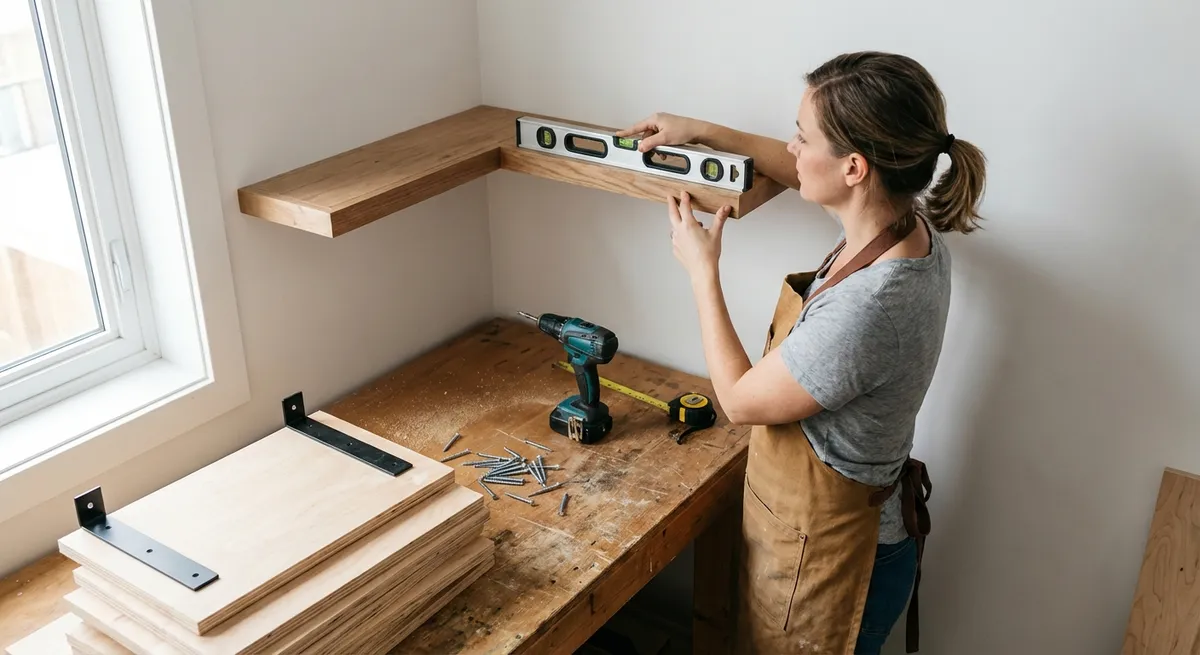
Floating shelves are one of the most useful DIY projects you can tackle: they add storage, look clean and modern, and don’t eat up floor space. Done right, they’re strong enough for books, plants, and decor. Done wrong, they sag, tilt, or pull out of the wall.
This guide walks you through a reliable way to build and install a sturdy floating shelf, with five clear steps from planning to finishing. You won’t need a full workshop—just basic tools, careful measuring, and a little patience.
Plan Your Shelf and Choose the Right Materials
Before you pick up a saw, decide exactly what you want the shelf to do. A shelf that holds a few small plants can be built lighter than one that carries heavy books or kitchen gear. The more weight you plan to store, the more important it is to anchor into studs and use solid materials.
Start by measuring the wall space where the shelf will go. Note three basic dimensions: length (how wide the shelf is along the wall), depth (how far it comes out from the wall), and thickness (how thick the shelf looks from the side). For most homes, a depth of 8–10 inches works well for books and decor without feeling intrusive. For living rooms and bedrooms, 1.5–2 inches of visible thickness looks solid without being chunky.
Choose your shelf material based on what you’re comfortable working with. A simple, strong option is a 1x10 or 1x12 board (actual thickness about ¾ inch) made of pine, poplar, or oak. You can also build a hollow “box” shelf from plywood with a face frame if you want a thicker, more modern look. For the hidden support, use a sturdy mounting board (like a 2x2 or 1x3) that will be screwed securely into wall studs.
Map out where you want studs to support the shelf. Use a stud finder and mark their positions lightly with painter’s tape or pencil. If your shelf spans multiple studs, it will be capable of supporting much more weight than if you rely on drywall anchors alone. Planning around stud locations now saves you from weak mounting later.
Collect Tools and Prep Your Workspace
Having everything ready before you start keeps the build simple and reduces mistakes. You don’t need pro-level gear, but you do need reliable basics. Clear a work area on a sturdy table or pair of sawhorses, and protect the surface with a drop cloth or scrap cardboard.
At minimum, gather: a measuring tape, pencil, level, stud finder, drill/driver with wood and masonry bits (if mounting into brick or concrete), a hand saw or circular saw, wood screws, wood glue (optional for a box-style shelf), sandpaper (120- and 220-grit), safety glasses, and a dust mask. If you have clamps, they’ll help keep boards steady while cutting or gluing, but they’re not mandatory.
Prep your wall area too. Remove any pictures, shelves, or fixtures from the space. Wipe down the wall so dust and dirt won’t get trapped under the shelf. If you know you’ll want multiple shelves in a column, consider marking out all the shelf heights now with light pencil lines or painter’s tape so they line up cleanly.
Double-check your power tools before you begin. Make sure batteries are charged, bits are tightened, and blades are sharp. Dull blades and bits are harder to control and more likely to cause tear-out or crooked cuts. Taking ten minutes to prep tools usually saves you from redoing cuts later.
Build the Shelf: Cut, Assemble, and Sand
Now you’ll create the shelf itself and the hidden support that holds it up. There are two common options: a solid board shelf that slides over a mounting cleat, or a hollow box shelf built around a support frame. The box style gives a thicker look and is easier to hide hardware, so we’ll focus on that.
Cut your top and bottom pieces from plywood or a solid board to your desired length and depth. Then cut a back piece that matches the length of the shelf and the thickness you want (often 1.5–2 inches). If you want side pieces (for a fully wrapped look), cut them to match the depth and thickness. Dry-fit (assemble without glue or screws) all pieces on your work surface to check for gaps or misalignment.
Once you’re happy with the fit, assemble the box. Apply wood glue on the edges if you’re using it, then fasten pieces together with brad nails or short wood screws from the underside or interior so the fasteners are hidden. Make sure all corners are square—use a carpenter’s square or measure diagonally from corner to corner; equal diagonals mean a square box.
Next, create the internal support. Cut a length of 2x2 or 1x3 to match the inside length of the box. This will be mounted to the wall and fit inside the hollow shelf like a glove. For extra rigidity, you can also cut short “arms” from the same stock and screw them into this back piece to form a simple frame that slides into the box.
Sand all exposed surfaces starting with 120-grit sandpaper to smooth roughness, then finish with 220-grit for a clean feel. Slightly round sharp edges with a few light passes of sandpaper; this reduces chipping and gives a more finished look. Wipe off dust with a tack cloth or slightly damp rag before finishing.
Mount the Hidden Support Securely to the Wall
This is the most critical part for strength. The hidden support must be firmly anchored to studs (or appropriate anchors in masonry) and level, or the shelf will sag or tilt. Take your time here and don’t rush.
Start by marking the exact height of the top of your finished shelf on the wall with a light pencil line. Then subtract the shelf thickness to mark where the top of the support board should go. Use a long level to extend that line across the width of your shelf location so you have a clear reference.
Hold your support board against the wall at this line and mark where it crosses each wall stud you located earlier. Pre-drill holes through the support at those marks slightly smaller than your screw diameter; this prevents the wood from splitting and makes driving screws easier. If you only catch one stud within your span, add high-quality drywall anchors or toggle bolts on either side for extra support, following the weight ratings on the package.
With a helper if possible, hold the support board in place on the wall. Recheck that it’s level, then drive wood screws through the pre-drilled holes into the studs. For typical shelving, 2½- to 3-inch wood screws into studs provide strong support. Tighten until the board is snug, but avoid overtightening, which can strip the wood or twist the board out of level.
If you’re attaching to brick, concrete, or block, use masonry screws or anchors designed for that material. Pre-drill with a masonry bit, insert the anchors, and then drive the screws through the support board into the anchors. Once mounted, tug firmly on the support; it should feel solid with no wiggle. If it moves, fix that now before you slide the shelf on.
Slide On, Finish, and Load Your Shelf Safely
With the support secured, you’re ready to install the shelf and finish it to match your space. This is where the project starts to look like the vision in your head—and where you make sure it stays looking that way for years.
Test-fit the hollow shelf box over the support board. It should slide on snugly without forcing. If it’s too tight, lightly sand the inside surfaces or plane down the support a bit at a time until it fits. Avoid hammering the shelf into place; that can split joints or damage the wall. Once you’re satisfied with the fit, remove the shelf to apply your finish.
Choose a finish that suits the room and your wood choice. For a natural look, use a clear polyurethane, water-based polycrylic, or furniture wax. For color, apply a wood stain first, then seal it. If you prefer painted shelves, use a primer followed by two coats of durable paint (semi-gloss or satin holds up well and is easier to clean). Always follow the manufacturer’s instructions for drying times and ventilation.
When the finish is fully dry, slide the shelf back over the support. To lock it in place, you can drive a couple of short screws up through the underside of the shelf into the support, or through the top at the back edge where they’ll be hidden by decor. Pre-drill pilot holes to avoid splitting the wood. Alternatively, a bead of construction adhesive on the top of the support before sliding the shelf on can help hold it firmly (just note that adhesive makes future removal harder).
Before loading the shelf with heavy items, test its strength gradually. Place a few books or decor pieces and watch for any sagging or movement. If everything stays solid, you can add more weight—but still respect the limits of your mounting method and materials. Spreading weight evenly along the shelf and keeping the heaviest items closer to the wall edge will help reduce stress.
Now you’ve got a clean-lined floating shelf that looks built-in, not slapped on. Take a quick photo of the build stages and the finished result—these projects are perfect for sharing progress shots, and your future self will appreciate seeing how you put it all together.
Conclusion
A solid floating shelf is more than just a nice-looking upgrade; it’s a practical, space-saving project that builds your confidence with tools, measuring, and wall-mounting hardware. By planning around studs, building a snug hollow box, and taking your time on the support, you end up with a shelf that not only looks good but stands up to daily use.
Once you’ve built one, you can repeat the same basic process for a row of kitchen shelves, a media wall, or an entryway display. The steps don’t change much—you just adjust size, finish, and layout to fit each room. That’s the value of learning a reliable method: you’re not just making a shelf, you’re adding a repeatable skill to your DIY toolkit.
Sources
- [U.S. Consumer Product Safety Commission – Anchor It!](https://www.cpsc.gov/anchorit) - Guidance on safe anchoring practices and preventing tip-over incidents, useful when planning sturdy wall-mounted storage.
- [Family Handyman – How to Build and Install Floating Shelves](https://www.familyhandyman.com/project/how-to-build-and-install-floating-shelves/) - Practical overview of different floating shelf designs and mounting methods.
- [Lowe’s – How to Find a Wall Stud](https://www.lowes.com/n/how-to/find-wall-studs) - Clear instructions on locating studs to ensure strong, safe mounting.
- [Minwax – Wood Finishing How-To](https://www.minwax.com/how-to) - Detailed tutorials on staining, sealing, and protecting wood shelves.
- [Occupational Safety and Health Administration (OSHA) – Hand and Power Tools](https://www.osha.gov/hand-power-tools) - Safety considerations for working with basic tools during DIY projects.
Key Takeaway
The most important thing to remember from this article is that this information can change how you think about DIY Projects.