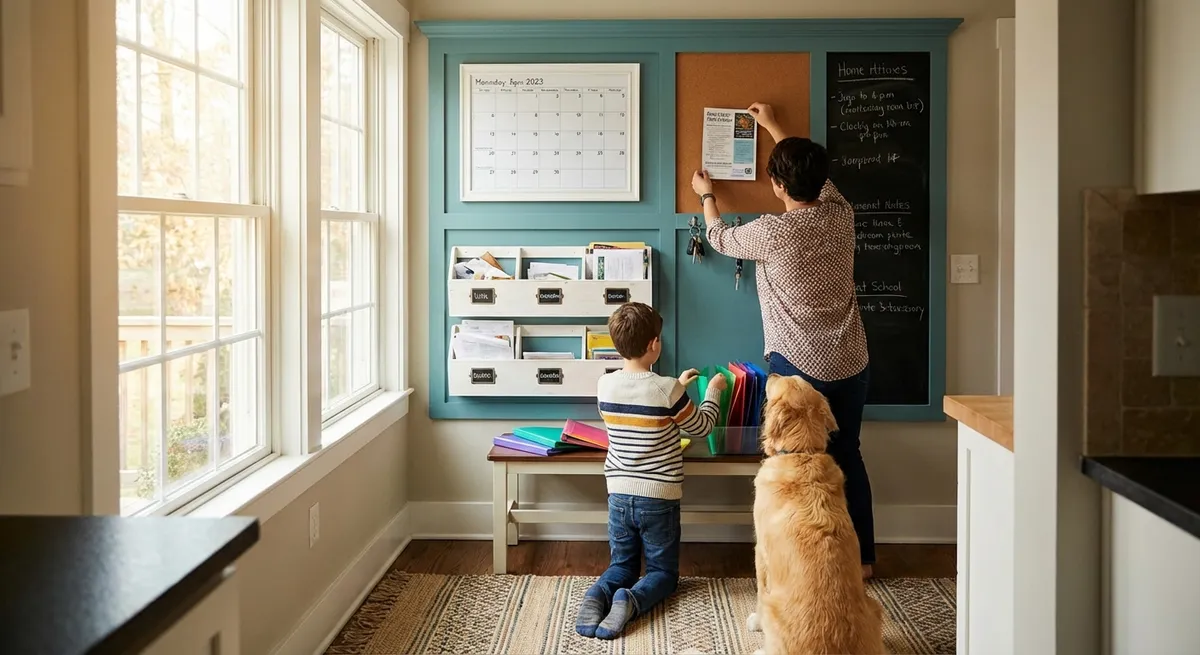
If you’re tired of lost mail, forgotten appointments, and keys that vanish every morning, a wall-mounted command center is one of the most useful DIY projects you can tackle. It doesn’t require advanced tools, but it makes a big impact on how your home functions. This guide walks you through planning, building, and hanging a simple, clean-looking command center you can customize to your space and style.
Plan Your Command Center Like a Working System
Before you pick up a single tool, decide what problems you want this project to solve. A command center is most effective when it’s purpose-built, not just a random collection of hooks and boards. Think about the daily bottlenecks in your home: incoming mail piling on the counter, school papers spread across the table, or phone chargers scattered everywhere. List the specific items you want to handle: mail, keys, schedules, backpacks, devices, or bills.
Next, choose the wall location where your household naturally passes through—near the entry door, in a hallway off the garage, or beside the kitchen. Measure the available wall space, noting both width and height, and mark any outlets, light switches, or thermostats you need to work around. Decide on the key components: a calendar or whiteboard, mail slots, key hooks, a shelf or two, and possibly a small corkboard. Sketch a simple layout on paper with rough dimensions so you know what will fit. Planning at this level prevents awkward spacing and makes shopping for materials much faster.
Step 1: Gather Materials and Basic Tools
Once you have your layout, choose materials that match your skill level and the look you want. For a clean, modern setup, 1x3 or 1x4 pine boards and a sheet of ¼" or ½" plywood work well and are easy to cut and finish. If you prefer a more rustic or industrial feel, consider pre-finished pine, common board, or even thin hardwood planks for the facing, and add metal hooks or brackets. Plan for one main backer board (this anchors everything to the wall), plus smaller pieces for mail slots, shelves, and trim.
You’ll need some basic tools: a tape measure, pencil, level, drill/driver, stud finder, and either a circular saw, jigsaw, or hand saw. For fasteners, have wood screws (1¼"–1⅝" for joining pieces; 2½"–3" for anchoring to studs) and wood glue. For finish work, grab sandpaper (120 and 220 grit), paint or stain, a brush or foam roller, and painter’s tape if you plan color blocks or accents. Don’t forget hardware: key hooks, cup hooks, small baskets or magazine racks (if you’re not building your own mail slots), and D-rings or a French cleat if you want to hang the entire panel like a picture. Laying everything out before you start helps avoid mid-project store runs that slow you down.
Step 2: Build the Backer Board and Layout the Components
The backer board is the backbone of your command center, so take time to size and cut it accurately. Using your wall measurements, subtract at least a couple of inches from each dimension so it has some visual breathing room and doesn’t feel crammed into corners or against door trim. Mark your cut line on the plywood with a straightedge, then cut slowly, keeping the saw base firmly against your guide to get a clean edge. Lightly sand the edges and faces with 120-grit to remove splinters.
Lay the backer board on a work surface and start “dry fitting” the components based on your sketch. Place your calendar or whiteboard first—this is usually the visual anchor—then arrange key hooks near the door side, mail slots or baskets below or beside the calendar, and any shelves higher up to keep them out of children’s reach if needed. Use a pencil and light lines to trace around each component and mark mounting points, keeping consistent spacing between elements (use a scrap board as a spacer for even gaps). Stand back several times and look at the layout from different angles; adjust until the composition looks balanced and uncluttered. This visual test run saves you from extra holes and patching later.
Step 3: Build Simple Mail Slots and Shelves
Mail slots and shallow shelves make your command center actually useful, not just decorative. For basic mail slots, cut two identical boards for the front and bottom and use the backer board itself as the back. For example, cut a 10" wide front piece (1x4 board) and a 10" bottom piece (1x3), then glue and screw them together in an L-shape. Position that assembly on your backer board along your layout lines and fasten from behind with screws into the sides of the slot, so no fasteners show on the front. Repeat for multiple slots, and slightly angle the bottom piece upward so papers naturally lean back and don’t fall forward.
For a simple shelf, cut a board to your desired width (often 12"–18" works well) and a second piece as a support cleat. Attach the cleat to the backer board first, perfectly level, with glue and screws into the backer. Then rest the shelf board on top and fasten from above down into the cleat. Use corner brackets if you want extra strength or a more industrial look. Sand all exposed edges smooth, then test-fit typical items—mail, sunglasses, a small plant, or a speaker—to confirm the depth and spacing work. This is the moment to tweak positions before you commit to finish and final assembly.
Step 4: Sand, Finish, and Pre-Install Hardware
Pre-finishing the board and components before they go on the wall makes everything look cleaner and avoids getting paint on your walls or floor. Start with a thorough sanding of all surfaces, moving from 120-grit to 220-grit for a smoother finish. Wipe away dust with a tack cloth or a damp rag. If you’re painting, apply a primer first—especially on softwoods like pine—then follow with two light coats of paint, sanding lightly between coats if you want a really smooth result. For a stained look, apply the stain with a rag, let it penetrate, then wipe off excess and finish with a clear topcoat like polyurethane or water-based polycrylic for durability.
While the finish dries, mark all the places where hooks, baskets, and whiteboards will attach. Pre-drill holes for screws and hooks so you’re not forcing hardware through thick finish later. If you’re hanging a whiteboard, corkboard, or clipboards, attach their mounting hardware to the backer board now, according to the manufacturer’s instructions. This is also the time to add small labels, stenciled words (“Mail,” “Keys,” “To Do”), or chalkboard paint sections if you want built-in note areas. Doing as much assembly as possible off the wall keeps the final installation faster and cleaner, especially in tight spaces like hallways or entry nooks.
Step 5: Securely Mount the Command Center to the Wall
A command center will carry real weight—mail, keys, maybe small electronics—so it needs a solid connection to the wall. Start with a stud finder and mark stud locations lightly with pencil above and below your intended mounting area. If you’re using a French cleat system, mount the wall-side cleat first, making sure it’s perfectly level and anchored with at least two screws into studs. The matching cleat on the backer board should be attached with multiple screws across its length to spread the load. Once both sides are in place, you can lift the whole command center and hang it on the cleat, adjusting side-to-side as needed.
If you’d rather screw the backer directly to the wall, pre-drill mounting holes through the backer where you know studs are located. With a helper, hold the board in place, confirm it’s level, then drive long wood screws through the backer into the studs. If you must use wall anchors (for spots without studs), choose heavy-duty toggle anchors and follow the manufacturer’s weight limits. After it’s secure, hang keys on the hooks, add mail to the slots, and place items on the shelves to confirm everything feels solid. Step back and double-check that doors still open fully, traffic flow isn’t blocked, and there’s enough clearance for backpacks or coats if you’ve planned those nearby. A quick live test with a normal day’s items will tell you if your new command center truly works for your household.
Conclusion
A wall-mounted command center is a relatively simple DIY project that solves everyday headaches: lost keys, piled-up mail, and scattered schedules. By taking time to plan the layout, build sturdy components, and mount everything securely, you end up with a custom system that fits your space and the way your home actually runs. Once it’s in use, you can adjust labels, swap baskets, or add hooks as your needs change—but the backbone will already be in place. This is the kind of weekend project that keeps paying off, every time you walk in the door and know exactly where everything belongs.
Sources
- U.S. Fire Administration – Electrical and Appliance Safety - Guidance on safe use of electrical devices and avoiding overloads near entry and command centers
- Family Handyman – How to Use a Stud Finder - Practical tips for locating studs before mounting heavy items on walls
- Lowe’s – How to Use a Level - Step-by-step overview on properly leveling shelves, cleats, and wall-mounted boards
- Sherwin-Williams – Surface Preparation for Painting - Detailed information on sanding, priming, and finishing wood surfaces
- OSHA – Hand and Power Tool Safety - Safety practices when cutting, drilling, and assembling components for DIY projects
Key Takeaway
The most important thing to remember from this article is that this information can change how you think about DIY Projects.