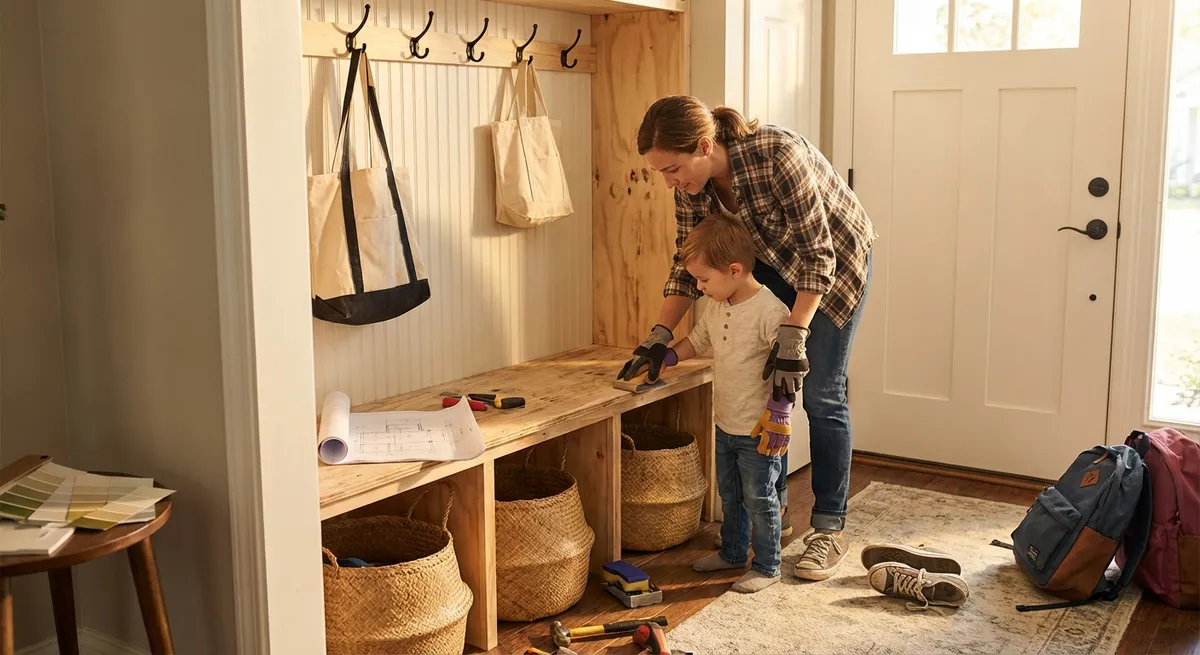
A cluttered entryway makes your whole home feel messy. The good news: you don’t need a full remodel to fix it. With a few basic tools and affordable materials, you can build a simple “drop zone” that tames shoes, bags, keys, and mail—without eating your entire weekend or budget.
This guide walks you through a practical, beginner-friendly project to turn that dead space by your door into a hardworking landing zone. You’ll get clear steps, tool lists, and straightforward tips you can actually use.
Plan a Drop Zone That Fits Your Space (and Your Stuff)
Before you touch a tool, get clear on what you need this space to do. A good drop zone solves daily problems, not just looks nice.
Look at your entryway and answer these questions:
- Where do shoes pile up now?
- Where do keys, wallets, and mail usually land?
- Do you need a spot for backpacks, purses, or work bags?
- Is there room for a small bench, or only wall space?
Measure the space you’ll use: width, height, and depth. Write these down. Most small entry setups can work within 36–48 inches of wall space, but even 24 inches is workable in tight areas.
Decide on your must-have features:
- Wall hooks for jackets and bags
- Shoe storage (open shelves or bins)
- A small bench or seat (if space allows)
- A small shelf or organizer for keys and mail
You don’t need all of them. Focus on 2–3 features you’ll actually use daily. That keeps the project realistic and avoids overbuilding something that becomes clutter.
Gather Tools and Materials Before You Start
Collect everything first so you’re not running to the store mid-project. Adjust quantities to your measurements.
Basic tools:
- Tape measure
- Pencil and painter’s tape
- Stud finder
- Level (24" or longer if possible)
- Power drill/driver with bits
- Handsaw or circular saw (or have boards cut at the store)
- Safety glasses and hearing protection
- Sanding block or 120–220 grit sandpaper
Materials (typical for a 36–48" wide setup):
- 1x4 or 1x6 boards for a top shelf and hook rail (2–3 boards, 6–8 ft each)
- Optional: 2x10 or 2x12 board for a simple bench top
- Heavy-duty wall hooks (4–8, depending on width)
- L-brackets or concealed brackets for the top shelf
- 2–3 simple fabric or plastic bins for shoes/accessories
- 2.5" wood screws for studs and 1.25" wood screws for brackets
- Wall anchors if you can’t hit a stud in every spot
- Wood filler, primer, and paint or stain (plus brush/roller)
- Felt pads for anything that rests on the floor
Choose materials that match how hard you’ll use the space. Solid pine or poplar boards are good for painted projects; for a more durable natural look, consider oak or another hardwood if budget allows.
Step 1: Mark the Layout on the Wall
Laying out your drop zone on the wall first prevents awkward heights and crooked lines.
- Find your studs. Use a stud finder to locate studs in the wall where your hooks and shelf will go. Lightly mark them with pencil from about 12" to 72" off the floor.
- Mark bench height (if using a bench). Standard bench height is around 18" from the floor to the top surface. Mark a horizontal line at 18" with a level. This helps you center storage bins underneath.
- Mark hook rail height. For most adults, 66–70" from the floor works well. If you have kids using this space, consider a second, lower row at 40–48". Use your level to draw a light pencil line where the board with hooks will mount.
- Mark shelf height. A top shelf above the hooks usually sits around 72–78" high. Mark another level line where the underside of the shelf will go.
- Use painter’s tape to visualize. Run short strips of tape along where the bench, hook board, and shelf will be. Step back and look:
- Is there enough room for a person to sit without bumping their head on the hooks?
- Are the hooks reachable for whoever will use them most?
Adjust now, before you cut anything.
Pro tip: If your ceiling is low or the space is narrow, prioritize hook height and skip the upper shelf. Function first.
Step 2: Cut, Sand, and Pre-Finish Your Boards
Doing as much prep as possible before installation keeps the final steps quicker and cleaner.
- Cut your boards to length.
- Hook rail: Cut a 1x4 or 1x6 to your wall width minus 1–2" so it doesn’t crowd corners or trim.
- Top shelf: Same width as hook rail.
- Bench top (if using): Match overall width or leave roughly 1" clearance from walls on each side.
- Lightly round sharp edges. Use sandpaper to ease the corners and edges of each board. It feels better in use and reduces chipping.
- Fill defects if painting. If you’re planning to paint, use wood filler on knots and deep imperfections, then sand smooth once dry.
- Prime and paint or stain before install. It’s much easier to coat boards on a work surface than on the wall:
- For paint: one coat primer, then 1–2 coats of durable paint (semi-gloss or satin cleans up well).
- For stain: apply stain, wipe off excess, then seal with 2–3 coats of clear polyurethane.
- Let everything dry fully. Follow dry times on the can. Rushing this step leads to sticky surfaces that collect dirt and scuffs quickly.
Pro tip: Pre-drill small pilot holes for your hooks in the hook rail before painting or staining. This prevents chipping later.
Step 3: Secure the Hook Rail Into Studs
Hooks hold a lot of weight, so this board has to be solid.
- Locate stud positions on the board. Transfer your wall stud marks to the back of the hook board. Lightly mark where screws will go, at least two screws per stud if possible.
- Pre-drill clearance holes. Drill holes through the board at your marks, slightly larger than the screw shank. This keeps the wood from splitting and lets the screw pull the board tight to the wall.
- Hold the board at your hook height line. Get help if possible. Use a level on the top edge to keep it straight.
- Drive the center screw first. Put one screw into a stud near the center while holding the board on your pencil line. Check level again.
- Secure the remaining screws. Once the board is level and anchored in the center, drive screws into the other studs along the board’s length.
- Touch up finish if needed. If screw heads are visible and you’re painting, you can countersink slightly, fill, and dab paint over them.
If you can’t hit a stud in the exact spots you want hooks:
Use heavy-duty wall anchors just for those hook positions, and still attach the board to at least one stud. Check the weight rating on the anchors and don’t overload them.
Step 4: Install the Top Shelf and (Optional) Bench
Now you’ll add storage surfaces that make the space truly useful.
Install the top shelf
- Mark bracket locations. Aim to place shelf brackets so at least one screw per bracket hits a stud. Space brackets 16–24" apart, depending on shelf length and load.
- Attach brackets to the wall. Hold each bracket along your shelf height line, check for plumb, and secure with appropriate screws:
- Into studs when possible
- Into solid wall anchors when you can’t hit a stud
- Set the shelf board in place. Center it over the hook rail and ensure equal overhang at both ends if you left space from the walls.
- Secure the shelf to the brackets. From underneath, drill pilot holes into the shelf board through the bracket screw holes, then drive short screws to fasten.
- Check level and stability. Gently push down and forward on the shelf. If anything moves, re-tighten or add an extra bracket.
Add a simple bench (optional but highly recommended)
- Decide on a support style. Easiest options:
- Two sturdy pre-made cube shelves or cabinets under the bench top
- Two vertical 2x legs screwed to the underside of the bench top at each end
- Set bench supports in place. Position them where they won’t block door swing or traffic. Check that the top will be about 18" high.
- Attach the bench top. Center the bench board on the supports and secure from underneath with wood screws. Pre-drill pilot holes to avoid splitting.
- Add felt pads. Stick felt pads under the supports so you don’t scratch your floor.
- Test the seat. Sit on it and shift your weight. If there’s any wobble, reinforce with extra screws or angled brackets at the back.
Step 5: Add Hooks, Bins, and Smart Organizing Details
Now you turn this from “boards on a wall” into a functional daily tool.
- Install the hooks.
- Mark hook spacing on the rail: usually 6–8" apart works for mixed bags and coats.
- Pre-drill pilot holes if you haven’t already.
- Screw hooks into place, keeping them upright and consistent.
- Place bins for shoes and accessories.
- Slide 2–3 bins under the bench or along the floor under the hook rail.
- Dedicate one bin for each person, or separate by type (shoes, hats/gloves, sports gear).
- Create a small “pocket zone.”
- Add a small wall-mounted tray, key hook, or narrow shelf near the door for keys, wallets, and sunglasses.
- Keep this minimal—too many trays become clutter magnets.
- Use vertical space wisely.
- Store off-season items or rarely used gear (umbrella, spare tote bags) in labeled bins on the top shelf.
- Keep daily-use items at arm height; ladder-only items go up high.
- Set house rules for the space.
- Example: “One coat and one bag per person on the hooks.”
- Example: “Shoes that are worn weekly go in the bins; everything else lives in bedroom closets.”
Live with the setup for a week, then adjust. If a hook is always empty and another is overloaded, move or add hooks. If bins are overflowing, upgrade to slightly larger ones or edit what lives there.
Conclusion
A well-designed entry drop zone doesn’t need custom cabinetry or a big budget. With a few boards, solid hardware, and a couple of hours of focused work, you can turn a chaotic hallway into a clean, predictable landing spot for your daily gear.
The key is planning around how you actually live: where you drop things now, who uses the door most, and what always ends up in a pile. Build for those habits, secure everything properly, and keep the layout simple. Your future self—walking into a tidy, organized entry—will thank you every single day.
Sources
- U.S. Consumer Product Safety Commission – Anchor It! - Guidance on safely securing furniture and shelving to prevent tip-overs
- Family Handyman – How to Use a Stud Finder - Practical tips for accurately locating studs in walls
- Lowe’s – How to Install Shelves - Step-by-step instructions and hardware options for safe shelf installation
- This Old House – Entryway Ideas - Inspiration and layout concepts for functional entry spaces
- Sherwin-Williams – Interior Paint Selection Tips - Guidance on choosing durable paint finishes for high-traffic areas
Key Takeaway
The most important thing to remember from this article is that this information can change how you think about DIY Projects.