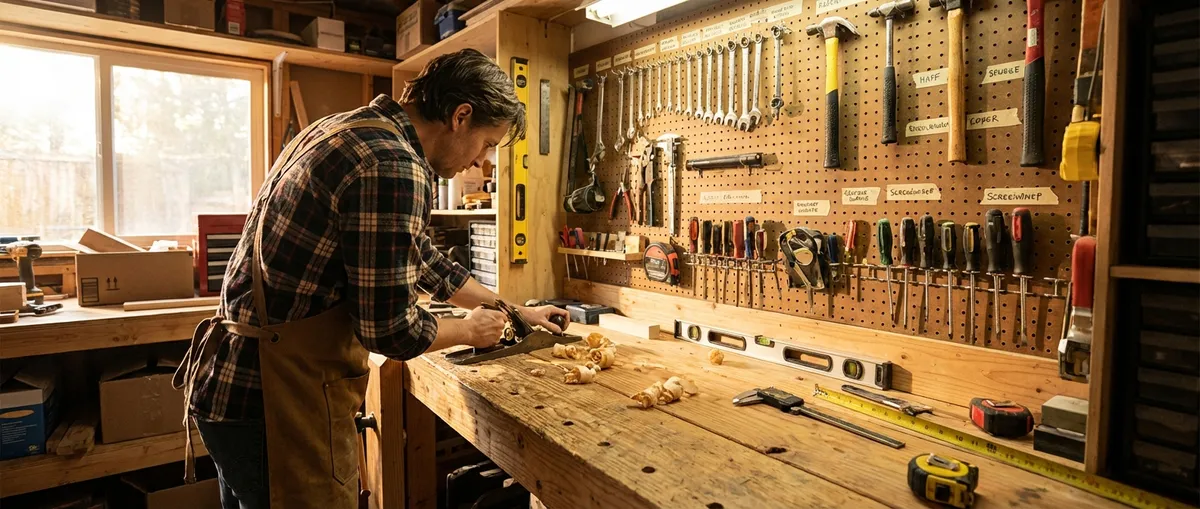
Getting clean, repeatable results from DIY projects isn’t just about having tools—it’s about setting them up correctly. Misaligned, dull, or poorly adjusted tools can ruin materials, waste time, and cause injuries. With a bit of careful setup, your basic toolbox can perform like a pro’s.
This guide walks through five practical, step‑by‑step setups for common hand tools so your cuts are straighter, measurements are accurate, and fasteners stay tight.
1. Setting Up a Tape Measure for Accurate Layouts
A tape measure that’s off by even 1/16" can throw off an entire project. Before you trust yours, take a few minutes to verify and mark it for real‑world accuracy.
Step 1: Check the hook movement
Pull the end hook out and push it back in. It should move about the thickness of the hook metal. This “slop” is intentional so the tape measures correctly for both inside and outside dimensions. If it’s loose or bent, accuracy is compromised.
Step 2: Verify against a known reference
Use a steel ruler or carpenter’s square with etched measurements. Line up the tape’s 1" mark with the ruler’s 1" mark (this ignores any hook error) and check at 12", 24", and 36". If it doesn’t match, retire that tape for critical work.
Step 3: Mark high‑visibility reference points
With a fine permanent marker, darken or circle common layout marks like 16" (stud spacing), 24", and 32". Add a small dot at 1/8" and 1/16" intervals near the 1" mark to make fine measurements easier to read quickly.
Step 4: Improve durability and readability
If your tape has a matte (non‑glare) finish, keep it. If it’s shiny and hard to read in bright light, consider designating it as a backup and getting a matte-finished tape for primary use. Wipe the blade clean and lightly rub with a dry cloth to remove dust that can cause it to bind.
Step 5: Store to protect the hook and blade
Retract the tape slowly—don’t let it snap back. Store it on its side or hanging so the hook isn’t bent or crushed. A protected hook and clean blade keep your measurements accurate for longer.
2. Tuning a Utility Knife for Clean, Safe Cuts
A utility knife is one of the most-used tools on a job, but many people run it dull and unsafe. Proper setup improves accuracy for drywall, flooring, caulk removal, and more.
Step 1: Choose the right blade type
Select a heavy‑duty blade for drywall or thick cardboard, and a standard blade for general purpose cutting. Avoid reusing rusted blades—corrosion weakens them and increases breakage risk.
Step 2: Install and secure the blade
Open the knife body (usually with a screw or slide latch). Insert the blade fully into the holder, making sure it seats in the notches. Tighten the screw or close the body fully. Test the slide to ensure the blade locks firmly with no wiggle.
Step 3: Set an appropriate blade extension
Extend only enough blade to cut your material—usually 1–2 blade segments. A blade extended too far flexes, snaps more easily, and is harder to control. For scoring drywall, just enough to break the paper face is usually sufficient.
Step 4: Establish a safe cutting routine
Always cut away from your body with your support hand well clear of the line of cut. Use a metal straightedge or level as a guide for long cuts. Clamp the material if possible instead of holding it with your free hand.
Step 5: Maintain a sharp edge
Replace or snap off the blade segment at the first sign of tearing instead of cutting. A sharp blade requires less force, which means more control and less chance of slipping. Keep a small container or taped‑shut jar for used blades and dispose according to local rules.
3. Preparing a Level for Reliable Alignment Work
If your level isn’t reading true, every shelf, cabinet, and frame you hang will show it. A quick setup and verification make your level a trustworthy reference for all alignment tasks.
Step 1: Inspect the body and vials
Check the level for twists, bends, or cracks. Look at the bubble vials—bubbles should move freely, and the fluid should be clear, not cloudy. Damage or cloudiness can affect visibility and accuracy.
Step 2: Perform a basic accuracy test (horizontal)
Place the level on a reasonably flat surface. Note where the bubble sits. Draw a small mark on the surface to show the level’s position, then flip it end‑for‑end and place it in the exact same location. The bubble should land in the same spot relative to the lines. If not, the level is out of calibration.
Step 3: Check vertical (plumb) accuracy
Hold the level against a vertical surface like a door frame. Mark the position of one edge on the frame. Note the bubble’s position. Rotate the level 180° (top to bottom) on the same line. If the bubble shifts to a different position, the plumb reading is off.
Step 4: Clean the contact surfaces
Wipe the bottom and side edges (the surfaces that touch your work) with a clean, slightly damp cloth to remove dust, dried paint, or adhesive. Even thin buildup can throw off readings, especially on shorter levels.
Step 5: Mark a “trusted” side
If only one side tests truly accurate, mark that edge with a small dot or line so you know which side to use for critical work. For serious projects like cabinetry or structural work, consider investing in a high‑quality, factory‑calibrated level and treat it as a precision tool, not a paint stirrer.
4. Adjusting a Ratcheting Wrench for Efficient Fastening
Ratcheting wrenches can speed up work dramatically, but only if they’re used and maintained correctly. Poor setup can round bolt heads or strip fasteners.
Step 1: Match the wrench size to the fastener
Use the correct metric or SAE size—never “close enough.” A loose fit places pressure on the corners of the fastener head and leads to rounding. If you’re unsure, test a few options and choose the tightest fit that still slides on smoothly.
Step 2: Inspect the ratchet mechanism
Before working in a tight spot, flip the direction switch and move the wrench back and forth in your hand. It should engage crisply with minimal slip. If it skips teeth or feels gritty, clean and lubricate the mechanism per the manufacturer’s instructions or reserve it for non-critical tasks.
Step 3: Set the direction intentionally
Confirm the direction (tighten vs. loosen) every time you start on a new fastener. You should be able to see or feel a clear indicator. Get in the habit of testing on a free turn before applying real force in tight spaces where you can’t see.
Step 4: Use proper hand positioning
Grip the wrench near the middle of the handle for control when starting a fastener. For breaking loose a tight nut, move your hand closer to the end of the handle for more leverage, but keep your other hand and fingers clear of pinch points and nearby edges.
Step 5: Clean and store after use
Wipe down the wrench with a clean rag, paying attention to the head and gear area. If it got wet or greasy, apply a small drop of light oil to the mechanism and work it back and forth. Store in a dry place to prevent rust, which can seize or weaken the ratchet over time.
5. Preparing a Hand Saw for Straight, Easy Cuts
A hand saw that binds or wanders off the line is frustrating and tiring. With some basic setup and technique, you can get clean, predictable cuts for framing lumber, trim, and small woodworking projects.
Step 1: Inspect teeth and blade condition
Check for missing, bent, or heavily dulled teeth. Sight down the blade from handle to tip—if it’s bent or twisted, it will be harder to control. For severe damage, it’s often cheaper and safer to replace the saw instead of trying to fix it.
Step 2: Clean the blade surface
Remove pitch, sap, and rust with a non‑abrasive cleaner or light solvent and a rag. A smoother blade face reduces friction and binding. After cleaning, lightly wipe with a tiny amount of paste wax or dry lubricant if recommended by the manufacturer.
Step 3: Mark your cut clearly
Use a sharp pencil or marking knife and a square to draw a straight line all the way around the board, not just on the top face. Having a visible line on the side helps you keep the saw aligned as you cut downward.
Step 4: Start the cut with a light, guided stroke
Place your thumb just beside (not in front of) the blade to act as a fence for the first stroke. Make 3–5 short, gentle strokes to establish a kerf on the waste side of the line. Once the kerf is started, move your guiding hand away and continue with longer strokes.
Step 5: Use smooth, full strokes and moderate pressure
Let the saw do the cutting—don’t force it. Keep your elbow, wrist, and saw in a straight line. Watch both the top and side lines as you cut; adjust angle slightly if you’re drifting. If the saw starts to bind, stop and check for twisting or pinching in the wood. Support the work properly so the cut‑off piece can fall away without tearing.
Conclusion
Getting better DIY results isn’t only about buying more tools—it’s about setting up and using the ones you already own with intention. When your tape measure, knife, level, ratcheting wrench, and hand saw are properly prepared, every project becomes smoother, safer, and more predictable.
Treat these setups as part of your routine before a project, not an afterthought. Over time, you’ll work faster, waste less material, and trust your tools to do what you ask of them.
Sources
- Consumer Product Safety Commission – Power and Hand Tool Safety - General safety guidance for using and maintaining hand tools
- Family Handyman – How to Use a Tape Measure - Practical tips on tape measure use and accuracy checks
- Fine Homebuilding – Levels: Types and How to Use Them - Explains level accuracy, selection, and proper use in construction
- Stanley Tools – Hand Saw Care and Maintenance - Manufacturer guidance on cleaning and maintaining hand saws
- OSHA – Hand and Power Tools - Official U.S. safety standards and best practices for hand and power tool use
Key Takeaway
The most important thing to remember from this article is that following these steps can lead to great results.