Getting more confident with tools isn’t about owning everything in the hardware aisle. It’s about knowing which tools matter, how to use them correctly, and how to keep them ready for the next project. This guide walks you through five practical, step-by-step routines that make your tools safer, more accurate, and longer lasting—so you can tackle home projects without second-guessing your gear.
Step 1: Choose the Right Tool for the Job (Before You Spend a Dollar)
Grabbing the wrong tool slows you down and can damage your project—or the tool itself. Before buying or pulling something off the shelf, walk through this quick decision process.
- Define the actual task, not just the category. Instead of “I need to cut wood,” think: “I need to rip 8-foot boards lengthwise,” or “I need to trim ¼ inch off a door.” Tasks dictate tools (circular saw vs. hand plane vs. jigsaw).
- Match the material and thickness. Check the tool’s specs: maximum material thickness for saws, torque and RPM for drills/drivers, and bit compatibility. For example, drilling into concrete needs a hammer drill and masonry bit, not just a basic cordless drill.
- Decide between manual and powered. If you’ll do the task rarely and speed isn’t critical (e.g., cutting one small piece of trim), a hand saw or manual screwdriver may be enough. For repeated, heavier work (deck builds, multiple shelves), power tools will save your wrists and time.
- Check for built-in safety and control features. Look for tools with blade guards, electric brakes (for some saws), variable speed triggers, auxiliary handles (for hammer drills), and solid grips. Better control is often safer than more power.
- Think about your power source. Do you have reliable outlets where you’ll work? If not, cordless may be worth it. If you’ll be in one place (like a garage shop), corded tools often deliver more power for the price.
- Plan for accessories and consumables. A great drill is useless without quality bits; a sander needs the right grit sandpaper. Before you buy, confirm that you can easily get blades, bits, belts, filters, and batteries for that tool line.
- Test how it feels in your hand when possible. Grip the tool, simulate the movement, and pay attention to weight and balance. If it already feels awkward in the store, it won’t get better during a two-hour project.
This simple checklist helps you buy once, buy smart, and avoid tools that will just sit in a drawer.
Step 2: Set Up a Reliable Measuring and Marking Routine
A lot of “DIY mistakes” come from bad measurements, not bad skills. Dialing in your measuring and marking process is one of the fastest ways to get better results with any project, no matter what tools you own.
- Standardize your measuring tools. Pick one tape measure as your “main” and stick with it for each project. Different tapes can have slightly different hook play, which can add up over multiple cuts.
- Use the right marker for the material.
- Pencil for wood (easily erasable or sandable)
- Fine-tip permanent marker for metal and plastic
- Chalk or removable marker for walls and tiles
- Measure from a consistent reference edge. For boards, always measure from the factory edge or the same end of each piece. This keeps small measuring errors from multiplying across the project.
- Mark clearly and accurately. Draw a small “V” pointing to your cut line, then mark your actual cut with a thin line at the tip of the V. This makes it obvious which side of the line the blade should remove.
- Account for blade or bit width (“kerf”). When cutting, decide which side of the line is the “keep” side and cut so the blade removes material next to the line, not through the center of it. The same idea applies when drilling near edges.
- Use guides and stops whenever possible. For repeated cuts or holes, clamp on a straight edge, use a miter gauge, or set a depth stop. This cuts down on measuring each piece individually and keeps everything uniform.
- Double-check critical measurements before committing. For things you don’t want to redo—like cabinet hardware, wall anchors for a TV mount, or door latch holes—measure twice from two different reference points (e.g., from the edge and from the floor) to confirm your layout.
Once you treat measuring and marking as part of your “tool system,” your saws and drills suddenly seem a lot more accurate.
Step 3: Get the Most Out of Your Cordless Drill/Driver
If you own only one power tool, it’s probably a cordless drill/driver. Used well, it can drill clean holes, drive screws without stripping them, and handle a surprising range of tasks. Used poorly, it can chew up screws and burn out bits.
- Choose the correct bit and driver tip.
- Use wood, metal, or masonry drill bits appropriate to the material.
- Match driver bits to screw heads (Phillips, Torx, square, etc.) and size. A loose fit is a warning sign—pick a different bit.
- Set the clutch correctly before you start. The numbered ring on the drill controls how much torque it applies before slipping. Use lower numbers for smaller screws and softer materials, higher numbers for larger screws and harder materials. This reduces stripping and sinking screws too deep.
- Pick the right speed setting.
- Low speed/high torque (usually “1”) for driving screws and drilling large holes.
- High speed/low torque (usually “2”) for drilling smaller holes in wood or metal.
- Hold the drill square to the work. Line up the bit straight with the screw or hole and use your other hand to steady the drill body. Let the drill’s weight help; don’t push excessively. Start slowly to establish the hole or bite into the screw head, then increase speed.
- Use pilot holes where they make sense. For hardwoods, larger screws, or near board edges, drill a pilot hole slightly smaller than the screw’s core diameter. This keeps wood from splitting and makes driving smoother.
- Manage your batteries. Rotate batteries if you have more than one, and don’t regularly drain them to zero. Store them in a dry, moderate-temperature place. If a battery gets very hot during use, let it cool before charging.
- Keep bits sharp and organized. Dull bits wander and overheat. If drilling takes noticeably more force or you see smoke, switch to a sharp bit. Store bits in labeled cases so you don’t waste time searching mid-project.
Using your drill with intention instead of just “full speed, full power” makes almost every home improvement task feel less frustrating.
Step 4: Maintain Your Cutting Tools So They Actually Cut
Dull blades and bits are hard on your tools, your materials, and your patience. Proper maintenance isn’t complicated—you just need a repeatable routine that keeps everything cutting cleanly and safely.
- Identify the cutting tools you use most. Common ones include utility knives, hand saws, circular saw blades, jigsaw blades, oscillating tool blades, and drill bits. Start by focusing on the tools you grab every project.
- Create a simple “inspect before use” habit. Before you start:
- Look for chips, missing teeth, or obvious damage on saw blades.
- Check if utility knife blades are nicked or bent.
- Spin drill bits and see if they wobble or look rounded at the tip instead of sharp.
- Clean before assuming “it’s dull.” Saw blades and bits often get coated with pitch, resin, or dust that makes them cut poorly. Use a manufacturer-approved cleaner or mild solvent with a nylon brush to remove buildup, then dry thoroughly to prevent rust.
- Replace blades more often than you think.
- Utility knife: snap or replace the blade as soon as cuts take more effort or tear material.
- Jigsaw/oscillating blades: replace when the cut starts burning, chattering, or drifting off line even with good technique.
- Circular saw blades: replace or sharpen when you see burn marks, splintered edges, or feel the motor straining on basic cuts.
- Store cutting tools so edges are protected. Use blade covers, hang saws on hooks, and keep drill bits in a case where they don’t knock into each other. Avoid throwing sharp tools into loose toolboxes where they get damaged and dull.
- Keep rust under control. Wipe metal surfaces with a light machine oil or manufacturer-recommended protectant if you live in a humid climate or store tools in a garage. Surface rust can shorten tool life and make cuts rough.
- Know when sharpening is worth it. High-quality circular saw blades, chisels, and hand planes are often worth sharpening; very cheap blades are usually better to replace. If you don’t want to learn sharpening, many hardware stores and specialty shops offer sharpening services.
Sharp tools cut straighter, safer, and faster. A few minutes of maintenance after each project pays off the next time you’re in a hurry.
Step 5: Store and Organize Tools So You Can Actually Find Them
The best tools are useless if you can’t find them when you need them. A basic storage and organization system doesn’t have to be fancy or expensive—it just needs to be consistent.
- Pick a primary “home base” for your tools. This could be a corner of your garage, a basement wall, or a closet. The important part is that most tools return to the same general area after every project.
- Separate tools by function. Group your tools into categories that match how you think:
- Measuring and layout (tape measures, levels, squares, markers)
- Cutting (saws, blades, utility knives, scissors)
- Drilling and fastening (drills, drivers, bits, screws, anchors)
- Finishing (sanders, paint tools, caulk guns)
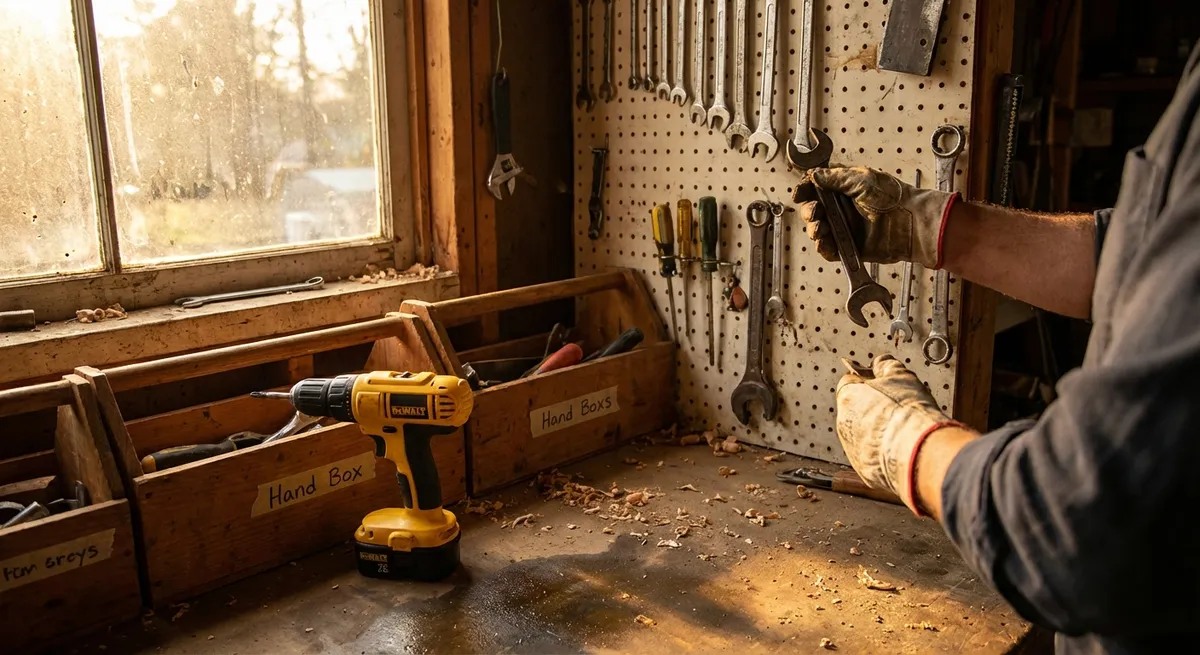
- Use simple, visible storage solutions first. Pegboards, open shelves, and clear bins beat complex systems you won’t maintain. Hang frequently used tools at eye level; store rarely used items higher or lower. Label shelves and bins clearly.
- Create a “grab-and-go” kit for small jobs. Put your most-used hand tools (screwdrivers, tape measure, utility knife, pliers, adjustable wrench, small level, pencil) in one toolbox or bag. This saves unnecessary trips back and forth for quick fixes around the house.
- Keep consumables and accessories together with their tools. Store drill bits with the drill, sandpaper with the sander, blades near their saw, and batteries/chargers in one obvious location. This reduces hunting for missing pieces that stall a project.
- Protect tools from moisture and dust. If your space is damp, use sealed bins for hand tools and silica gel packs or a dehumidifier where practical. Dust covers or cabinets help protect power tools with vents and electronics.
- End each project with a 5-minute reset. Wipe down dusty tools, coil cords or hoses, return items to their zone, and note anything that needs replacing (batteries, blades, screws). This short cleanup makes the next project start much faster and smoother.
When tools have a predictable place, you spend more time building and less time searching—or buying duplicates of tools you already own.
Conclusion
You don’t need a professional workshop to get professional-looking results—you just need a smart approach to the tools you already have or plan to buy. By choosing the right tool for each job, measuring and marking consistently, using your drill with intention, maintaining your cutting edges, and organizing your workspace, you turn a random collection of gear into a reliable DIY system.
These five routines are easy to build into your projects, and they compound over time: fewer mistakes, cleaner work, and tools that are ready whenever the next idea hits.
Sources
- [U.S. Consumer Product Safety Commission – Power Tool Safety Tips](https://www.cpsc.gov/safety-education/safety-guides/tools-and-equipment/power-tools) - Official guidance on safe selection and use of power tools
- [Family Handyman – Drill Buying Guide](https://www.familyhandyman.com/project/drill-buying-guide/) - Practical explanation of drill types, features, and how to choose the right one
- [Fine Woodworking – Understanding Saw Blades](https://www.finewoodworking.com/2004/01/01/understanding-saw-blades) - Detailed look at blade types, sharpening, and when to replace or maintain blades
- [OSHA – Hand and Power Tools](https://www.osha.gov/hand-power-tools) - Authoritative safety standards and best practices for hand and power tools
- [MIT – How to Use a Drill Safely (MIT MakerWorkshop)](https://makerworks.mit.edu/resource/how-use-drill) - Educational overview of correct drill setup, bit choice, and operation
Key Takeaway
The most important thing to remember from this article is that following these steps can lead to great results.