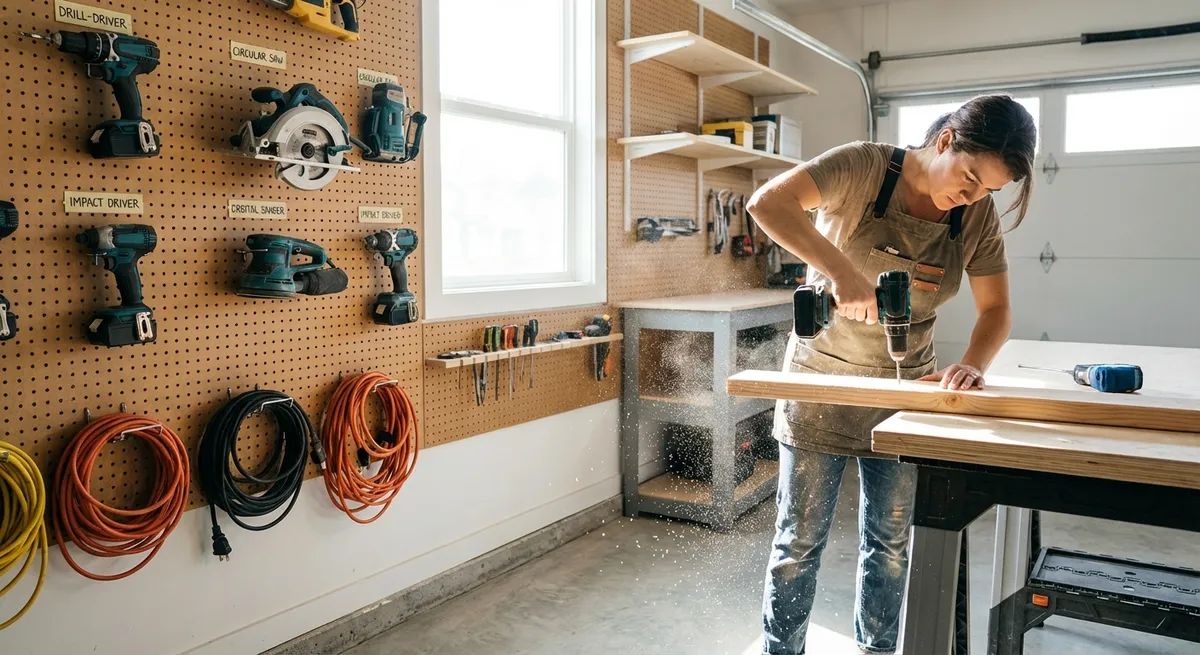
Power tools can make home projects faster, safer, and more precise—but only if you set them up and use them the right way. Instead of buying every tool in sight, focus on a small set of combos that cover most real-world household jobs. This guide walks you through five practical setups, with step‑by‑step instructions so you can get more done with less guesswork.
1. Set Up a Drill/Driver Combo for Reliable Anchors and Fasteners
A cordless drill/driver is the core of almost every DIY toolkit. With a few key accessories and a smart setup, you can drill cleaner holes, drive screws without stripping them, and hang almost anything on your walls confidently.
Step-by-step setup
Choose the right drill/driver and batteries
Pick an 18V or 20V cordless drill/driver from a reputable brand so you can expand with compatible tools later. Look for at least two batteries and a charger, plus a clutch with multiple torque settings. Avoid very cheap “no-name” kits; they often have weak motors and short-lived batteries.
Build a basic bit kit that actually matches your projects
At minimum, have: - Wood drill bits (1/8"–3/8") - A masonry bit set (for brick and concrete) - Phillips, Torx, and square-drive driver bits - A magnetic bit holder Store them in a labeled case so you don’t waste time hunting for the right size.
Dial in clutch settings before driving fasteners
Start with a low clutch setting when driving screws into wood or drywall. Test on scrap material: if the clutch “clicks” before the screw seats, increase one step at a time. If it buries the screw too deep or strips the head, reduce the setting. Once you find a reliable setting for a common task (like hanging shelves), note it with masking tape on the drill.
Use the right anchor for the wall material
- Drywall: use plastic expansion anchors or self-drilling anchors for light loads, toggle/strap anchors for heavier loads. - Brick/concrete: use masonry bits and appropriate masonry anchors. - Wood studs: often no anchor is needed—just a wood screw. Always check anchor weight ratings against the actual load, including the item plus anything it will hold.
Maintain batteries and bits for consistent performance
Don’t store lithium-ion batteries fully drained; charge to around 40–60% if they’ll sit for a while. Avoid leaving batteries on a hot dashboard or in a freezing garage. Sharpen or replace dull bits—if the drill is smoking or the bit is burning the wood, it’s time to stop and swap.
2. Configure a Circular Saw to Make Straight, Safe Cuts
A circular saw can replace many beginner table-saw tasks if you set it up correctly. With a simple cutting guide and a decent blade, you can break down plywood, cut dimensional lumber, and handle most framing cuts.
Step-by-step setup
Install the correct blade for the material
Use a 24-tooth framing blade for fast, rough cuts and a 40+ tooth blade for cleaner cuts on plywood or trim. Make sure the blade’s diameter and arbor size match your saw. Unplug or remove the battery before changing blades, and tighten the arbor nut firmly without over-torquing.
Square the base plate to the blade
Set the saw to 0° bevel. Use a reliable square against the blade (avoiding the teeth) and the base plate. If there’s a gap, adjust the bevel stops per your manual. A square base plate means your cuts will be straight and true—critical for cabinets, shelves, and trim.
Build a simple straight-edge cutting jig
Clamp a long, straight board or aluminum guide rail to your workpiece so the saw’s base plate can ride along it. Measure from the blade to the edge of the base plate to know exactly how far from your cut line the guide needs to be. Label that offset on the saw with a marker for quick setup next time.
Support your work to avoid binding and kickback
Place your sheet goods on 2x4s or foam insulation so the cut piece is fully supported. Keep offcuts from pinching the blade: make sure the waste side can fall or move freely as you finish the cut. Never let the part you’re cutting off hang with its weight supported only near the cut line.
Use proper cutting technique and safety gear
Wear safety glasses and hearing protection. Keep both hands on the saw, start the blade before it touches the wood, and push steadily without forcing it. Let the blade come to a complete stop before setting the saw down. If the saw struggles or stalls, stop and check for pinched material, dull blade, or hidden fasteners.
3. Turn a Random Orbit Sander into a Finish-Ready Workhorse
A random orbit sander (ROS) is one of the easiest tools to handle and dramatically improves the look and feel of your projects. With the right setup, you can prep surfaces for paint, stain, or clear finish without swirl marks and gouges.
Step-by-step setup
Match sandpaper grits to the job
Stock these common grits: - 80: shaping and removing rough material - 120–150: general smoothing before primer - 180–220: pre-stain or pre-finish sanding Use hook-and-loop discs that fit your sander’s pad holes so dust collection works properly.
Connect dust collection or use a good dust bag
Wood dust is a health and safety concern, not just a mess. If possible, connect the sander to a shop vac with a fitting that doesn’t restrict airflow. If you only have the sander’s bag, empty it frequently so suction doesn’t drop. Wear a dust mask or respirator when sanding for more than a few minutes.
Sand in stages rather than skipping grits
Don’t jump from 80 grit directly to 220—that often leaves deep scratches that show through paint or stain. Work up through the grits: 80 → 120 → 180 → 220. Wipe the surface with a tack cloth or slightly damp rag between grits so you’re not grinding old dust into the surface.
Let the sander’s weight do the work
Pressing down hard creates swirl marks and uneven surfaces. Hold the sander flat, keep a light grip, and move it slowly—about 1–2 inches per second. Overlap your passes like mowing a lawn so you cover the entire area evenly.
Inspect with raking light before finishing
Shine a light from a shallow angle across the surface to reveal scratches, dips, or shiny spots you missed. Resand any problem areas with the last grit you used before moving to finish. Doing this once saves you from stripping and redoing a bad finish later.
4. Use a Stud Finder and Measuring Tools for Confident Wall Mounting
Hanging shelves, TVs, and cabinets goes much smoother when you can trust your measurements and know what’s behind the wall. A simple combo of stud finder, tape measure, and level can prevent a lot of ugly holes and failed anchors.
Step-by-step setup
Choose the right stud finder for your walls
For standard drywall over wood studs, a basic electronic stud finder is fine. If you have plaster walls, look for a model that’s rated for plaster or use a magnetic stud finder to locate nails in the lath. Read the manual—some units need calibration on a blank section of wall before scanning.
Map out studs and mark them clearly
Start 3–4 inches away from a corner or outlet and slowly slide the stud finder horizontally, marking the stud edges lightly with a pencil. Find both edges and mark the center. Continue across the wall so you know where multiple studs are. Label them with “S” at the top so you can see them even after holding something up to the wall.
Use a level to transfer and align marks
Once you know where studs are, use a 2–4 foot level to draw light horizontal lines at the height of your bracket, shelf, or mount. Connect stud center marks to these lines so you know exactly where to drill. If you don’t have a long level, use a shorter one and a straight board as a temporary guide.
Pre-drill pilot holes in studs and anchor locations
Choose a drill bit slightly smaller than your screw’s root diameter (the solid core, not including threads). Drill straight in at your mark and stop once you feel solid resistance. For anchors in drywall, follow the anchor manufacturer’s drill size and depth instructions—oversized holes reduce holding power.
Double-check layout before final fastening
Temporarily hold or clamp the item in place with one fastener and verify level, height, and centering. Adjust if needed before driving all screws. Tighten screws evenly; if the mount is pulling the wall surface unevenly, remove it and verify your holes are straight and properly aligned.
5. Prep a Basic Safety and Maintenance Kit for All Your Tools
No tools perform well—or safely—if you ignore basic maintenance. A small, dedicated kit can keep your equipment running smoothly, extend tool life, and reduce the chances of accidents or failures mid-project.
Step-by-step setup
Assemble core safety gear in one grab-and-go spot
At a minimum, keep: - ANSI-rated safety glasses - Hearing protection (earmuffs or plugs) - Dust masks or a basic respirator - Work gloves appropriate for your tasks Store them together in a bin or bag near your main tool area so you’re more likely to use them every time.
Create a simple cleaning routine after each project
After you finish for the day, quickly: - Blow or brush sawdust off tools and vents - Wipe metal surfaces with a dry rag - Check cords and hoses for cuts or kinks This 5–10 minute habit helps prevent overheating, corrosion, and unnoticed damage.
Lubricate and protect moving and metal parts
Use a light machine oil for hinges and pivot points, and a dry lubricant (like dry PTFE) where dust is an issue. For cast-iron tables or bare metal, apply a protective wax or rust inhibitor per the manufacturer’s instructions. Always unplug tools before lubricating.
Schedule blade, bit, and accessory inspections
Every few projects, inspect saw blades, drill bits, and sanding pads. Look for chipped teeth, blue discoloration from overheating, or torn backing on sanding discs. Replace or sharpen as needed. Dull tools require more force and increase the risk of kickback or slips.
Keep manuals and warranties organized and accessible
Store paper manuals in a labeled folder, or download digital copies to a dedicated “Tools” folder on your phone or computer. Note purchase dates and serial numbers. This makes it easier to follow correct maintenance steps, order parts, and use warranty coverage if something fails prematurely.
Conclusion
You don’t need a truckload of tools to tackle home projects—you need a few well-chosen tools set up and used the right way. A dialed-in drill/driver, a properly guided circular saw, a random orbit sander, reliable layout tools, and a basic maintenance kit will cover a surprising amount of real-world DIY work. Start with these setups, build confidence on smaller tasks, and expand your toolkit only when a new project truly demands it.
Sources
- U.S. Consumer Product Safety Commission – Power Tool Safety Tips - Official safety guidance for using portable power tools at home
- Occupational Safety and Health Administration (OSHA) – Hand and Power Tools - Federal standards and best practices for tool safety and maintenance
- Family Handyman – How to Use a Circular Saw - Practical instructions and visuals for safe, accurate circular saw use
- Fine Woodworking – Proper Sanding Techniques - Detailed discussion of grit progression and sanding methods for better finishes
- This Old House – How to Find a Stud - Methods for locating studs accurately in different wall types
Key Takeaway
The most important thing to remember from this article is that this information can change how you think about Tools & Equipment.