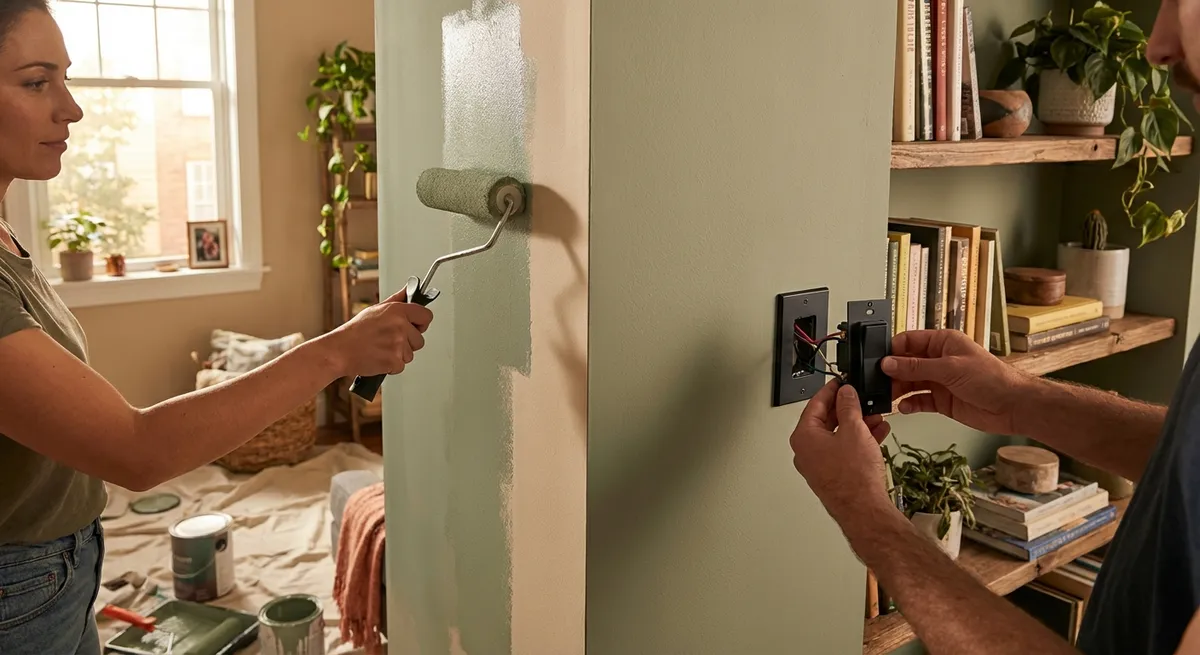
Small, smart upgrades can change how your home looks, feels, and works—without needing a contractor or a full weekend. This guide walks through five practical DIY projects most people can handle with basic tools and a bit of patience. Each one focuses on results you’ll notice right away: better function, cleaner lines, and a home that feels more “finished” every day.
Project 1: Swap Out Old Light Fixtures for a Cleaner, Brighter Look
Changing a dated or dim light fixture is one of the fastest ways to modernize a room. If you can safely shut off a breaker and use a screwdriver, you can likely handle this.
Tools & Materials
- New light fixture (check it includes mounting hardware)
- Screwdrivers (flathead and Phillips)
- Voltage tester
- Wire strippers
- Wire nuts (often included with fixture)
- Ladder or step stool
- Safety glasses
Step-by-Step Instructions
- Cut the power at the breaker and confirm it’s really off.
Don’t trust the wall switch. Turn off the circuit at the breaker panel, then use a voltage tester at the fixture wires to confirm there’s no power.
- Remove the old fixture carefully.
Take off glass shades or bulbs first. Unscrew the fixture canopy from the ceiling bracket while supporting the fixture with one hand. Once it’s free, gently pull it down to expose the wiring.
- Disconnect and label the wires.
You’ll likely see a black (hot), white (neutral), and bare or green (ground) wire. Take a photo for reference, then unscrew the wire nuts and separate the wires. If wires aren’t clearly colored, label them with tape.
- Install the new mounting bracket and connect the wires.
Follow the new fixture’s instructions to attach the mounting bracket. Connect black to black, white to white, and ground to ground (bare or green wire to the grounding screw or wire). Twist wires together clockwise, then secure with wire nuts and gently tug to confirm they’re tight.
- Secure the fixture and test.
Tuck wires neatly into the electrical box. Attach the fixture to the bracket using the provided screws. Install bulbs, restore power at the breaker, and test the light switch. If it doesn’t work, turn the breaker back off and recheck your connections.
Pro tip: Choose LED bulbs with a color temperature around 2700K–3000K for warm, inviting light in living areas, and 4000K for brighter task lighting in kitchens and workspaces.
Project 2: Install a Backsplash Without Tile Cutting (Using Peel-and-Stick)
A backsplash instantly upgrades a kitchen or bathroom and protects the wall from splashes and stains. Peel-and-stick panels let you get the look of tile without mortar, grout, or a wet saw.
Tools & Materials
- Peel-and-stick backsplash panels
- Utility knife with sharp blades
- Straightedge or metal ruler
- Measuring tape
- Level
- Degreasing cleaner
- Microfiber cloth
- Pencil
Step-by-Step Instructions
- Prep the wall for good adhesion.
Remove outlet covers and switch plates. Clean the wall thoroughly with a degreasing cleaner, especially near the stove or sink. Rinse and let it dry completely—any grease or dust will keep panels from sticking.
- Plan your layout before peeling anything.
Measure the width and height of the backsplash area. Dry-fit a few panels on the counter against the wall to see how the pattern lines up, especially at corners and around outlets. Mark a light level line along the wall to keep your first row straight.
- Start in the most visible corner.
For kitchens, this is often the area above the stove or sink. Peel a small section of backing from the panel, align it with your level line and countertop, then press firmly. Gradually remove more backing while smoothing from the center outward to avoid bubbles.
- Cut panels to fit outlets and edges.
Measure from the last full panel to the edge or outlet. Transfer the measurements to a new panel, marking on the back. Use a straightedge and utility knife to score, then snap or cut through. Test-fit before peeling, then apply.
- Finish edges and reinstall plates.
At exposed edges, trim panels neatly and consider adding a thin edge trim (often sold with the panels) for a finished look. Reinstall outlet and switch plates—they may need slightly longer screws if the panels are thick.
Pro tip: If a panel sticks slightly crooked, gently heat it with a hair dryer to soften the adhesive, peel it back, realign, and press again.
Project 3: Build a Simple Wall-Mounted Entry Shelf with Hooks
If shoes, keys, and bags pile up near your door, a small wall-mounted shelf with hooks instantly adds order. This project is beginner-friendly and only requires straight cuts.
Tools & Materials
- 1 board (e.g., 1x6 or 1x8, length 24–36 inches)
- Sandpaper (120- and 220-grit)
- Wood stain or paint and brush
- Clear topcoat (polyurethane or polycrylic) if staining
- 3–5 hooks
- Drill and drill bits
- Screws (for hooks and wall mounting)
- Stud finder and level
- Anchors (if not mounting into studs)
- Measuring tape and pencil
Step-by-Step Instructions
- Cut and prep the board.
Have the board cut to length at the home center if you don’t have a saw. Lightly sand all sides and edges with 120-grit, then 220-grit for a smoother finish. Wipe off dust with a damp cloth.
- Finish the wood before adding hardware.
Apply stain following the grain, wipe off excess, and let dry. Or apply paint in thin coats. Once the color is dry, seal with a clear topcoat to protect against scuffs and bags banging into it.
- Lay out and attach the hooks.
Measure and mark equal spacing along the front of the board (for example, one hook every 6–8 inches, centered vertically). Pre-drill pilot holes for each hook screw to prevent splitting, then install the hooks.
- Find mounting points on the wall.
Use a stud finder to locate studs near your desired height (often around 60–66 inches from the floor). Mark them lightly. If no stud is in a good position, use appropriate wall anchors rated for the weight you expect.
- Mount the shelf level and secure.
Hold the board against the wall, use a level to make sure it’s straight, and mark screw locations through the board. Pre-drill into the studs or install anchors. Then drive mounting screws through the board into the wall, countersinking them slightly. Cover screw heads with wood filler or matching paint/stain if you want a cleaner look.
Pro tip: Add a second, narrower board above the hooks as a shallow shelf for mail or sunglasses, using simple L-brackets underneath for support.
Project 4: Refresh Interior Doors with New Hardware and a Cleaner Finish
Doors take up a lot of visual space, and tired hardware or scuffed paint makes everything feel older. Updating knobs and giving doors a quick refresh is a high-impact, low-cost project.
Tools & Materials
- New door knobs/handles and latches (check door thickness and backset)
- Screwdrivers
- Utility knife
- Painter’s tape
- Sanding sponge or fine sandpaper
- Interior paint or enamel
- Small foam roller and angled brush
- Drop cloth
Step-by-Step Instructions
- Remove existing hardware.
Open the door and support it so it doesn’t move. Unscrew the interior and exterior knob plates, then pull the knobs apart. Remove the latch from the edge of the door and the strike plate from the frame.
- Lightly sand and clean the door.
Leave the door on its hinges. Use a sanding sponge to dull any glossy finish and smooth rough spots, then wipe down the door with a damp cloth to remove dust and dirt.
- Tape and prep for painting.
Apply painter’s tape along the hinges, around glass inserts (if any), and where the door meets the frame. Lay a drop cloth under the door.
- Paint in panels and edges for a smooth finish.
If the door is paneled, paint the recessed panels and details with a brush first, following the grain. Then use a small foam roller on the flat sections and edges. Avoid overworking the paint; several thin coats look better than one thick one.
- Install the new hardware once the paint is fully dry.
After the final coat has fully cured (follow the paint can’s timing), cut any paint that may have sealed the latch opening with a utility knife. Install the new latch, then the knobs, and finally the strike plate. Test the latch and ensure the door closes smoothly—adjust the strike plate if necessary.
Pro tip: If you’re switching from round knobs to levers, check that the levers are reversible (most are) so you can orient them correctly on both left- and right-hand doors.
Project 5: Add Slide-Out Organization Under the Sink
Under-sink cabinets are usually messy and hard to reach. Adding a simple slide-out organizer means you’ll actually use the space and stop losing cleaners behind the pipes.
Tools & Materials
- Slide-out organizer or drawer designed for cabinets
- Measuring tape
- Pencil
- Drill and bits
- Screwdriver
- Short wood shims (optional, for uneven cabinet bases)
Step-by-Step Instructions
- Measure carefully around plumbing and hinges.
Measure the width, depth, and height inside the cabinet. Note the locations of the P-trap, garbage disposal, or water lines, and in-swing hinges. Choose a slide-out that fits with clearance for these obstacles.
- Empty and clean the cabinet.
Remove everything from under the sink and wipe the surfaces clean. This is a good time to toss expired products and group similar items.
- Dry-fit the slide-out base.
Place the slide-out base inside the cabinet and slide it in and out by hand to confirm nothing hits. If the cabinet floor is uneven or has a lip, you may need shims to create a flat surface.
- Mark and pre-drill mounting holes.
Once the base is aligned and centered, mark the screw hole locations on the cabinet bottom. Remove the base, then pre-drill shallow pilot holes to prevent splitting the cabinet material.
- Secure the base and attach the sliding basket.
Screw the base to the cabinet bottom, ensuring it’s snug but not warping. Attach the sliding basket or tray according to the manufacturer’s directions, then load heavier items toward the front and lighter items toward the back to keep the slide operating smoothly.
Pro tip: Use small bins or caddies inside the slide-out for “zones” (cleaners, dish supplies, trash bags) so you can grab exactly what you need without digging.
Conclusion
You don’t need a full workshop, a big budget, or a full weekend to make your home feel better built and more organized. Swapping a fixture, adding a backsplash, building a small shelf, refreshing doors, and organizing hidden spaces are realistic wins for most DIYers—especially if you move slowly, measure twice, and follow basic safety steps.
Start with the project that solves your most annoying daily problem, then work your way down the list. Each upgrade builds your skills and confidence, so the next “intimidating” project starts to feel like something you can handle.
Sources
- U.S. Consumer Product Safety Commission – Electrical Safety - Guidance on working safely around household electrical systems
- Energy.gov – LED Lighting Basics - Explains LED bulb types, color temperature, and efficiency for home lighting choices
- The Home Depot – How to Replace a Light Fixture - Step-by-step reference for safely swapping light fixtures
- Lowe’s – How to Install a Backsplash - General backsplash installation techniques and layout tips
- Family Handyman – How to Install Pull-Out Shelves - Detailed tips for planning and mounting slide-out organizers in cabinets
Key Takeaway
The most important thing to remember from this article is that this information can change how you think about DIY Projects.