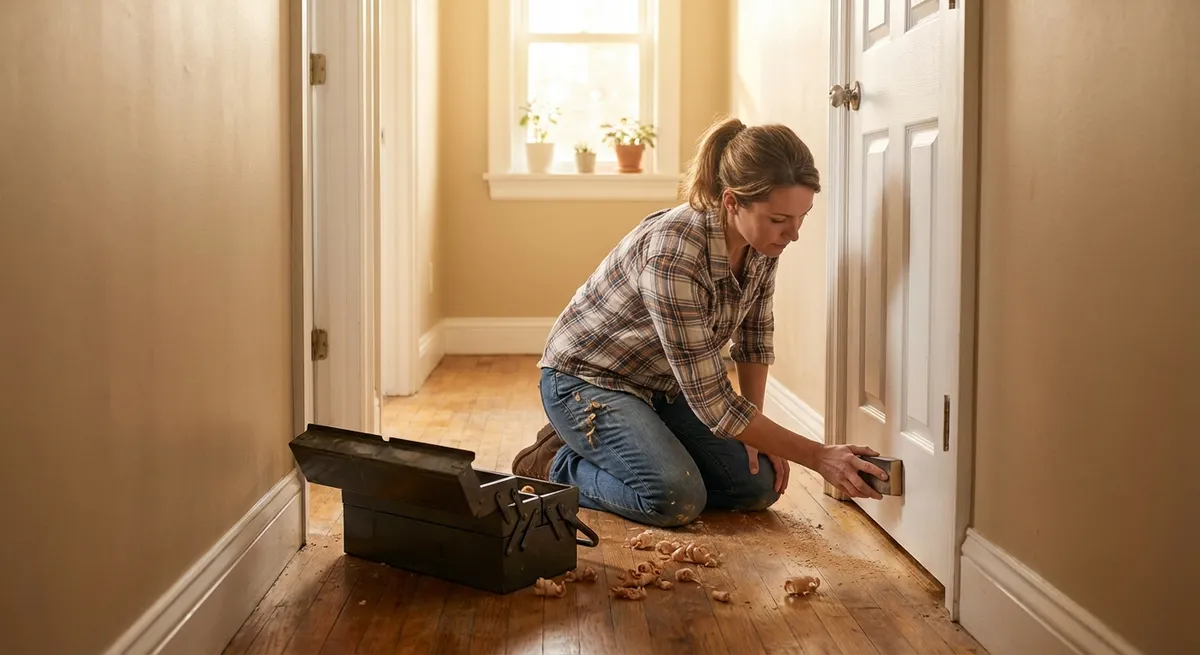
Sticky, dragging doors are one of those daily annoyances that people live with for months—sometimes years—because they assume the fix is complicated. It’s not. With a few basic tools and a bit of patience, you can get most interior doors opening and closing smoothly in under an hour. This guide walks you through practical, step‑by‑step fixes that work for real homes, not just showroom-perfect renovations.
Step 1: Diagnose Why the Door Is Sticking
Before you start shaving, sanding, or adjusting anything, figure out exactly where and why the door is binding.
Close the door slowly and watch what happens. Look for:
- Top corner rubbing the frame: Often a hinge issue or slightly warped door.
- Bottom edge dragging on the floor or carpet: Usually sagging hinges or an uneven floor.
- Latch side jammed tight against the strike side of the frame: The door may be out of alignment or swollen.
- Rubbing only when it’s humid: The door or frame may be swelling from moisture.
Use a pencil to lightly mark the exact points where the door rubs against the jamb or floor. Run a strip of painter’s tape along the edges where you see contact, then close the door a few times—any scuffing on the tape shows you the trouble spots clearly.
This diagnosis step keeps you from taking off material in the wrong place, which is one of the most common DIY mistakes with doors.
Step 2: Tighten and Adjust the Hinges First
Many sticky doors are caused by simple hinge issues, not warped wood. Fixing the hinges should always come before cutting or sanding.
- Tighten all hinge screws.
Open the door fully and use a screwdriver (manual is safer than a drill for this) to snug every screw on the door side and frame side of each hinge. Do not overtighten to the point of stripping.
- Check for loose or stripped screws.
If a screw just spins and won’t tighten, the wood in the frame or door is probably stripped. Remove the screw, insert wooden toothpicks or a short sliver of wood dipped in wood glue into the hole, let it set for a few minutes, then reinsert the screw. This gives it fresh material to bite into.
- Look for sagging hinges.
With the door open a few inches, lift up gently on the handle. If the door moves up and down noticeably, the hinge pins or screw holes may be worn. You can try:
- Swapping a short screw in the top hinge for a longer one (2.5–3") that bites into the wall stud.
- Tapping hinge pins out, cleaning them, and lightly lubricating before reinstalling.
- Test the door again.
Close the door after tightening and reinforcing hinges. In many cases, this alone fixes the sticking. If not, you’ve at least minimized the movement so further adjustments will be more precise.
Practical tip: Always start with hinge adjustments. It’s reversible and doesn’t permanently remove material from the door.
Step 3: Shift the Door Slightly for Better Alignment
If the door still rubs, you may be able to “nudge” it within the frame without cutting anything.
- Loosen hinge screws slightly.
With the door open, loosen (don’t remove) the screws on one hinge at a time—just enough that the hinge leaf can move a bit.
- Reposition the door.
- If the top of the door hits the frame: Push the door slightly toward the latch side while tightening the top hinge screws.
- If the latch side is too tight against the jamb: Pull or push the door gently so it centers better in the opening while you retighten screws.
- Use cardboard shims if needed.
If a hinge recess (the mortise) is too deep, the door edge on that side may sit too close to the frame. You can:
This small shim can move the door enough to clear light rubbing without sanding or trimming.
- Check the reveal around the door.
Close the door and look at the gap around all sides. Ideally, the gap (reveal) is fairly even and not pinched tightly in any one area.
If careful hinge adjustments don’t give you enough clearance, you’re ready to remove a bit of material where the door is actually binding.
Step 4: Trim or Sand the Door Where It Binds
Once you’ve identified exactly where the door is rubbing and confirmed that hinge tweaks aren’t enough, it’s time to trim.
- Mark trim areas clearly.
Use your previous pencil or painter’s tape marks as a guide. Outline the high spots on the door edge. It’s better to work in small sections than to “eyeball” a long cut.
- Remove the door safely.
- Place a wedge or block under the door to relieve pressure on the hinges.
- Tap out hinge pins with a nail set or small screwdriver and hammer.
- Lift the door off and lay it flat on a pair of sawhorses or a sturdy table.
- Choose your tool: hand plane or sander.
- For larger adjustments (more than 1–2 mm): Use a sharp hand plane along the door edge, working with the grain. Take very light passes.
- For small corrections: Use 80–120 grit sandpaper on a sanding block or a power sander. Keep the edge straight and don’t round it over accidentally.
- Remove small amounts, test often.
Take off a little material, then rehang the door and test. It’s easier to remove more than to fix an overcut door. Aim for a small, even gap rather than a big, obvious bevel.
- Seal any freshly cut edges.
Bare wood edges are more prone to absorbing moisture and swelling. Once you’re satisfied with the fit:
- Lightly sand the trimmed area smooth.
- Prime, then paint or seal to match the rest of the door as closely as possible.
This step is where patience really pays off: slow, careful material removal gives you a clean, pro-looking result instead of a hacked-up edge.
Step 5: Fine-Tune the Latch and Strike Plate
Sometimes the door swings fine but sticks or won’t latch smoothly. That’s usually a latch and strike plate alignment issue.
- Identify the latch problem.
Close the door slowly and watch the latch:
- Does it hit the strike plate instead of sliding into the hole?
- Do you have to push or pull hard to get it to click?
- Does it latch only if you lift the door slightly by the handle?
- Mark where the latch hits.
Rub a little lipstick, chalk, or marker on the latch bolt, close the door, and try to latch it. Open the door and look at the strike plate—where the color transferred shows you the contact point.
- Adjust the strike plate position.
If the misalignment is small:
- Loosen the screws on the strike plate.
- Shift it slightly up/down or in/out to center it on the latch mark.
- Retighten and test.
- Use a file to shave a bit off the edge of the strike plate opening where the latch is hitting.
- Keep the edges smooth and avoid sharp burrs.
- Deeper or wider hole if needed.
- Remove the strike plate.
- Use a drill bit or wood chisel to deepen the hole behind it slightly.
- Reinstall the strike plate and test again.
- Lubricate moving parts.
- Apply a small amount of dry lubricant or silicone spray to the latch (avoid heavy oil that can attract dust).
- Wipe off excess so you don’t stain the door or jamb.
For slightly larger changes:
If the latch doesn’t fully engage:
To finish:
A properly aligned latch should click into place with a gentle push, without forcing the door or hearing grinding metal-on-metal sounds.
Conclusion
A sticky interior door doesn’t mean you need a new slab, an expensive contractor, or a major remodel. By diagnosing the actual cause, tightening and adjusting hinges, making controlled trims, and tuning the latch, you can restore a smooth, solid-feeling door in an afternoon with basic tools.
These same techniques apply to many interior doors in your home: once you’ve done one, the rest get easier. The key is working methodically—adjust, test, then adjust again—so you end up with a door that feels as good as it looks and stays that way through changing seasons.
Sources
- [U.S. Department of Energy – Doors and Heat Loss](https://www.energy.gov/energysaver/doors) - General guidance on doors, materials, and how they respond to temperature and humidity
- [Family Handyman – How to Fix a Sticking Door](https://www.familyhandyman.com/project/how-to-fix-a-sticking-door/) - Step-by-step example of diagnosing and repairing binding doors
- [This Old House – How to Fix a Sticking Door](https://www.thisoldhouse.com/doors/21016459/how-to-fix-a-sticking-door) - Practical tips on planing doors and adjusting hinges with photos
- [Home Depot – Door Hardware Installation & Adjustment Guide](https://www.homedepot.com/c/ah/how-to-install-door-locks-and-handles/9ba683603be9fa5395fab9010e2f78) - Reference for latch and strike plate alignment and general door hardware basics
Key Takeaway
The most important thing to remember from this article is that this information can change how you think about DIY Projects.