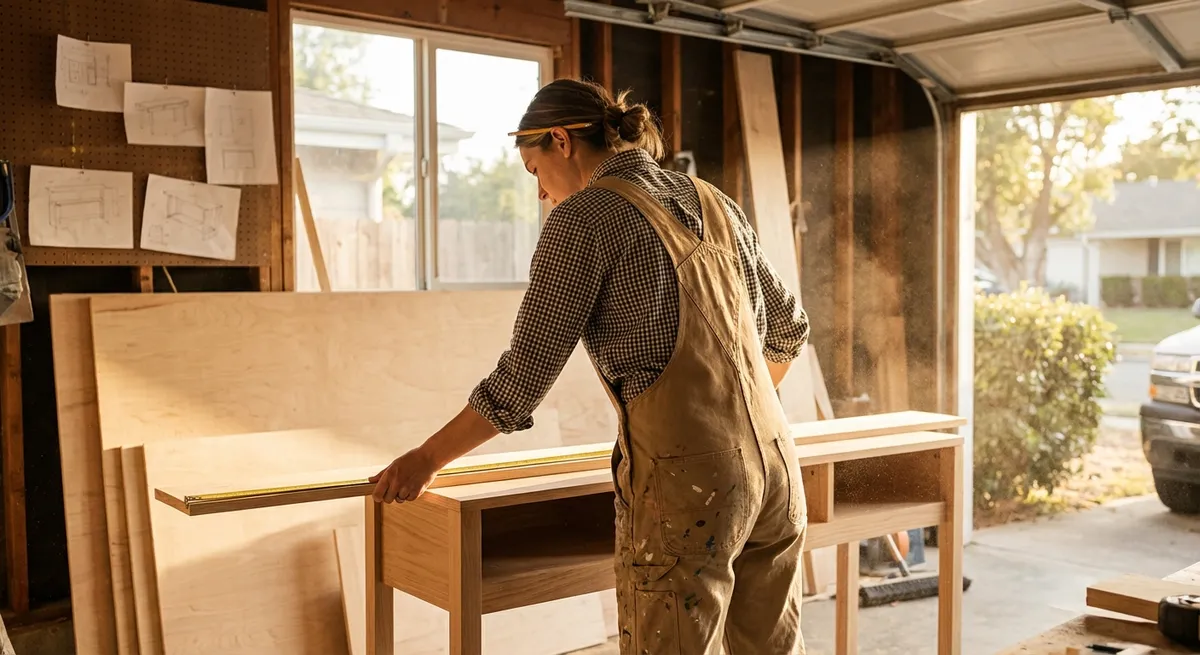
Every DIY project starts as a “that would be nice” thought and either becomes something you’re proud of—or something half-finished in the garage. The difference usually isn’t skill; it’s planning, workflow, and knowing what to expect before you pick up a tool. This guide walks you through a practical, repeatable way to go from concept to finished build, using five clear step-by-step processes you can apply to almost any home project.
Step 1: Define the Project (Before You Touch a Tool)
Jumping straight to cutting wood or ripping out trim is how projects get expensive and frustrating. First, you need a clear target.
- Write a one-sentence goal. Example: “Build a wall-mounted floating shelf for the living room that holds at least 40 lbs and hides visible brackets.” This keeps you focused when decisions pile up.
- Decide exactly where it goes. Measure the wall, the floor space, surrounding furniture, and outlets. Write measurements down, don’t trust memory.
- List your must-haves and nice-to-haves. Must-haves might be: fits a 55” TV, uses stainable wood, supports heavy books. Nice-to-haves: decorative edge, hidden LED strip, matching hardware.
- Set a basic budget range. Think in a range, not a single number (for example, $80–$120 for materials). This helps you make tradeoffs—better wood vs. cheaper brackets, for example.
- Choose a realistic timeline. Break it into sessions: one for planning and buying, one for cutting, one for assembly and finishing. This is especially important if you’re working in shared spaces like a living room or small garage.
- Check for hidden constraints. For wall-hung projects, note where studs are likely to be. For anything near water or heat, look at nearby plumbing, vents, baseboard heaters, or radiators.
- Take “before” photos. These help if you need advice later, and they’re great for sharing your progress and results.
By the end of this step, you know what you’re building, where it’s going, how it should perform, and roughly how much time and money you’re ready to spend.
Step 2: Translate the Idea into Measured Plans
Once you know what you want, you need a simple, buildable plan. This doesn’t have to be architect-level; it just needs to be clear, accurate, and readable later.
- Sketch the project from two angles. For example, a front view and a side view of a bench or shelf. Keep it simple: boxes, lines, and labels.
- Add real measurements to the sketch. Include length, width, and height for each major piece. Double-check all measurements at the actual installation location (walls are rarely perfectly square).
- Convert total dimensions into parts. If your shelf is 48" long, and you want two end pieces at ¾" each, your front face might be 48", but the internal bottom piece might be 46½" to fit between the ends. Think about how pieces overlap.
- Create a cut list. Write a list of every piece you’ll need with quantity, dimensions, and material (e.g., “2x – 1×8 pine, 44" long” or “1x – ¾" plywood, 16" × 48"”). This cut list will be your build roadmap.
- Plan joinery and hardware. Will you use pocket screws, wood glue and brad nails, brackets, or dowels? Decide now so you can add holes, recesses, and fastener lengths to your plan.
- Factor in material thickness. Measure your actual boards or plywood with a tape or caliper—“¾ inch” plywood often isn’t exactly ¾". Adjust your dimensions if precision matters (like for inset doors or tight joints).
- Test tricky dimensions with scrap. If a fit is critical (like something going between two walls), cut a cheap scrap stick to that length first and dry-fit it on site.
A clear plan and cut list reduce wasted material, extra trips to the store, and “why doesn’t this fit?” moments mid-build.
Step 3: Build a Safe, Efficient Work Setup
A good project can go wrong if your workspace is unsafe or chaotic. Setting up smartly once can save hours of struggle every time you build.
- Choose where you’ll work. Garage, driveway, balcony, or a cleared room with protection on the floor. Consider ventilation, noise (neighbors, kids, pets), and access to power.
- Set up safety gear where you can’t ignore it. Keep eye protection, hearing protection, and a dust mask/respirator right next to your tools, not buried in a bin.
- Organize tools you’ll use most. Lay out only what’s needed: measuring tape, pencil, square, drill/driver, bits, clamps, sander. Put everything else away so your workspace stays clear.
- Control power and cords. Use heavy-duty extension cords rated for your tools. Route cords away from your cutting path and walking areas. If possible, plug higher-demand tools into separate circuits to avoid tripping breakers.
- Manage dust and mess. Use drop cloths or cardboard under sawhorses. Attach a shop vac to saws when possible. Sweep between phases—especially before finishing, where dust will ruin your results.
- Set a rule for cleanup. For example: “No leaving for the day without clearing the floor and putting away sharp tools.” This matters if kids, pets, or others share the space.
Create three basic zones:
- Cutting zone: For saws and noisy tools, with space to support long boards. - Assembly zone: Flat surface (workbench, sturdy table, or even folding tables with a sheet of plywood). - Finishing zone: A dust-minimized area for painting or staining (can double as assembly zone if needed, just clean thoroughly first).
A deliberate setup doesn’t just make a project nicer—it makes it safer, faster, and far more repeatable for your next build.
Step 4: Execute the Build in Logical Phases
Now you’re actually building—but you’re doing it in a controlled sequence instead of improvising. This approach works for shelves, benches, built-ins, and many other indoor projects.
- Phase 1 – Measure, mark, and cut. Work from your cut list. Mark all pieces clearly with pencil labels (e.g., “Front,” “Side A,” “Back”). Cut slowly and check each piece against your plan as you go.
- Phase 2 – Dry fit everything. Without glue or final fasteners, assemble the parts to make sure they align and sit square. Use clamps temporarily. If something is off, fix it now—shaving ⅛" off a board is easier before assembly.
- Phase 3 – Drill and prep joinery. Drill pilot holes, pocket holes, or dowel holes, and route or sand any edges you want shaped. Doing all of this together keeps your workflow smooth and reduces setup changes.
- Phase 4 – Glue and assemble structurally. Apply wood glue (if using), then assemble in a logical order—usually from the main structure outward. Use clamps to hold pieces in place while you drive screws or nails.
- Phase 5 – Square and reinforce. Use a carpenter’s square or measure diagonals to ensure your project isn’t racked or twisted. Add corner braces, extra screws, or back panels if needed for stiffness.
- Phase 6 – Sand in stages. Start with a coarser grit to remove defects (80–120), then move up to a smoother grit (150–220) before finishing. Always sand in the direction of the grain on wood surfaces.
- Phase 7 – Test install (if practical). For wall-mounted or built-in pieces, dry-fit or lightly mount them before final finishing to confirm alignment, height, and fit.
This phased approach helps you catch mistakes early, keeps frustration down, and gives you a clear sense of momentum as you move through each stage.
Step 5: Finish, Install, and Evaluate the Result
Finishing and installation are where your project goes from “homemade” to “this looks professionally done.” The details here matter more than people expect.
- Pick the right finish for the use.
- Heavy-use surfaces (benches, tabletops): consider durable clear coats like polyurethane.
- Decorative shelves or trim: paint or stain plus a light clear coat is often enough.
- Moisture-prone areas: use finishes rated for bathrooms/kitchens or exterior, as needed.
- Prep the surface thoroughly. Wipe off dust with a tack cloth or slightly damp rag. Fill nail/screw holes with wood filler and sand again once it’s dry if you want a smooth, uninterrupted surface.
- Apply thin, even coats. Whether you’re using paint, stain, or clear finish, thin coats are more forgiving and more durable than thick ones. Follow the manufacturer’s drying times and recoat instructions.
- Install with structure in mind.
- For wall-mounted projects, locate studs with a stud finder and confirm by test drilling.
- Use appropriate anchors where studs aren’t accessible.
- Use the right length and type of fasteners for your wall material—drywall, plaster, masonry, etc.
- Level and align carefully. Use a level instead of eyeballing. For things that need to align with others (like multiple shelves), mark a consistent reference line on the wall first.
- Test load and function gradually. Add weight in stages to a new shelf or bench and check for flex or movement. Open and close anything hinged or sliding repeatedly to confirm smooth operation.
- Evaluate and document. Take “after” photos from different angles. Note what went well and what you’d change next time—tool choices, materials, fasteners, timing. This self-review is how your projects noticeably improve over time.
By finishing strong and installing carefully, you’re not just completing a build—you’re building your own standards for what “done right” looks like in your home.
Conclusion
Turning a DIY idea into something solid and reliable isn’t about being naturally handy; it’s about following a clear process. Define the project, turn it into a measured plan, set up your workspace, build in phases, and finish with care. Once you’ve walked through this workflow a few times, you can apply it to almost any home project—from a simple wall shelf to a more complex built-in—without guessing your way through it. The more intentional your steps, the more confident you’ll be tackling the next build.
Sources
- [U.S. Consumer Product Safety Commission – Power Tool Safety](https://www.cpsc.gov/safety-education/safety-guides/tools-and-home-maintenance/power-tools) - Guidance on safe setup and use of common power tools
- [OSHA – Woodworking ETool](https://www.osha.gov/etools/woodworking) - Covers workspace layout, machine safety, and dust control in woodworking environments
- [This Old House – How to Use a Stud Finder](https://www.thisoldhouse.com/walls/21015122/how-to-use-a-stud-finder) - Practical tips for locating studs accurately before wall-mounted installations
- [Family Handyman – How to Use a Carpenter’s Square](https://www.familyhandyman.com/project/how-to-use-a-carpenters-square/) - Explains checking for square and keeping builds aligned
- [Fine Woodworking – The Basics of Sanding](https://www.finewoodworking.com/2012/01/25/the-basics-of-sanding) - Detailed overview of sanding grits, techniques, and prep for finishing
Key Takeaway
The most important thing to remember from this article is that this information can change how you think about DIY Projects.