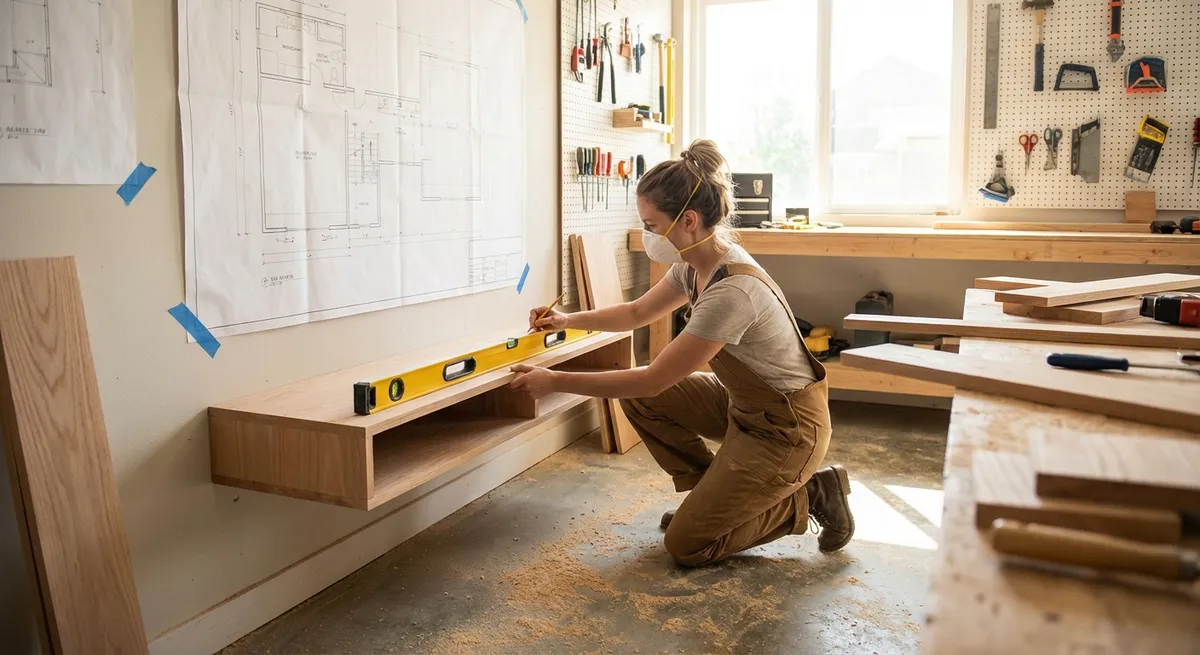
Thinking up DIY projects is easy—getting them done (safely and correctly) is the hard part. Instead of another list of “fun ideas,” this guide walks you through how to actually move a project from a sketch in your notebook to something installed and working in your home. You’ll learn a practical, repeatable process you can reuse whether you’re building a simple shelf, adding a new light, or upgrading a closet.
Step 1: Define the Project in Plain Language
Before you buy a single board or tool, get crystal clear about what you’re making and why.
Write one plain-language sentence that finishes this phrase:
“I am building this to…”
Examples:
- “I am building this to stop shoes from piling up by the door.”
- “I am building this to add better task lighting over the kitchen counter.”
- “I am building this to organize cleaning supplies in one spot.”
Then:
- Set your limits. Decide your:
- Budget range (e.g., “Under $150”)
- Time block (e.g., “One Saturday” or “Two evenings after work”)
- Skill level (e.g., “Comfortable with drilling, not with electrical”)
- Measure the space carefully.
- Measure width, height, and depth.
- Note any obstacles: outlets, switches, pipes, vents, trim, baseboards, doors.
- Write measurements down and label them clearly.
- Capture the “must haves” and “nice to haves.”
- Must haves: “Has to fit in a 36-inch gap,” “Must support 75 lb,” “Needs to be wipeable.”
- Nice to haves: “Looks like natural wood,” “Hidden hardware,” “Soft-close if possible.”
- Make a fast sketch.
- Use grid paper or printer paper.
- Draw the front view and side view.
- Add major measurements (width, height, depth, shelf spacing, etc.).
- This doesn’t need to be pretty—it just needs to be readable.
This step keeps you from overbuilding, wasting money, or ending up with something that doesn’t fit the space or solve the problem.
Step 2: Break the Build into Clear, Doable Tasks
Big projects feel overwhelming because everything is mixed together in your head. Turn the project into a short checklist of actions you can actually do.
- Split your project into phases.
Common phases:
- Plan and sketch
- Buy materials and hardware
- Cut and prep parts
- Assemble
- Finish (paint, stain, seal)
- Install and clean up
- Write every step as a small, physical action.
- Mark cut lines on boards
- Cut boards to length
- Sand cut edges
- Pre-drill screw holes
- Attach brackets to wall
- Mount shelf to brackets
- Order the steps logically.
- Do all measuring and marking before cutting.
- Do all cutting before sanding.
- Do all sanding before painting/finishing.
- Let finishes dry before installation.
- Estimate time per step (roughly).
- Mark steps that take < 15 minutes (quick wins).
- Mark steps that need long drying/curing times.
- Group similar steps (all cutting, all painting) to stay efficient.
- Flag “high risk” steps.
- Anything involving electricity, plumbing, or cutting near hidden wires/pipes.
- Anything where a mistake is expensive (cutting expensive lumber, drilling into tile).
For example, instead of “Build the shelf,” use:
For these, plan extra time and double-checks, or decide if you’ll call a pro for that piece.
When your project is broken into clear steps, you can stop when you’re tired and still know exactly where to pick up next time.
Step 3: Choose Materials and Fasteners That Match the Job
Good materials make a DIY job last; wrong materials make it fail early. You don’t need fancy products—you just need the right ones for the conditions.
- Match material to location.
- Dry indoor spaces: Pine, poplar, MDF, standard drywall anchors, interior paint.
- Moist areas (bathroom, near sinks): PVC trim, exterior-grade plywood, moisture-resistant drywall, caulk rated for “kitchen/bath.”
- Garage/basement: Pressure-treated lumber where it contacts concrete, corrosion-resistant screws (coated or stainless).
- Think about load and support.
- For shelves or wall storage, check:
- How much weight they will hold (books, tools, paint cans, pantry items).
- If you can hit studs with screws.
- Use:
- Studs + wood screws for heavy loads.
- Heavy-duty anchors rated above your actual load if you can’t hit studs.
- Select the right fasteners.
- Wood-to-wood: wood screws or construction screws (not drywall screws).
- Into concrete or brick: masonry screws or anchors rated for masonry.
- In damp areas: exterior-grade or stainless steel screws.
- For visible areas: consider head style (flat, trim, decorative) and color (black, brass, zinc).
- Factor in finishing.
- If you’re painting: MDF or paint-grade plywood can be smoother and cheaper than hardwood.
- If you’re staining: choose a wood species that stains evenly (e.g., poplar, maple, oak—pine can blotch without conditioner).
- For high-traffic surfaces (desk, countertop, bench): use durable finishes (polyurethane, water-based polycrylic, or hardwax oils).
- Buy a bit extra—strategically.
- 10–15% extra for boards or trim to cover mistakes or defects.
- An extra box of screws/anchors if they’re standard sizes you’ll reuse.
- One more tube of caulk/adhesive than you think you need for long beads or multiple gaps.
Good material decisions early on prevent sagging shelves, peeling finishes, and “mushy” fasteners that fail when you need them most.
Step 4: Build and Assemble with Accuracy and Safety in Mind
This is where your project turns from parts into something solid. A few habits make a big difference in how clean and sturdy the final result feels.
- Measure, mark, and verify before cutting.
- Use a sharp pencil or marking knife for accurate lines.
- Mark each piece with a label (e.g., “Left side,” “Top,” “Shelf 1”) before cutting.
- Dry-fit your layout on the floor or workbench to confirm lengths make sense.
- Cut safely and consistently.
- Clamp workpieces whenever possible—your hands are not clamps.
- Use a cutting guide (straightedge or speed square) for circular saws.
- Make repeated cuts by setting a stop block instead of re-measuring each time.
- Pre-drill and countersink where needed.
- Pre-drill for screws near edges to prevent splitting.
- Use a countersink bit if screw heads need to sit flush or below the surface.
- Space screws consistently (use a small scrap as a spacer for repeating patterns).
- Check square and level as you go.
- Use a speed square for corners and a level for long runs (shelves, cabinets).
- Check “diagonals” on rectangular frames (measure from corner to corner; both diagonals should match).
- Fix “out of square” problems early—don’t assume you’ll hide them later.
- Use adhesives where they help—don’t rely on them alone.
- Wood glue between boards plus screws = stronger, less squeaky joints.
- Construction adhesive behind trim or panels reduces movement and gaps.
- Wipe off squeeze-out glue immediately with a damp rag; dried glue can ruin stain/finish.
- Protect yourself properly.
- Eye protection any time you’re cutting, drilling, or sanding.
- Hearing protection for power saws and extended tool use.
- Dust mask or respirator when sanding, cutting MDF, or working with finishes.
Accurate measuring and careful assembly make your DIY project look professional, even if your tools are basic.
Step 5: Finish and Install for a Clean, “Built-In” Look
The last 10–20% of a project—sanding, caulking, painting, and installing—does most of the visual work. This is where your project stops looking like a pile of boards and starts looking like part of the house.
- Prepare the surfaces.
- Sand all visible surfaces, moving from coarser to finer grits (e.g., 80 → 120 → 180).
- Round over sharp edges slightly; it looks better and resists chipping.
- Vacuum dust and wipe with a tack cloth or damp rag before finishing.
- Fill and caulk strategically.
- Fill nail and screw holes with wood filler or spackle; let dry, then sand flush.
- Caulk gaps at joints and where wood meets walls/trim (use paintable caulk).
- Avoid caulking where you need movement or access (e.g., around removable panels).
- Apply finish with your use in mind.
- For paint:
- Prime bare wood, patched areas, and MDF first.
- Use a small foam roller for flat surfaces and a brush for corners/edges.
- For stain:
- Test on a scrap first.
- Wipe off excess stain evenly; finish with clear topcoat after it dries.
- For clear finishes:
- Apply thin coats, sand lightly between coats with fine grit (220+) for smoothness.
- Plan your installation points.
- Find studs with a stud finder and verify by test drilling or small nails.
- Mark stud locations on painter’s tape on the wall, then transfer measurements to your project.
- Pre-drill mounting holes in your project piece and in the wall where needed.
- Level and secure the project.
- Have a helper hold the piece in place, or support it with temporary blocks/braces.
- Use a level before driving final screws—adjust until it’s level and plumb.
- Start with one screw in the center; check level, then add the rest.
- Do a final detail pass.
- Touch up paint around fasteners and caulk lines.
- Remove any visible pencil marks and stray caulk.
- Clean up dust, smudges, and fingerprints before taking “after” photos.
Finishing and installing with care makes your project feel intentional—like it’s always been there—rather than something that was just added on.
Conclusion
Every DIY project can follow the same basic path: define what it’s for, break it into steps, choose the right materials, build accurately, and finish cleanly. Once you’ve done this a couple of times, you’ll spend less time guessing and more time making upgrades that actually work for your home.
The next time you get an idea, don’t jump straight to the store. Walk through these five steps on paper first, then build with purpose. That’s how you get from “I should do something about this” to “I can’t believe I built that.”
Sources
- U.S. Consumer Product Safety Commission – Home Workshop Safety Tips - Guidance on staying safe while using tools and equipment at home
- Family Handyman – How to Use a Stud Finder - Practical advice for safely locating studs before mounting projects
- This Old House – Choosing the Right Fasteners - Overview of screw types and where to use them in home projects
- Lowe’s – How to Choose Lumber - Explains common lumber types and grades for DIY building
- Fine Woodworking – Sanding for a Perfect Surface - Detailed best practices for surface prep before finishing
Key Takeaway
The most important thing to remember from this article is that this information can change how you think about DIY Projects.