There’s a big difference between owning tools and actually knowing how to use them well. If you’ve ever stripped a screw, ruined a cut, or measured three times and still been wrong, you’re not alone. This guide focuses on real-world, step-by-step techniques with common tools so your next project is cleaner, safer, and less frustrating.
Step 1: Drive Screws Cleanly With a Drill (Without Stripping Anything)
A cordless drill/driver is the tool you’ll use more than almost anything else. Used wrong, it chews up screw heads, splits wood, and drains batteries fast. Used right, it feels almost effortless.
How to do it:
- Match the bit to the screw head.
Pick the exact style and size (e.g., PH2 for common drywall screws, T25 for many construction screws). The bit should fully fill the screw head with almost no wobble.
- Set the drill to “driver” mode and adjust the clutch.
Use the screw/driver icon instead of the drill icon. Start with a low-to-medium clutch setting (around 6–10 on many drills). This stops torque before you bury or strip the screw.
- Pre-drill when working near edges or with hardwood.
Use a bit slightly smaller than the screw’s shank (not including the threads). Pre-drilling reduces splitting and makes driving smoother.
- Hold the drill in line with the screw.
Keep your forearm, drill, and screw in a straight line. Use your second hand behind the drill body to apply firm, controlled pressure. Let the drill’s speed do the work—don’t “lean” too hard.
- Start slow, then increase speed.
Squeeze the trigger gently to get the screw started straight. Once it’s biting, increase speed but ease off near the end so you don’t overdrive it.
Practical tips:
- If the clutch stops the drill too soon, increase it by one or two settings and try again.
- Keep a small magnetized bit holder on the drill so swapping bits takes seconds instead of minutes.
- For long screws into studs, use an impact driver if you have one—it’s designed for that kind of work.
Step 2: Make Straight, Accurate Cuts With a Circular Saw
A circular saw can feel intimidating, but it’s one of the fastest ways to cut sheet goods and lumber at home. The key is controlling the saw instead of letting it control you.
How to do it:
- Support the material properly.
Use sawhorses or a workbench. The cut-off piece should be fully supported so it doesn’t pinch the blade as it falls. Don’t balance plywood between two sawhorses and cut in the middle—it will bind and splinter.
- Set blade depth correctly.
Unplug or remove the battery. Adjust the blade so it extends about 1/4–1/2 inch below the material. This reduces tear-out and makes the cut safer and more efficient.
- Mark your cut clearly and use a guide.
Use a sharp pencil or fine-tip marker and a straightedge. For long cuts, clamp a straight board or a metal level so the saw’s base rides along it. This works like a budget track saw.
- Position yourself and the saw safely.
Stand to the side of the cut line, not directly behind the blade. Make sure the cord or battery isn’t where you’re cutting. Keep both hands on the saw handles.
- Start the saw before it touches the wood, then move steadily.
Let the blade reach full speed first. Push the saw forward with even pressure—don’t force it. Watch the saw’s notch or indicator on the base, not just the blade, to stay on your line.
Practical tips:
- For cleaner cuts on plywood, cut with the good side facing down—the bottom side usually gets less tear-out.
- Use a framing square hooked on the board’s edge for quick 90° crosscuts.
- Always let the blade fully stop before setting the saw down.
Step 3: Measure and Mark Like a Pro So Things Actually Line Up
A lot of “crooked shelf” and “gappy trim” problems start with bad measuring and marking. A few simple habits make almost every project look more professional.
How to do it:
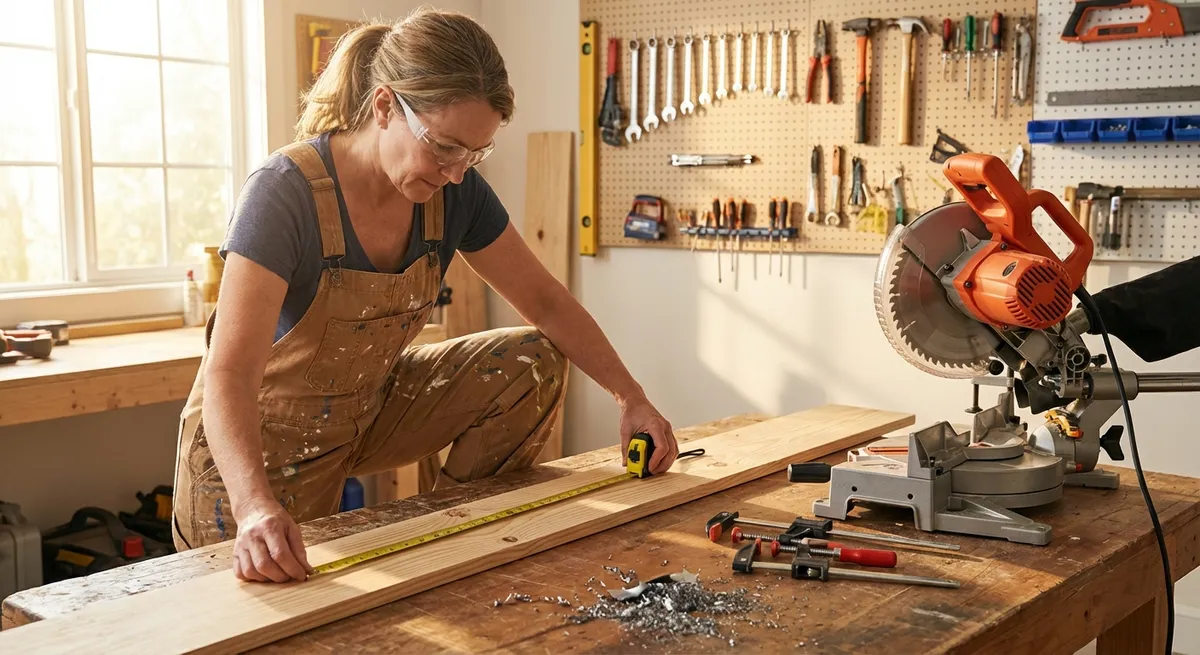
- Use the same tape measure for the whole project.
Different tapes can vary slightly. Sticking with one removes that variable.
- Hook the tape carefully and lock it.
Make sure the hook is firmly against the edge or surface. Pull the tape until straight (no sag), then use the lock so the dimension doesn’t change while you mark.
- Mark with clear, readable lines.
Instead of a dot, draw a short line across the measurement point and then place an “X” on the waste side of the cut. This tells you where the blade should go.
- Account for blade thickness (“kerf”).
When cutting, keep the blade just on the waste side of your line so you don’t shorten your piece. If you need extreme accuracy, test cut on scrap and measure how much the saw removes.
- Use the right marking tools for the job.
- Carpenter’s pencil for general carpentry.
- Fine mechanical pencil for precision work like trim or cabinetry.
- Marker only for rough layout, not for final cut lines.
Practical tips:
- For long repeated measurements (like stud spacing), mark one “master” board and use it as a template instead of re-measuring.
- Use a speed square for quick 90° lines and 45° angle marks.
- For hanging items on walls, use a level or laser level along with your tape for straight, aligned results.
Step 4: Use a Stud Finder and Fasteners Correctly for Solid Wall Mounting
Hanging heavy items—TVs, shelves, cabinets—comes down to finding structure and using the right fasteners in the right way. This is where tools protect you from expensive (and dangerous) failures.
How to do it:
- Locate studs accurately.
- Use a stud finder slowly along the wall, marking where it beeps or lights at the edges.
- Studs are typically 16" or 24" apart on center in many homes. Confirm by finding a second and third stud.
- As a cross-check, look for outlets; studs are usually on one side of them.
- Confirm stud position before drilling.
Use a small finish nail or drill a tiny pilot hole where you think the stud center is. If you hit solid wood, you’re in the right place. Patch and repaint small test holes later if needed.
- Use appropriate screws or anchors.
- Into studs: Use wood or structural screws sized to your bracket or load. Length should penetrate at least 1–1.5 inches into the stud.
- No stud: Use high-quality, weight-rated wall anchors designed for your wall type (toggle bolts, heavy-duty anchors).
- Pre-drill for precise, clean mounting.
Choose a drill bit slightly smaller than the screw’s core. Pre-drill through the bracket holes and into the stud. This reduces splitting and helps the screw pull the item in tight.
- Tighten hardware gradually and evenly.
For brackets with multiple screws, partially install each one first, then snug them all down. This keeps things level and reduces stress on any single fastener or anchor.
Practical tips:
- Always check the manufacturer’s mounting instructions for minimum fastener sizes and patterns.
- For very heavy installations (large TVs, wall cabinets), aim for at least two studs if possible.
- If you must rely on anchors, choose ones rated for significantly more than your expected load for a safety margin.
Step 5: Maintain and Store Your Tools So They Work When You Need Them
Tools that are dull, rusty, or lost in a pile slow every job down. A bit of simple maintenance and organization makes every project go smoother and extends tool life.
How to do it:
- Clean tools after each use.
Wipe dust, glue, and debris off with a dry or slightly damp rag. For sticky residue, use a bit of mineral spirits on a cloth (away from ignition sources, with ventilation).
- Protect metal surfaces from rust.
Lightly oil saw blades, drill bits, and wrench heads with a rust-preventive oil or even a light machine oil. Wipe off excess so they’re not greasy.
- Sharpen or replace cutting tools regularly.
- Replace circular saw blades and utility knife blades when they start burning, chipping, or tearing materials.
- Use a simple sharpening stone or file for chisels and hand tools if you’re comfortable doing so.
- Store tools in defined “zones.”
Group by type: cutting, measuring, fastening, layout, etc. Use pegboards, labeled bins, or drawer organizers so each tool has a home you can find quickly.
- Maintain batteries and power cords.
- For cordless tools, store batteries in a cool, dry place and avoid fully draining them when possible.
- Inspect power cords and plugs for damage; replace or repair frayed cords before they become a hazard.
Practical tips:
- Keep a small “go-to” toolkit with your most-used items (tape, multi-bit screwdriver, utility knife, small level, pliers) separate from your full setup for quick fixes.
- Put a magnet strip or small magnetic tray near your work area to corral loose screws, bits, and small parts.
- Schedule a quick “tool check” every few months to recharge batteries, clean blades, and reorganize.
Conclusion
Better results at home don’t come from buying every new gadget—they come from mastering a handful of core tools and using them correctly. If you can:
- Drive screws cleanly,
- Cut straight and safely,
- Measure and mark accurately,
- Mount securely to walls, and
- Keep your tools in good shape,
you’ve already solved most of the frustrations that slow DIY projects down.
Pick one skill from this guide to practice on your next small project. As each step becomes second nature, every repair, upgrade, and build around your home will feel more controlled, safer, and a lot more satisfying.
Sources
- [Occupational Safety and Health Administration (OSHA) – Hand and Power Tools](https://www.osha.gov/hand-power-tools) – Official safety guidance on using and maintaining common tools
- [Family Handyman – How to Use a Circular Saw](https://www.familyhandyman.com/project/how-to-use-a-circular-saw/) – Practical tips and visuals for accurate, safe circular saw cuts
- [This Old House – How to Use a Power Drill](https://www.thisoldhouse.com/tools/21017610/how-to-use-a-power-drill) – Step-by-step instructions and advice on drilling and driving screws
- [Lowe’s – How to Find a Wall Stud](https://www.lowes.com/n/how-to/find-wall-studs) – Detailed overview of stud finding techniques and mounting basics
- [Home Depot – Power Tool Maintenance Tips](https://www.homedepot.com/c/ab/power-tool-maintenance/9ba683603be9fa5395fab9014e21876) – Guidance on cleaning, storing, and extending the life of power tools
Key Takeaway
The most important thing to remember from this article is that this information can change how you think about Tools & Equipment.