If people can dream up hilarious excuses to call in sick from work, DIYers have their own version: “I’d fix it, but my tools are a disaster.” With posts about bizarre reasons for skipping the office trending right now, it’s a good moment to look at the home version of that problem—an unorganized, unsafe, or under‑equipped workspace that makes even simple repairs feel exhausting.
The good news: you don’t need a pro shop or a huge budget to fix this. With a bit of planning and a few smart tool choices, you can turn a cluttered corner of your garage, spare room, or balcony into a reliable, safe, and actually enjoyable place to work. Here’s how to set up a practical home workshop so your projects stop feeling like something to “call in sick” from.
Step 1: Pick the Right Spot (And Make It Safe First)
Before you buy a single new tool, choose where your workshop will live and make it safe to use.
- Check power and lighting.
- You’ll want at least one 15–20A circuit within reach. Avoid chaining multiple cheap power strips together—use one heavy‑duty, surge‑protected strip or, better, a wall outlet on a dedicated circuit for big tools.
- If the space is dim, add LED shop lights or clamp lights. Good light prevents mistakes and injuries.
- Think about noise and dust.
- If you share walls with neighbors or sleeping kids, plan louder work (saws, sanders) for reasonable hours and choose quieter tools when possible (hand saw instead of circular saw for small cuts, for example).
- In basements and garages, add a box fan in a window or door to blow dust out, and keep a simple shop vac close by.
- Clear a safe working zone.
- Give yourself enough room to walk completely around your main surface (a workbench or sturdy table).
- Remove tripping hazards: loose cords, scrap wood, old paint cans on the floor. Run cords along walls or overhead where possible.
- Set up basic safety gear now.
- Keep safety glasses, hearing protection, a dust mask/respirator, and work gloves in one visible spot.
- Add a small fire extinguisher rated for electrical and flammable liquids (often labeled ABC). Mount it near the exit, not buried in a corner.
- Decide your “mess boundary.”
- Lay down a rubber mat or drop cloth to mark your work zone. This protects floors and makes cleanup easier, especially in apartments or shared spaces.
Step 2: Build a Starter Tool Kit That Actually Matches Your Projects
Instead of buying every gadget you see on social media, build a tool set around what you really do: hanging shelves, fixing doors, assembling furniture, light plumbing, etc.
- Start with quality hand tools.
These are the tools you’ll use on almost every project:
- 16–20 oz hammer (claw style)
- Two screwdrivers: #2 Phillips and medium flathead (or a good multi‑bit driver)
- Tape measure (at least 16 ft / 5 m, easy‑read markings)
- Utility knife with replaceable blades
- Adjustable wrench plus a basic mechanic’s socket set
- Pliers: combination pliers and needle‑nose pliers
- Torpedo level (small level) and/or 24" level for shelves and frames
- Add just a few power tools that pull real weight.
- Cordless drill/driver with 2 batteries and a charger
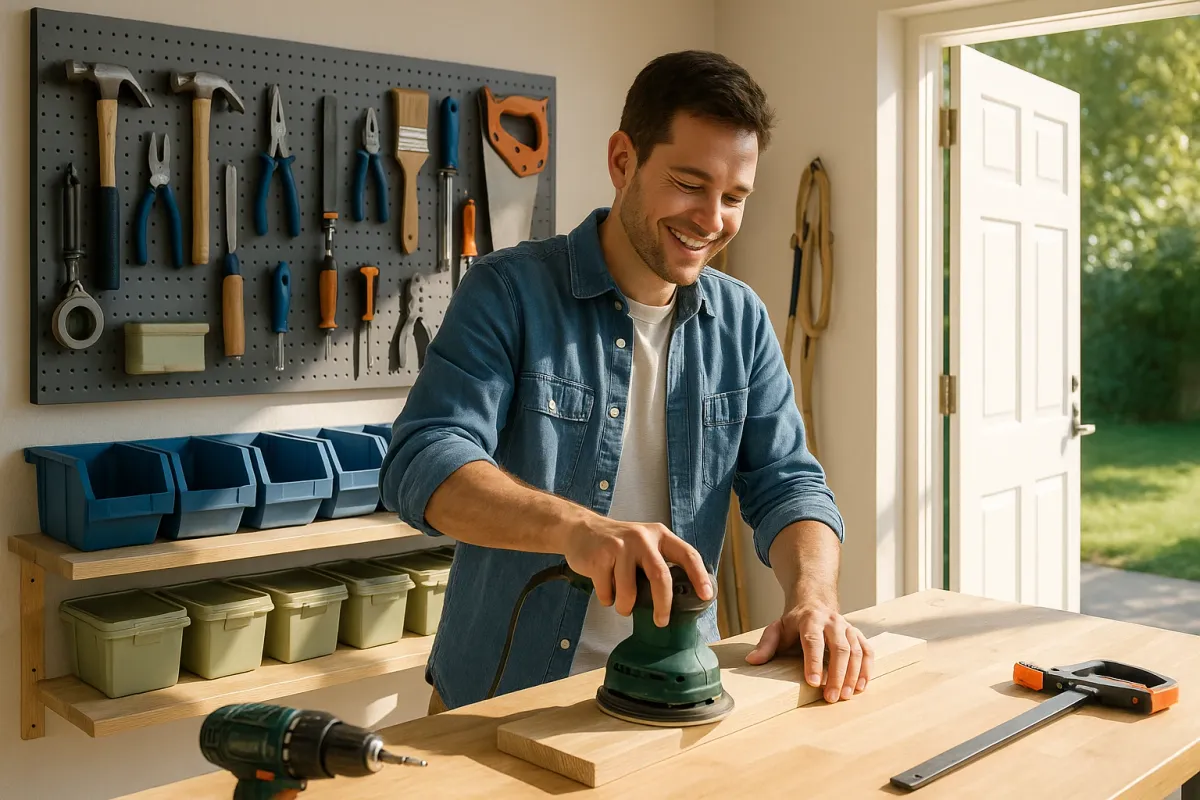
- Orbital sander for smoothing wood and surface prep
- Jigsaw for curved and straight cuts in wood, plastic, and some metals
For most homeowners, these three do the most work:
Choose tools from a single battery system if you go cordless, so you can share batteries as your collection grows.
- Buy the consumables you’ll actually burn through.
- Wood and metal drill bits (a basic set is fine to start)
- Extra screws in common sizes (1 1/4", 1 5/8", 2") in labeled containers
- Sandpaper (80, 120, 220 grit) for your sander and for hand use
- Painter’s tape, wood glue, super glue
- Prioritize reliability over flash.
- Check current user reviews before you buy—ignore “must‑have” hype and look for comments about torque, battery life, and durability.
- For tools you’ll use constantly (drill, tape measure), it’s worth paying a bit more to avoid constant frustration.
- Leave room for project‑specific tools.
- Rent or borrow big tools (miter saw, tile saw, nailer) the first time you need them. If you find yourself renting the same thing repeatedly, that’s your sign to buy.
Step 3: Create a Work Surface That Can Take a Beating
You don’t need a fancy workbench, but you do need something stable, flat, and strong enough to clamp things to.
- Upgrade from the dining table.
- A solid core door blank on two sawhorses makes an excellent budget workbench.
- If space is tight, use foldable sawhorses and store the “bench” vertically when not in use.
- Make it sturdy and shake‑free.
- Whatever you use, test it: lean on it, push it side‑to‑side. If it rocks, add bracing or cross‑supports, or tighten all fasteners.
- Aim for a comfortable height: roughly at or slightly below your wrist when your arms are relaxed at your sides.
- Protect the top so you’re not afraid to work.
- Screw a sacrificial sheet of plywood or MDF on top. When it’s too rough or chewed up, you can just replace it.
- This lets you drill through pieces or cut at the edge without worrying about damaging the “real” structure.
- Add clamping options.
- Keep at least two medium bar clamps and a couple of spring clamps within reach.
- Install a simple vise on one corner if you work with metal or do a lot of shaping and filing.
- Plan for storage under or above.
- A simple shelf or crate under the bench holds bulky items (paint, sandpaper, power tool cases).
- Pegboard or a tool rack above your bench keeps most‑used tools at eye level, not buried in a box.
Step 4: Organize Tools So You Can Find Them in 10 Seconds
A messy workshop is a big reason people avoid starting projects. Good organization doesn’t have to be pretty; it just has to be obvious.
- Give every tool a “home” right away.
- As you set up, decide where each category lives: drilling, cutting, measuring, fastening, safety.
- Use labels on drawers, bins, and shelves. Simple text beats “I’ll remember where I put it.”
- Use vertical space first.
- Pegboard with hooks is cheap and flexible—perfect for hand tools you grab constantly.
- Outline tools with a marker if you like; missing outlines show what hasn’t been put back.
- Separate everyday tools from specialty tools.
- Keep a small “grab and go” kit: hammer, tape measure, multi‑bit screwdriver, utility knife, pliers. Store it in a tote or tool bag.
- Put less‑used specialty tools (pipe wrench, tile tools, stud finder) in clearly labeled bins.
- Small parts need real containment.
- Use divided organizers or clear screw‑top containers for screws, anchors, nails, and fittings.
- Label by size and type: “Wood Screws 1 1/4" – Fine Thread,” “Drywall Anchors,” etc. You’ll waste less time and buy fewer duplicates.
- Make clean‑up automatic, not optional.
- Keep a small broom, dustpan, and shop vac in the workshop.
- At the end of each session, spend five minutes returning tools to their “home” and clearing the work surface. Treat it as part of the project, not extra credit.
Step 5: Work Like a Pro: Safe, Repeatable Habits for Every Project
Tools are only half the story. Your habits determine whether your workshop feels empowering or intimidating.
- Do a quick pre‑project check.
- Is the area clear? Do you have enough light? Are cords out of the way of where you’ll cut or drill?
- Put on the right safety gear before you even plug things in.
- Match the tool to the material.
- Use the right bit or blade: wood bits for wood, masonry bits for concrete, metal‑rated blades for metal.
- If you’re not sure, check the packaging or manufacturer’s website. Forcing the wrong tool is how bits snap and motors burn out.
- Let tools do the work—don’t muscle them.
- With a drill, use the right speed and let the bit cut; pressing too hard overheats and dulls it.
- With saws, keep a steady feed rate. If the motor bogs down or smells hot, back off and let it cool.
- Test on scrap first.
- Before you drill into a finished surface or make a visible cut, try it on a scrap piece of similar material.
- Adjust your technique—speed, pressure, clamping—until you’re confident, then move to the real piece.
- Wrap up like a pro.
- Unplug corded tools, remove batteries from cordless tools if you won’t use them soon, and coil extension cords properly.
- Wipe dust off moving parts, blow out vents, and empty the shop vac or dust bag before it’s overflowing. Basic maintenance keeps tools safer and extends their life.
Conclusion
A lot of people joke online about absurd excuses for skipping work. In the DIY world, a badly set‑up workshop can become that same kind of excuse—you “mean” to fix things, but the thought of digging through piles of tools or working in a dark, dusty corner kills all motivation.
By choosing a safe spot, building a realistic starter kit, creating a sturdy work surface, organizing your tools, and adopting a few simple pro habits, you remove those excuses. Your tools become easier to use, projects move faster, and your home actually gets better with every weekend, not worse.
Set up the space once, maintain it a little each time, and your workshop will be Fix Ready whenever inspiration—or that next unexpected repair—hits.
Key Takeaway
The most important thing to remember from this article is that following these steps can lead to great results.