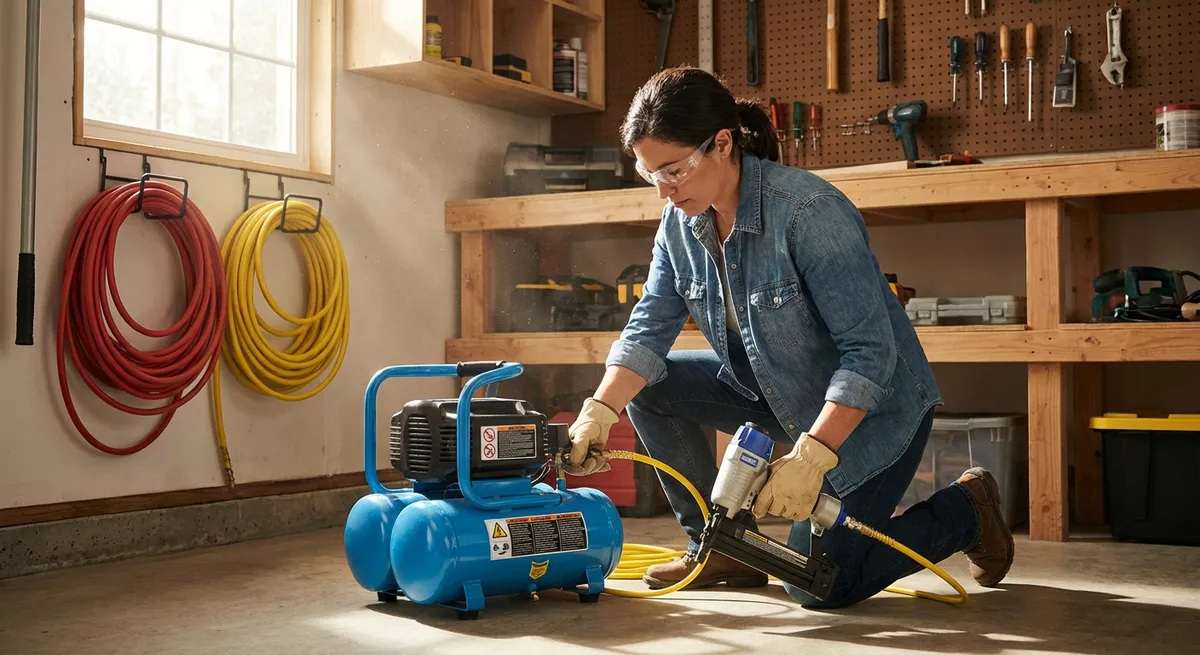
An air compressor can turn a basic DIY setup into a serious home workshop. From inflating tires and blowing out sawdust to running nailers, staplers, and impact wrenches, this one tool unlocks a lot of capability. But mis-sized hoses, wrong fittings, and poor maintenance can make it loud, frustrating, and even unsafe. This guide walks you through choosing, setting up, and safely using an air compressor at home—without the confusion.
Understanding What Your Air Compressor Can (and Can’t) Do
Before buying or unboxing anything, it helps to know what air compressors are actually good at—and what they’re not.
Air compressors convert electrical energy into compressed air stored in a tank. That stored air then powers tools that need quick bursts of energy (like a brad nailer) or a steady flow (like a paint sprayer). Compressors shine when you need:
- Consistent driving power for nailers and staplers
- Occasional high-torque bursts for impact wrenches
- Fast, reliable inflation for tires and sports gear
- Easy cleanup of dust and debris from tools and benches
Where they struggle is with tools that need a huge continuous air supply (big sanders, grinders, or some HVLP paint guns) unless you buy a large, often expensive unit. Knowing this up front helps you pick a compressor that fits your projects instead of overrunning its limits and burning it out.
Aim to match the compressor’s capabilities (PSI and CFM) to the tools you actually plan to use—not the most powerful tool you might someday want.
Step 1: Choose the Right Compressor for Your DIY Projects
Picking the right compressor is the difference between a smooth weekend project and a constant “waiting for the tank to refill” headache.
Key specs to understand:
- PSI (Pounds per Square Inch):
Pressure. Most DIY tools run comfortably at 90 PSI. Many small compressors reach 125–150 PSI, which is plenty for typical home use.
- CFM (Cubic Feet per Minute):
Air volume. This is the big one. Your tools list a required CFM at a specific PSI (e.g., 2.0 CFM @ 90 PSI). Your compressor needs to meet or exceed this for reliable performance.
- Tank Size (Gallons):
- Portable trim work & inflating: 1–6 gallons
- General home projects, light automotive: 6–20 gallons
- Regular heavy tools or spraying: 20+ gallons (often not truly “portable”)
A bigger tank means longer run time between refills, but also more weight and space. For typical DIY:
How to match tools and compressor:
- List your main tools (brad nailer, framing nailer, impact wrench, blower, inflator, etc.).
- Check the CFM rating for each tool at 90 PSI (from the tool manual or manufacturer’s site).
- Choose based on your “hungriest” tool if you’ll run it often.
- If you’ll use multiple tools at once, add their CFM requirements together.
Noise and power considerations:
- Look for decibel ratings if noise matters; “quiet” compressors are often 60–70 dB, vs. 80+ dB for standard models.
- Confirm your outlet: many homeowner-grade units run on 120V, but larger ones may require 240V.
If you’re mostly using nailers and inflating tires, a quiet “pancake” or small hot-dog style compressor is usually enough.
Step 2: Set Up Your Compressor Safely and Correctly
Once you have your compressor, a careful first setup will make it safer and extend its life.
1. Place it in a good location
- Use a flat, level surface so the compressor doesn’t vibrate or walk during use.
- Keep it in a well-ventilated area; don’t run it in a tight closet or sealed room.
- Leave a few inches of clearance around the unit so it can cool properly.
2. Check the power and cord
- Plug directly into a grounded outlet whenever possible. Long extension cords can cause voltage drop and overheat both cord and motor.
- If you must use an extension cord, use a heavy-duty, short (14-gauge or thicker) cord rated for the compressor’s amperage.
- Avoid sharing the circuit with other high-draw tools while the compressor is running.
3. Read and set the controls
Most basic compressors have:
- On/Off or Auto switch – controls motor operation.
- Tank pressure gauge – shows pressure inside the tank.
- Regulated pressure gauge – shows pressure going out to the hose.
- Regulator knob – adjust this to match your tool’s needed PSI.
- Safety valve – a small pull ring; do not tamper with it beyond quick testing per the manual.
Before you connect tools:
- With the compressor off, turn the regulator knob down (counterclockwise) to minimum.
- Turn the unit on and let it build pressure.
- Once it stops running, slowly turn the regulator up (clockwise) until the regulated gauge matches your tool’s recommended PSI.
4. Test the safety valve (first-time use)
- With pressure in the tank, briefly pull the small ring on the safety valve. You should hear a strong burst of air.
- Release immediately so it can reseal. If it leaks afterward, shut off the compressor and consult the manual or a service center.
Step 3: Attach Hoses and Fittings Without Leaks or Surprises
Air leaks waste time, build heat, and make your compressor run more than necessary. A careful setup of your air lines avoids this.
1. Pick compatible fittings
Most home compressors use 1/4" NPT threads and standard quick-connect couplers. You’ll typically see:
- Male plugs – on tools and sometimes hoses
- Female couplers – on hose ends and compressor outlet
Stick to one style (e.g., industrial/M-style) across your setup to avoid compatibility issues.
2. Use thread sealant correctly
For threaded metal-to-metal connections (not the quick-connect ends):
- Wrap PTFE (Teflon) tape clockwise around the male threads 2–3 times, starting one thread back from the edge.
- Or use a pipe thread sealant/pipe dope approved for air systems.
- Do not tape or coat the smooth quick-connect surfaces—only the threaded parts.
3. Tighten—but don’t over-tighten
- Hand-tighten first, then use a wrench to snug the fitting. It should be firm but not forced.
- If a connection still leaks (you’ll hear a faint hiss), slightly tighten more. If it keeps leaking, remove it, re-tape, and reinstall.
4. Connect the hose and tool
- Push the male plug fully into the female coupler until you hear a solid click. Tug gently to confirm it’s locked.
- When disconnecting, firmly hold the coupler and pull back the sleeve; the tool will pop off. Always release pressure (or at least dial the regulator down) before frequent connect/disconnect cycles.
5. Check for leaks
- Turn on the compressor, let it fill, then turn it off.
- Listen around fittings and connections. A small leak sounds like a quiet hiss.
- For a more precise test, spray a mixture of soapy water on joints; bubbles indicate air leaks.
Step 4: Power Your Tools Correctly and Avoid Common Mistakes
Once everything is connected, you want to use your tools efficiently, safely, and without damaging workpieces or the compressor.
1. Set the right pressure for each tool
- Check your tool’s manual or label (e.g., “Operating Pressure: 70–110 PSI”).
- Start at the low end of the range and test on scrap material.
- Increase pressure slightly if:
- Nails don’t sink fully
- Impact wrench won’t break loose lug nuts
- Decrease pressure if:
- Nails overdrive and bury into the surface
- You’re damaging soft woods or delicate finishes
2. Work in short bursts when needed
Many smaller compressors are “intermittent duty”—they’re meant to cycle on and off, not run constantly.
- For impact wrenches and blow guns, use quick, controlled bursts instead of continuous holding.
- If the motor runs nearly non-stop while you’re working, you may be:
- Using a tool that demands more CFM than the compressor can handle, or
- Working too fast for the tank size. Slow down or take short breaks.
3. Avoid “deadheading” and unsafe practices
- Don’t block the tool’s air exit (e.g., covering the nozzle of a blow gun) to “build more power”—this can damage the tool and be dangerous.
- Avoid pointing blow guns or pressurized air at your skin or another person. High-pressure air can cause serious injury even without visible damage.
4. Manage the hose to prevent tripping and strain
- Run hose along walls or behind you instead of across main walkways.
- Use simple hose reels or hooks to keep it off the floor when not in use.
- Avoid sharp bends or kinks that restrict airflow and wear out the hose.
5. Shut down safely after use
When you’re done for the day:
- Turn the power switch off.
- Turn the regulator knob down to zero.
- Disconnect tools and store them properly.
- If you won’t use the compressor again soon, move to the next step: draining the tank.
Step 5: Maintain and Store Your Compressor So It Lasts
Air compressors are fairly simple machines, but neglect will wear them out quickly. A few habits drastically extend their lifespan and keep them safer.
1. Drain the tank after each serious use
Compressed air always carries moisture, which condenses inside the tank and leads to internal rust if not removed.
- Locate the drain valve at the bottom of the tank (often a small petcock or twist valve).
- With the compressor off, and ideally with some pressure in the tank, tilt the tank slightly if needed and open the valve slowly.
- Let water (and a bit of air) escape until it runs clear and dry, then close the valve.
- Do this after any heavy use, or at least once per week if used often.
2. Clean or replace the air intake filter
Your compressor may have a small intake filter that keeps dust out of the pump.
- Check your manual for location and service intervals.
- Inspect monthly if you work in a dusty garage or workshop.
- Clean or replace it as recommended; a clogged filter makes the motor work harder and run hotter.
3. If it’s an oil-lubricated compressor, check and change oil
Some small units are oil-free (low maintenance), while others require oil.
For oil-lubricated models:
- Check the oil sight glass or dipstick according to the manual.
- Top off with the manufacturer-recommended compressor oil only.
- Change oil on the schedule given in your manual (often after break-in, then every X hours or annually).
4. Inspect hoses and fittings regularly
- Look for cracks, bulges, or worn spots in hoses. Replace any damaged hose immediately.
- Periodically re-check fittings for slow leaks using the soapy water test.
- Store hoses loosely coiled; don’t wrap tightly around small hooks or bend sharply.
5. Store in a dry, protected area
- Keep the compressor in a dry space, away from standing water or heavy condensation.
- Cover it lightly with a breathable cover if it sits for long periods, but don’t block ventilation if it’s plugged in or ready for use.
- Before long-term storage, drain the tank completely and leave the drain valve cracked open for a short time to air out moisture.
Conclusion
A well-chosen, properly set up air compressor turns many frustrating DIY jobs into fast, clean, and repeatable tasks. By understanding your tools’ air requirements, connecting hoses and fittings correctly, setting safe pressures, and maintaining the tank and filters, you avoid the usual pitfalls: endless refilling cycles, leaks, and premature failure.
Start small if you’re unsure—a compact compressor that runs a brad nailer, blow gun, and tire inflator covers a huge range of home projects. As your skills and needs grow, you’ll know exactly what to upgrade, and your existing setup will still be safe, reliable, and ready to work.
Sources
- Occupational Safety and Health Administration (OSHA) – Compressed Air Safety - Provides official safety guidelines and limits for using compressed air tools
- California Department of Industrial Relations – Compressed Air Safety Program - Covers best practices for handling, maintaining, and operating compressed air systems
- Ingersoll Rand – Air Compressor Selection & Sizing Guide - Explains how to match compressor PSI, CFM, and tank size to various tools and applications
- Campbell Hausfeld – Air Compressor Basics - Offers beginner-friendly explanations of compressor types, maintenance, and common uses
- Family Handyman – Air Compressor Buying Guide - Practical advice for homeowners choosing and using air compressors for DIY projects
Key Takeaway
The most important thing to remember from this article is that this information can change how you think about Tools & Equipment.