If your projects never seem to fit quite right, your tools might not be the problem—your measuring setup might be. Even a solid drill or saw can’t fix bad measurements. The good news: with a basic set of measuring and marking tools, properly set up and maintained, you can dramatically upgrade the accuracy of every DIY project you tackle.
This guide walks you through building a reliable measuring “system” at home: what to use, how to prep it, and step-by-step habits that keep your cuts, holes, and layouts consistent and repeatable.
Build a Reliable Measuring Basics Kit
Before you worry about advanced gadgets, lock in a small set of dependable measuring and marking tools you’ll reach for constantly. You don’t need a huge collection—just a few pieces that are accurate and easy to read.
Look for a 25-foot locking tape measure with a sturdy, readable blade and a solid hook (preferably with a protective coating and clear fraction markings). Add a 6- or 12-inch metal ruler for close work and checking small parts. A combination square (with a metal rule and sliding head) is essential for marking 90° and 45° lines and verifying square edges on boards and tools. For larger projects, a 4-foot level or straightedge helps with straight lines and checking flatness. Finally, keep a good marking pencil or carpenter’s pencil plus a fine-tip marker for different surfaces—pencil for wood, marker or paint pen for metal and rough materials.
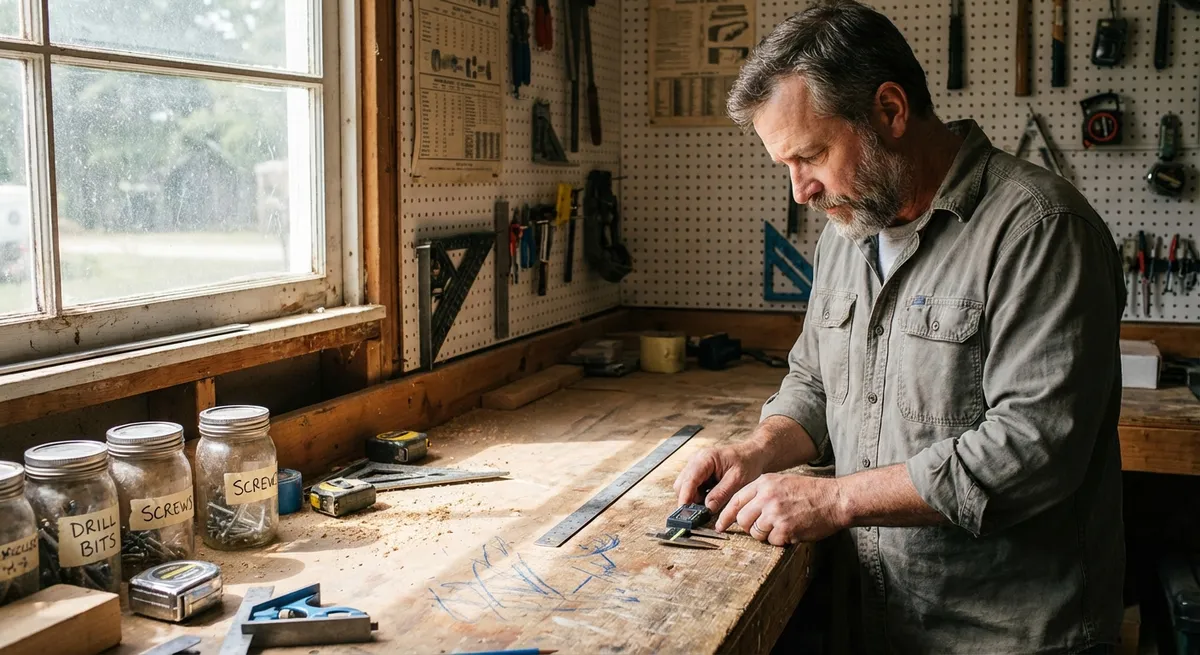
Keep these core tools together in one place: a small wall-mounted rack in your workspace or a dedicated measuring pouch in your tool bag. The goal is simple: when you need to measure or mark, you’re never hunting around for the right tool.
Step 1: Check and Adjust Your Tape Measure for Accuracy
A tape measure that’s off by even 1/16 inch can throw off a whole project. Before you rely on any tape, verify it.
First, compare your tape to a known straight and accurate reference, like a good steel ruler or a framing square. Lay the tape and the reference side-by-side on a flat surface and line them up carefully at the 1-inch mark on both tools to avoid any wear at the very end. Check at several points—6 inches, 12 inches, 24 inches. If the numbers don’t match, the tape may be stretched, damaged, or simply poor quality.
Next, inspect the metal hook at the end. It’s supposed to move slightly—usually about the thickness of the hook itself—to account for inside and outside measurements. If it’s bent, loose, or too tight (doesn’t move at all), your readings will be off. Gently bend it back with pliers if it’s clearly out of line, or tighten/loosen the rivets just enough so it can move but not wobble excessively. If the tape is rusted, cracked, or badly kinked, replace it. Once you’ve confirmed a tape is accurate, mark it with a small piece of tape or paint dot so you know it’s “trusted” gear.
Step 2: Square Up Your Tools Before You Start Cutting
Even perfectly measured lines are useless if your tools aren’t square. Before cutting or assembling anything, take a couple of minutes to confirm your primary tools are actually at 90°.
Start with your combination square. Place the stock (thicker part) firmly against a known flat edge of a board or table and draw a line along the blade. Flip the square over and align the stock on the same edge, then draw another line overlapping the first from the opposite direction. If the two lines diverge, even slightly, your square isn’t true. Many combination squares allow subtle adjustment by loosening the screw and gently resetting the blade. If not, and it’s noticeably off, treat it as a layout-only tool or replace it for critical work.
For circular saws or miter saws, use your confirmed-accurate square to set the 90° positions. On a circular saw, unplug it, place the square against the saw’s shoe and blade (avoiding the teeth), and adjust the bevel until the blade sits perfectly against the square. On a miter saw, set it to 0° and slide the square between the fence and blade to ensure there’s no gap. Lock those settings and periodically recheck, especially after moving or bumping your tools. This small habit greatly improves your cut accuracy and reduces “mysterious” gaps in assemblies.
Step 3: Use Consistent Reference Faces and Mark Clearly
Accuracy isn’t just about numbers—it’s also about consistency. A common DIY mistake is flipping boards, switching reference edges, and then wondering why things don’t line up.
When you pick up a board, choose one face and one edge as your “reference” sides—usually the flattest and straightest ones. Lightly mark them with an “R” or a small tick to remind yourself. All your measurements and layout marks should start from these reference sides whenever possible. That way, minor imperfections on the opposite edges don’t stack up into bigger errors.
When marking, use clear, sharp lines instead of thick, vague marks. Sharpen your carpenter’s pencil to a fine edge, or use a mechanical pencil or marking knife for precise work like trim or cabinet projects. Always decide whether you’re cutting on the line, to the waste side of the line, or leaving the line intact; then be consistent throughout the project. Add quick notation near your marks—like “top,” “front,” or arrows showing which side is the waste—to avoid cutting on the wrong side when you come back later or get interrupted.
Step 4: Lay Out Repetitive Spacing Without Doing All the Math
Many home projects involve repeated spacing: deck boards, shelf pin holes, wall hooks, slats, or fence pickets. Instead of re-measuring every single piece and risking small variations each time, use your tools to create simple, repeatable layouts.
For equal spacing across a fixed length, use the “diagonal tape” method. Say you want 5 evenly spaced hooks on a board. Rather than calculating fractions, angle your tape measure across the board until a convenient number lands exactly on one end—like 20 inches. Mark at 4, 8, 12, 16, and 20 inches along the tape. Those marks will be evenly spaced across the board, no matter the angle. Use a combination square or straightedge to transfer those marks squarely across the board if needed.
For shelf pin holes or sections of trim, make a simple story stick: a scrap board or strip marked with your key measurements and hole locations. Drill or mark on the story stick once, then use it as a template for each new piece instead of re-measuring. This reduces measuring error, speeds up the work, and keeps spacing visually consistent. Just remember to label the story stick clearly and store it flat so it doesn’t warp.
Step 5: Keep Your Measuring and Marking Tools Clean, Protected, and Ready
Accurate tools stay accurate only if you take basic care of them. Dust, rust, and drops can make even the best gear unreliable over time.
After dusty or dirty jobs (cutting drywall, sanding, working outside), wipe down your tape measure, square, and levels with a clean cloth. Avoid letting plaster or paint dry on measuring surfaces; scrape or wipe it off gently before it hardens. For metal tools, a light coat of machine oil or a corrosion inhibitor on the steel parts helps prevent rust, especially if you store them in a damp basement or garage. Don’t spray directly onto measuring markings—apply to a cloth first, then wipe.
Never let your tape measure snap back uncontrolled; guide it in with your hand to prevent the hook from bending and the blade from kinking. Store your levels and squares where they won’t get knocked off shelves: hang them on hooks or dedicated wall mounts. Keep pencils and markers in a small container or pouch near your measuring gear so you’re never tempted to “just scratch a line with a screw” and damage a surface. A few simple habits like these mean you can trust your measurements every time you start a project, instead of wondering if your tools let you down.
Conclusion
Most frustrating DIY mistakes trace back to measuring and marking, not a lack of fancy tools. By building a small, reliable kit, confirming accuracy, using consistent reference faces, laying out repetitive spacing smartly, and maintaining your tools, you turn measuring into a strength instead of a gamble.
The payoff is immediate: parts fit together more cleanly, gaps shrink, and your projects start to look intentionally built instead of “close enough.” Set up your measuring system once, keep it in good shape, and every tool and project you tackle after that gets easier and more predictable.
Sources
- [U.S. Consumer Product Safety Commission – Workshop and Power Tool Safety](https://www.cpsc.gov/safety-education/safety-guides/tools-and-workshop) - General guidance on safe tool use and workshop practices
- [Fine Homebuilding – How to Check Your Tape Measures for Accuracy](https://www.finehomebuilding.com/2013/12/12/how-to-check-your-tape-measures-for-accuracy) - Detailed look at verifying and understanding tape measure accuracy
- [Family Handyman – 20 Tape Measure Hacks](https://www.familyhandyman.com/list/tape-measure-hacks/) - Practical tips for using a tape measure more effectively in DIY projects
- [Wood Magazine – How to Use a Combination Square](https://www.woodmagazine.com/woodworking-tools/reviews-and-buying-guides/hand-tools/how-to-use-a-combination-square) - Explains proper use and benefits of combination squares in layout work
- [OSHA – Hand and Power Tools Safety](https://www.osha.gov/hand-power-tools) - Official safety information relevant to handling and maintaining tools properly
Key Takeaway
The most important thing to remember from this article is that this information can change how you think about Tools & Equipment.