Opening up a cramped room by removing a wall is one of the most dramatic upgrades you can DIY. Done right, it can improve light, flow, and how you actually use your home—without a full-gut renovation. This guide walks you through how to safely remove a non-load-bearing interior wall, from planning through cleanup, with step-by-step instructions focused on safety and practicality.
Important: If you are not 100% sure a wall is non‑load‑bearing or how to deal with electrical/plumbing, bring in a licensed pro for an inspection or partial help. Saving a few dollars is never worth damaging your home’s structure or risking injury.
Step 1: Confirm the Wall Is Non‑Load‑Bearing
Before you touch a tool, you need to confirm that the wall does not support your house structurally.
- Study your house plans if available.
Look for framing or structural drawings. Load‑bearing walls are typically shown under beams, or stacked above other walls or supports. If you don’t have plans, your city or county building department may have copies on file.
- Check wall orientation and location.
On traditional wood-framed homes, load-bearing walls usually:
- Run perpendicular to floor joists above or below
- Sit under beams, ridge lines, or another wall directly above
- Sit near the center of the house, not just around the perimeter
Interior walls that run parallel to joists are more likely to be non-load-bearing, but this is not a guarantee.
- Inspect from the attic or basement if possible.
From below (basement/crawlspace) or above (attic), look at the direction of the joists:
- If joists span across the wall and the wall lines up under a joint or beam, it may be load-bearing.
- If joists run parallel and don’t rest on the wall, it is more likely non-load-bearing.
- Look for structural clues.
Look for beams, posts, or large headers over openings (like wide doorways) near the wall. These often indicate load transfer. If the wall aligns with those elements, you need a pro to verify.
- When in doubt, hire an expert.
A structural engineer or licensed contractor can usually confirm status with a short on-site visit. This small expense can prevent very big problems. Treat any uncertainty as a red flag.
Step 2: Plan the Opening and Deal With Utilities
Once you know the wall is non‑load‑bearing, plan exactly how you’ll open it and deal with what’s inside it.
- Decide how much of the wall to remove.
You don’t have to take out the entire wall. You can:
- Create a wide cased opening
- Build a half wall or pony wall
- Open just part of the wall for a pass-through
Mark your proposed opening with painter’s tape on the floor and walls and live with it for a day or two to see how it feels.
- Check for switches, outlets, and vents.
Look carefully at both sides of the wall:
- Light switches and outlets indicate electrical wiring inside.
- Heat registers, return vents, or ducts indicate HVAC.
- Visible plumbing fixtures nearby (kitchen, bath, laundry) raise the odds of pipes inside the wall.
- Use a stud finder and inspection holes.
- Turn off power to that circuit at the breaker.
- Cut a small inspection hole (about 4" x 4") at shoulder height between studs.
- Use a flashlight and small mirror/phone camera to look inside for wires, pipes, or ducts.
- Make a plan for electrical, plumbing, and HVAC.
- Electrical: You may be able to reroute wires to new locations or add junction boxes with covers in accessible areas, but any changes must meet electrical code. Many DIYers demo the wall and hire an electrician just for the rough-in.
- Plumbing: Pipes usually require a plumber to reroute. Don’t cut any pipe without a clear reroute plan and shutoff access.
- HVAC: Ducts and vents affect system balance; this is usually HVAC-pro territory.
- Obtain permits if required.
A stud finder with live‑wire detection can help map studs and some wiring paths. To know for sure:
Many jurisdictions require permits for removing walls and almost always for electrical/plumbing work. Call your local building department, explain your plan, and follow their guidance. Inspections protect you from unsafe work and future resale issues.
Step 3: Prepare the Site and Set Up Safety
Good prep keeps the rest of your house from becoming a dust storm and reduces the chance of injury.
- Gather essential tools and materials.
Common items include:
- Safety: goggles, dust mask or respirator, work gloves, hearing protection
- Tools: utility knife, pry bar, hammer, reciprocating saw (with wood and metal blades), drill/driver, stud finder, measuring tape, level
- Protection: plastic sheeting, painter’s tape, drop cloths, cardboard floor protection
- Disposal: contractor trash bags, buckets, or a small dumpster if needed
- Protect surfaces and isolate the work area.
- Lay rosin paper, cardboard, or drop cloths over floors.
- Move furniture out or cover it with plastic.
- Hang plastic sheeting from ceiling to floor around the work area, taping seams, to create a dust barrier.
- Cover HVAC registers and returns in the work zone (but don’t forget to uncover them later).
- Shut off utilities to the wall.
- Turn off power to any circuits serving outlets/switches in that wall. Verify with a non-contact voltage tester.
- If there’s any chance of plumbing, locate the main water shutoff so you can react fast if needed.
- Remove trim and fixtures first.
- Carefully pry off baseboards and any crown or door casings connected to the wall with a thin pry bar. Score caulk lines with a utility knife first to reduce drywall tearing.
- Remove switch plates, outlet covers, and any wall fixtures (hooks, shelves, etc.).
- Plan your debris path and staging.
Decide where you’ll stack lumber and drywall pieces and how you’ll carry debris out. Keeping materials sorted (wood vs. drywall vs. metal) simplifies disposal and potential recycling.
Step 4: Remove Drywall, Then Studs, in a Controlled Sequence
Demolition doesn’t have to mean chaos. Working methodically makes the job safer and the cleanup easier.
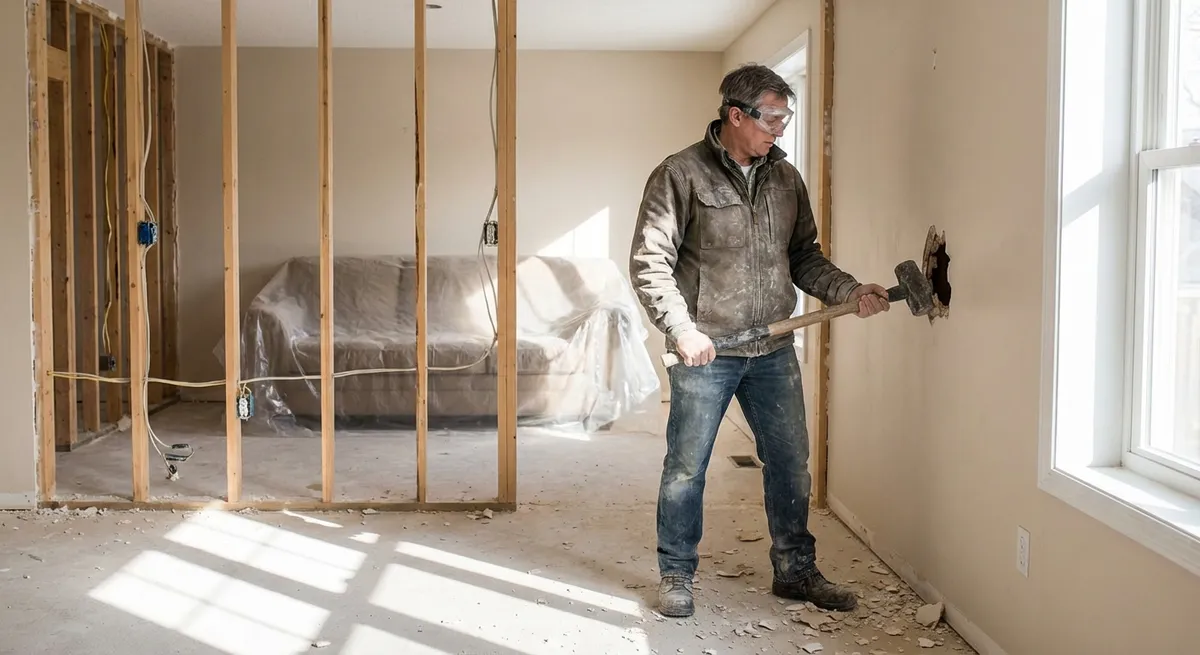
- Score seams and cut drywall in manageable sections.
Use a utility knife to score along corners and seams. Then:
- Start at one side of the wall and cut a horizontal strip of drywall at about waist height with a drywall saw or reciprocating saw (check inside first so you don’t hit pipes/wires).
- Gently pry drywall off studs in sections, working from top to bottom. Avoid smashing with a sledge; it creates more dust and irregular waste.
- Expose and handle wiring or pipes carefully.
- Confirm power is off with a tester before touching any cable.
- Stapled electrical wires can be carefully freed from studs or cut and capped in junction boxes if you’ve already planned the reroute with an electrician.
- If you discover unexpected plumbing or ducts, stop and reassess. This is often the point to call in a pro.
- Remove drywall on both sides before cutting studs.
As the studs become visible:
Take off drywall on one side first, then the other, leaving the framing intact until all sheathing is removed. This keeps the wall stable while you work and lets you see the full framing layout.
- Cut and remove studs without damaging the ceiling.
With drywall gone:
- Measure and mark a cut line about 1–2 inches below the ceiling on each stud.
- Use a reciprocating saw to cut studs at the mark.
- Wiggle the lower part of each stud free from the bottom plate and nail connections.
- Carefully pry off the top and bottom plates from ceiling and floor once studs are out. Use a pry bar against a scrap piece of wood to prevent gouging.
- Handle nails, screws, and metal carefully.
- Pull or hammer in exposed nails and remove screws from plates and studs.
- Keep a magnet or magnetic sweep handy for stray fasteners on the floor.
- Collect metal components separately for recycling where available.
Step 5: Finish the New Opening for a Clean, “Always Been There” Look
With the wall gone, you’re only halfway done. Finishing the opening makes the change look intentional and polished.
- Repair ceiling and floor where the wall was.
- Ceiling: After removing the top plate, you’ll have a gap in the drywall. Cut a piece of drywall to fit, screw it into ceiling framing, and tape/mud the seams.
- Floor: If you have hardwood, there will be a strip where the bottom plate was. Options:
- Patch with matching boards
- Install a threshold or transition strip if flooring differs between rooms
- Plan a larger flooring project (refinish or new floor) to fully blend the area
- Frame the new opening (optional but recommended).
If you’re leaving a cased opening or half wall:
- Install new drywall and tape joints.
- Cut drywall to fill side gaps, edges, and patched areas.
- Use drywall screws to secure it to framing.
- Tape all seams with paper or mesh tape and apply joint compound in thin layers, feathering edges.
- Sand lightly between coats and after the final coat, using a sanding sponge and dust collection if possible.
- Add casing or corner bead for a clean edge.
There are two common approaches:
- Prime, paint, and blend the space.
- Prime all new drywall and patched areas to prevent flashing (uneven sheen).
- If touch-up matching is tricky, repaint the entire connected wall or room for a uniform look.
- Step back and evaluate how the new opening affects furniture layout, lighting, and traffic flow—then adjust your layout to take full advantage of the new space.
Conclusion
Removing a non‑load‑bearing wall is a high-impact DIY project that can make your home feel larger, brighter, and more functional without a full renovation. The key is to treat it like a serious construction task: confirm the wall’s role in your structure, plan for utilities, control dust and debris, and finish the opening with care. If you respect the limits of your skills and bring in pros where needed—especially for structural verification, electrical, and plumbing—you can transform your space safely and confidently.
Sources
- [U.S. Department of Housing and Urban Development – Residential Rehabilitation Inspection Guide (PDF)](https://www.hud.gov/sites/documents/REHABINSPECTIONGUIDE.PDF) - Provides guidance on evaluating existing residential structures, including walls and structural elements
- [The Family Handyman – How to Tell if a Wall is Load-Bearing](https://www.familyhandyman.com/project/how-to-tell-if-a-wall-is-load-bearing/) - Practical tips and diagrams for determining whether a wall supports structural loads
- [This Old House – Removing a Nonbearing Wall](https://www.thisoldhouse.com/walls/21015119/removing-a-nonbearing-wall) - Step-by-step overview of the process and considerations when taking down a non-load-bearing wall
- [U.S. Consumer Product Safety Commission – Electrical Safety in the Home](https://www.cpsc.gov/safety-education/safety-guides/electrical) - Safety guidelines relevant when dealing with wiring during demolition
- [U.S. Department of Energy – Air Sealing Your Home](https://www.energy.gov/energysaver/air-sealing-your-home) - Explains how changes to walls and openings can affect air flow and efficiency, with sealing best practices
Key Takeaway
The most important thing to remember from this article is that this information can change how you think about Renovation.