Noisy upstairs neighbors. Street traffic. A gaming setup that keeps the rest of the house awake. Whatever the cause, a loud room makes it harder to relax, work, or sleep. The good news: you can seriously cut noise with DIY-friendly upgrades that don’t require rebuilding your whole house. This guide walks through practical, step-by-step ways to make a room noticeably quieter using tools and materials most DIYers can handle.
Understanding Where the Noise Really Comes From
Before you start buying panels and fancy doors, it helps to understand how and where sound is getting in (or out). That way you spend money where it actually matters.
Sound moves in two main ways:
- Airborne noise – voices, TV, music, traffic. These leak through gaps and thin surfaces.
- Impact noise – footsteps, things dragging on the floor, doors slamming. These transfer through solid structures.
Common weak spots in a typical room:
- Gaps around doors, windows, baseboards, and outlets
- Hollow-core doors that act like drums
- Bare walls and floors that reflect sound instead of absorbing it
- Shared walls with neighbors, hallways, or loud rooms
- Ceilings under another apartment or a second floor
Walk around the room during a noisy time and just listen. Note where noise seems strongest (door, window, wall). That becomes your priority list.
Step 1: Seal the Easy Gaps That Leak Sound
This is the fastest, cheapest upgrade—and it helps with energy efficiency too.
What you’ll need:
- Acoustic or high-quality silicone caulk
- Weatherstripping (foam or rubber)
- Door sweep or automatic door bottom
- Utility knife and caulk gun
- Putty knife or caulk-smoothing tool
How to do it:
- Inspect all gaps with the lights off (optional but helpful).
At night, turn on a bright light in the hallway and turn off the light in your room. Look around the door frame and baseboards—if you see light, sound is leaking there too.
- Weatherstrip around the door frame.
- Clean the jamb so the adhesive sticks.
- Apply weatherstripping along the top and sides of the door frame where the door meets the jamb.
- Close the door to check for a snug seal but not so tight the door is hard to close.
- Install a door sweep.
- Measure the width of the door.
- Cut the sweep to size with a hacksaw or tin snips if needed.
- Attach it to the bottom edge of the door so it lightly brushes the floor or threshold with no visible gap.
- Seal baseboards and trim.
- Run a small bead of caulk where the baseboard meets the wall and where it meets the floor (if it’s a hard floor).
- Smooth it with a wet finger or tool for a clean line.
- Wipe any excess immediately.
- Address outlets and switch boxes on shared walls.
- Turn off power to the room at the breaker.
- Remove cover plates.
- Use acoustic putty pads (or foam gaskets as a budget option) behind the plates and around the box edges.
- Reinstall the covers and restore power.
Practical tip: If you can slip a standard sheet of paper under the door when it’s closed, sound can slip through too. Adjust weatherstripping and sweeps until that gap disappears.
Step 2: Upgrade That Flimsy Door Without Rebuilding the Frame
Many interior doors are hollow-core and barely block sound. You don’t always need to tear out the frame to upgrade.
Option A: Replace with a solid-core door
- Measure your existing door.
- Note height, width, thickness, and hinge placement (distance from top/bottom).
- Photograph the hinge positions for reference.
- Buy a slab solid-core door with matching dimensions.
- Look for MDF or solid-wood core; they’re much heavier than hollow-core.
- Avoid pre-hung unless you plan to replace the whole frame.
- Transfer hinge locations.
- Lay the old and new doors side by side.
- Trace hinge locations from the old door onto the new.
- Use a router or chisel to mortise hinge pockets to the same depth.
- Install hardware and hang the door.
- Attach hinges to the new door.
- Hang it on the existing jamb.
- Check for smooth swing and adjust shims or hinge screws if needed.
- Finish with weatherstripping and a sweep.
- Even a solid door leaks sound if it’s not sealed.
- Repeat the gap-sealing process from Step 1.
Option B: Add mass to an existing hollow door (budget-friendly)
- Apply a mass layer.
- Cut a sheet of MDF or mass-loaded vinyl (MLV) to slightly smaller than the door face.
- Attach with construction adhesive and screws (sink screw heads below surface if using MDF).
- Cover and finish.
- If you used MDF, skim coat with joint compound if needed, sand, prime, and paint to match.
- Add edge trim if you want a cleaner look.
- Recalibrate hinges.
- The door is now heavier. Tighten hinge screws and, if sagging, use longer screws into the framing to support the weight.
Practical tip: If the door no longer stays closed firmly, upgrade to a stronger latch or add a magnetic catch to keep the seal tight.
Step 3: Build a “Soft Shell” with Rugs, Curtains, and Wall Treatments
Bare surfaces bounce sound around the room. Even without full construction work, you can make a space feel dramatically quieter by absorbing those reflections.
What you’ll need:
- Thick area rug (plus rug pad)
- Heavy curtains or “thermal/blackout” drapes
- Curtain rods that extend beyond window edges
- Optional: acoustic panels or DIY fabric-wrapped panels
How to do it:
- Start with the floor.
- On hardwood, tile, or laminate, lay the thickest rug your space allows.
- Add a dense rug pad underneath; this helps both sound and comfort.
- For strong impact noise from below, consider interlocking rubber underlayment tiles under the rug.
- Upgrade your window coverings.
- Install curtain rods 6–12 inches wider than the window on each side and several inches above the top.
- Hang heavy, lined curtains that fully cover the window and overlap the wall.
- The goal is fabric that seals the edges, not just decor.
- Soft-load the walls.
- Place full bookcases along noisy walls and fill them with books and mixed items.
- Hang large fabric wall art, quilts, or upholstered panels where sound bounces (behind your desk, opposite speakers, etc.).
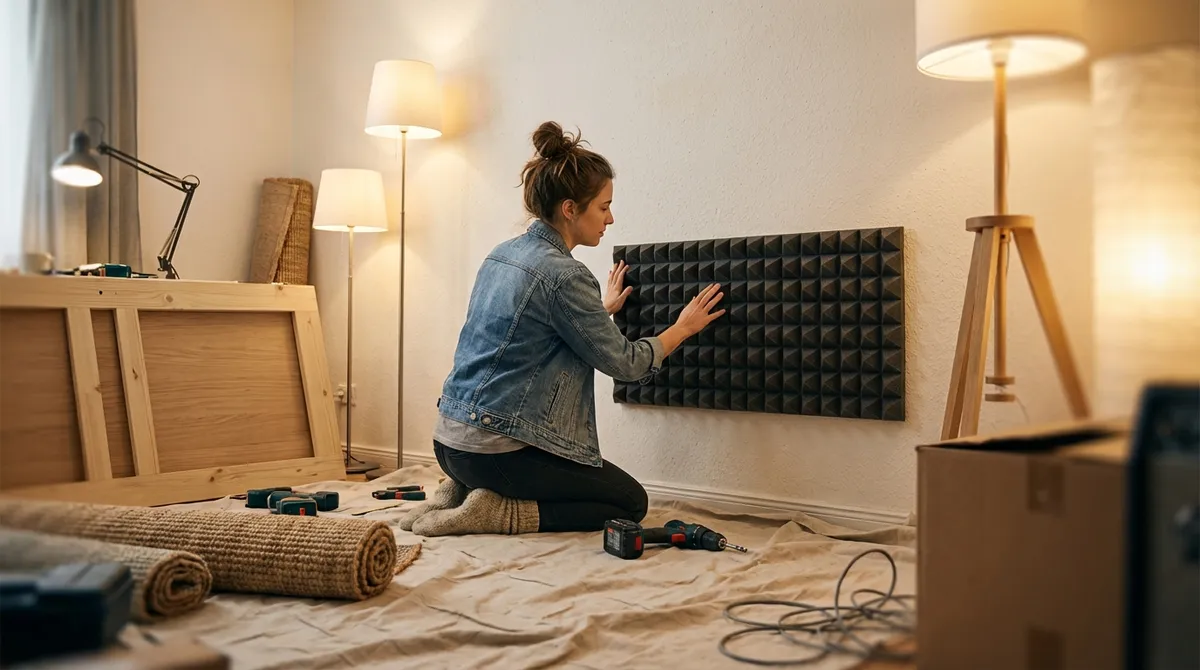
- Add acoustic panels where it actually matters.
- Focus first on the wall directly opposite the main noise source and the wall behind your listening position or bed.
- You can buy ready-made panels or build your own with insulation, fabric, and simple wooden frames.
- Walk test the room.
- Clap or speak at normal volume and listen.
- The goal isn’t total silence but a softer, less “echoey” sound.
Practical tip: You don’t need “soundproof-branded” curtains for basic improvement. Any dense, layered fabric with solid coverage will perform better than thin decorative panels.
Step 4: Tackle a Noisy Shared Wall with a DIY “Mass + Decouple” Layer
If you share a wall with neighbors, a hallway, or a loud room, adding mass and breaking the direct path of vibration makes a big difference. You can do this with an additional drywall layer and specialized mounting hardware.
What you’ll need:
- Resilient channels or sound isolation clips with hat channel
- 5/8" Type X drywall (heavier and denser than 1/2")
- Acoustic caulk
- Drywall screws
- Stud finder, drill/driver, utility knife, drywall saw
How to do it:
- Locate studs and mark them.
- Use a stud finder to mark stud centers across the wall.
- Snap chalk lines or use painter’s tape for reference.
- Install resilient channels or clips.
- If using resilient channels: run them horizontally, perpendicular to studs, spaced according to manufacturer specs (often 16–24" apart).
- If using clips and hat channel: mount clips to studs, then snap hat channel into the clips.
- The goal is to create a “floating” surface for the drywall.
- Hang new drywall over the system.
- Use 5/8" Type X for better sound performance.
- Stagger seams from the existing drywall joints underneath if possible.
- Screw drywall only into the resilient channels/hat channel, not directly into studs.
- Seal all perimeter gaps.
- Leave a small 1/8" gap at floor, ceiling, and corners.
- Fill these gaps with acoustic caulk, not regular caulk.
- Don’t tape the gap to the floor; allow the wall to “float.”
- Finish and paint.
- Tape, mud, sand, prime, and paint as you would any new drywall.
- Remember the performance gain comes mostly from structure and sealing, not the finish coat.
Practical tip: This method works best when you treat the entire wall surface. Partial treatment (just one section) may help a bit but won’t be as impressive for loud neighbors or shared rooms.
Step 5: Soften Impact Noise from Upstairs or Your Own Activities
Impact noise—footsteps, dropped items, chair legs scraping—travels through framing. You can reduce this both from above and below, depending on what’s under the noisy room.
If the noisy room is above you (e.g., apartment or second floor):
- Decouple the ceiling (advanced but DIY-manageable).
- Similar to Step 4, install resilient channels or clips on the ceiling joists.
- Hang 5/8" drywall from the channels.
- Seal all perimeter gaps with acoustic caulk.
- Consider double-layer drywall for extra mass.
- Apply acoustic sealant or damping compound between two layers of 5/8" drywall.
- Stagger seams between layers.
- This adds weight and reduces vibration transfer.
- Seal penetration points.
- Around light fixtures, fans, and vents, use acoustic caulk and putty pads where possible.
- Avoid large open gaps around boxes and penetrations.
If you’re trying to keep your own noise from bothering others (home gym, kids’ playroom, music space):
- Float heavy activity zones.
- Build or buy a small “floating platform” using rubber isolation pads under plywood for weightlifting, drumming, or high-impact exercises.
- Cover with dense foam and durable surface material (like rubber matting).
- Add soft landings.
- Use thick rubber mats where weights or equipment might hit the ground.
- Put felt pads under furniture and chair legs to reduce scraping noise.
- Plan your layout.
- Put the noisiest activities or speakers away from shared walls and directly above load-bearing walls (usually less flexible than long spans of joists).
Practical tip: In many homes, simply adding thick, dense floor covering (rug + pad or rubber mat) in high-traffic areas cuts noise more than expected, especially above finished spaces.
Conclusion
You don’t need a full gut renovation to win against noise. Start with sealing gaps and softening the room, then work up to heavier upgrades like solid doors, extra drywall, and decoupled walls or ceilings if needed. The key is to match your effort to the actual problem: gaps for airborne noise, mass and decoupling for shared walls, and cushioning for impact noise.
Pick one or two of these steps that fit your budget, tools, and time, and tackle them in order of the biggest annoyance. With a weekend of focused work and the right materials, you can turn a loud, echo-filled room into a space that feels calmer, more private, and a lot more livable.
Sources
- [U.S. General Services Administration – Sound Control for Improved Productivity](https://www.gsa.gov/governmentwide-initiatives/sustainability/emerging-building-technologies/published-findings/building-technologies/sound-control-for-improved-productivity) - Overview of sound control strategies in buildings and how they affect comfort and productivity
- [National Research Council of Canada – Guide to Noise Control in Buildings](https://nrc-publications.canada.ca/eng/view/object/?id=c0b1ca93-dbb6-4d22-8e54-fd7f824ac869) - Technical information on airborne and impact sound transmission and building assemblies
- [Green Glue Company – Soundproofing Basics](https://www.greengluecompany.com/understanding-soundproofing) - Plain-language explanations of mass, damping, and decoupling for residential soundproofing
- [United States Department of Energy – Energy Savers: Air Sealing Your Home](https://www.energy.gov/energysaver/air-sealing-your-home) - Guidance on sealing gaps and cracks, which also helps reduce airborne sound leaks
- [U.S. Department of Housing and Urban Development – Noise Guidebook](https://www.hud.gov/program_offices/comm_planning/environment/review/noise/guidebook) - Background on building noise issues, measurement, and mitigation strategies
Key Takeaway
The most important thing to remember from this article is that this information can change how you think about Renovation.