A tired bedroom doesn’t always need a full remodel with new walls, wiring, and weeks of chaos. With a clear plan and a few strategic upgrades, you can turn an out‑of‑date space into a calm, functional room without tearing your house apart. This guide walks you through a realistic, five-step renovation approach: cosmetic changes that make a big impact while staying DIY‑friendly and budget-conscious.
Whether your bedroom feels dark, cramped, or just “off,” these steps will help you tackle the project in order, avoid common mistakes, and finish with a room that actually works for how you live.
Step 1: Define the Room’s Job Before You Buy Anything
Most bedroom “renovation regrets” start with buying decor first and asking questions later. Instead, treat this like a small construction project and define what the room needs to do for you.
Spend 10–15 minutes answering:
- Who uses this room, and how? (Sleep only, work, reading, nursery corner, etc.)
- What’s not working now? (Too dark, no storage, noisy, cluttered, no outlets where you need them.)
- What must stay? (Existing flooring, bed size, built‑ins, window location.)
- What’s your real budget and time frame?
Write down a short list of priorities:
Improve lighting
Add hidden storage
Reduce visual clutter
Make it easier to clean
This list becomes your filter. Every decision—paint color, furniture changes, storage, lighting—should support those priorities. If it doesn’t, skip it.
Practical tips:
- Take “before” photos and rough measurements of all walls, windows, doors, and major furniture.
- Sketch a simple floor plan on paper so you can test layout changes without moving heavy pieces repeatedly.
- Decide up front what work is DIY and what you’ll call a pro for (electrical changes beyond swapping fixtures, moving structural walls, significant window changes).
Step 2: Update Surfaces for Instant Change (Walls, Trim, Doors)
You can change how a bedroom feels—size, brightness, mood—just by updating surfaces. Paint and basic repairs are the fastest way to make an old room look new without major construction.
Walls and ceiling
- Patch dings and cracks with spackle or joint compound, sand smooth, and prime any repairs.
- Pick a low‑VOC paint made for interior walls; it’s better for air quality and usually less smelly.
- To make a small or dark room feel larger, choose a light, neutral color with a warm undertone (e.g., soft beige, warm gray, or off‑white).
- Don’t forget the ceiling: a fresh coat of clean white can make the entire room feel taller and brighter.
Trim and doors
- Clean fingerprints, dust, and old grime off baseboards, door frames, and window trim with a degreaser or mild soap solution.
- Caulk gaps where trim meets wall for a clean, finished look.
- Repaint trim and doors in a semi‑gloss or satin white or off‑white to contrast softly with the walls and resist scuffs.
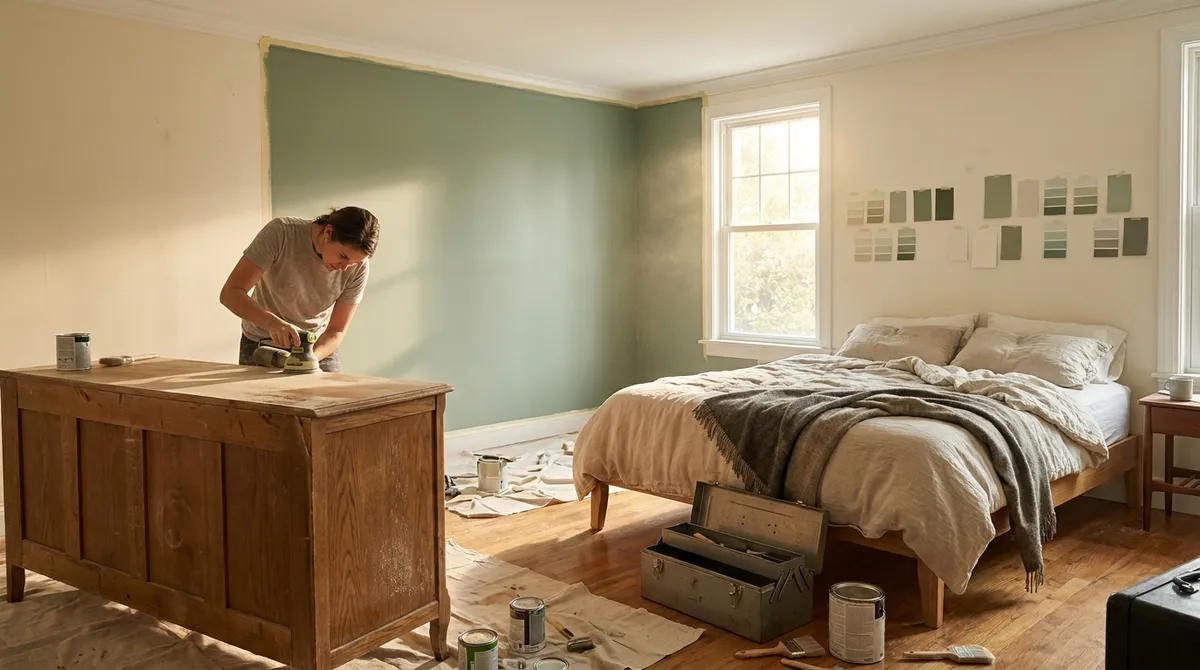
DIY steps for painting a bedroom:
- Move furniture to the center of the room and cover it with plastic or old sheets.
- Remove outlet and switch covers, and tape around trim and windows.
- Cut in around edges with a brush, then roll the main sections.
- Let the first coat dry completely before deciding if you need a second.
- Once dry, remove tape at a low angle to reduce peeling.
Safety and practicality:
- Ventilate: open windows and use a fan to move air out.
- Wear a mask when sanding.
- If your house is older (before 1978 in the U.S.), be cautious about disturbing potential lead paint—especially if sanding heavily or removing old finishes.
Step 3: Re‑Think the Layout for Better Flow and Function
You can’t make a room bigger without major work, but you can make it feel bigger and work better just by rearranging what’s already there. Layout changes are “zero‑demo” renovations that often solve more problems than new furniture would.
Start with the bed
- Place the bed so you can see the door but aren’t directly in the path of the door swing. This often means the headboard on the wall opposite or diagonal to the door.
- Avoid blocking windows if possible; if space is tight, leave enough room for curtains/blinds to function.
- Center the bed on a solid wall with enough space for at least one nightstand.
Plan clear paths
- Keep at least 30–36 inches of walkway where you need to move around the room.
- Don’t put tall furniture right next to doors; it can make the entry feel cramped.
- Ensure closets and drawers can open fully without hitting the bed or other furniture.
Make zones if the room does double duty
- If you work from the bedroom, keep the desk visually separated (for example, on the opposite wall from the bed, or tucked into an alcove).
- Use a rug, small bookcase, or a floor lamp to define a reading corner without adding walls.
- Keep “sleep items” (bed, nightstands, lamps) grouped together and “work items” grouped separately to reduce visual chaos.
Simple DIY layout process:
- Measure all large pieces of furniture (width, depth, height).
- Draw them to scale on graph paper or use a free room‑planning app.
- Test 2–3 layouts before you move anything.
- Start by moving the bed first, then adjust everything else around it.
- Live with a new layout for a few days before deciding if it works.
Step 4: Upgrade Lighting and Outlets for Real-Life Use
Most bedrooms are stuck with a single overhead fixture and maybe one lamp. That’s fine for a spare room, but not if you actually use the space daily. A simple “lighting renovation” is one of the highest-impact, lowest-disruption changes you can make.
Aim for three types of light:
- Ambient light (overall room light) – overhead fixture or ceiling fan with a light kit.
- Task lighting – bedside lamps, reading lights, or desk lamps.
- Accent lighting – softer lights that create a calm mood (wall sconces, strip lights behind the headboard, or a small table lamp on a dresser).
DIY‑friendly upgrades:
- Replace dated ceiling fixtures with modern LED fixtures that diffuse light better and use less energy.
- Add plug‑in wall sconces beside the bed to free up nightstand space (no new wiring required; just mount to the wall and plug in).
- Use smart bulbs or dimmable bulbs with compatible dimmer switches so you can adjust light levels for reading vs. winding down at night.
Outlets and cords:
- Add outlet extenders or surge‑protected power strips with USB ports behind nightstands to handle phone chargers, lamps, and clocks without a cord mess.
- Use cord clips along baseboards and behind furniture to keep wires from hanging visibly.
- If you need new outlets or want to move them, hire a licensed electrician—especially for any work inside walls.
Basic safety checklist:
- Turn power off at the breaker before replacing any light fixtures.
- Use fixtures rated for bedroom or indoor use, and match bulb wattage to the fixture’s limit.
- Don’t overload extension cords or power strips; if you’re daisy‑chaining multiple strips, you’re overdue for proper outlet planning.
Step 5: Build In Storage That Actually Gets Used
Clutter ruins almost every bedroom “after” photo within a month. The solution isn’t more decor; it’s storage that matches how you really live. Think vertically and under-used spaces first, so you don’t have to tear out closets or build new ones.
Closet efficiency upgrades (no demolition)
- Install a second hanging rod below the existing one for shirts and pants if you have unused vertical space.
- Add simple shelf dividers to keep stacks of clothes from collapsing.
- Use a combination of closed bins (for seasonal items) and open baskets (for daily items) along the top shelf.
- Mount a small hook rail on the inside of the closet door for belts, bags, or scarves.
Under‑bed and “dead corner” solutions
- Choose low plastic bins or rolling drawers that fit under the bed for out‑of‑season clothes or linen storage.
- If you’re buying a new bed, consider one with built‑in drawers instead of a traditional frame.
- Turn an awkward corner into a vertical storage tower: a narrow bookcase or open shelving unit can hold baskets, shoes, or folded items.
Nightstands and dressers
- Pick nightstands with drawers or doors, not just open shelves, to hide chargers, books, and everyday items.
- Use drawer organizers in dressers so small items don’t turn into a jumble.
- Keep flat surfaces intentionally minimal: lamp, one or two daily items, and maybe a small tray for keys and glasses.
Simple DIY storage project sequence:
- Empty the closet and drawers completely; group items by category (daily wear, formal, seasonal, sentimental).
- Donate or remove anything you don’t wear or use.
- Measure interior closet dimensions and map where a second rod, extra shelf, or shoe rack could go.
- Install new rods, shelves, or organizers before loading items back in.
- Label bins and baskets so you don’t have to remember what’s where six months from now.
Conclusion
You don’t need to rip your bedroom down to the studs to get a space that feels new and works better every day. By defining the room’s job, updating the visible surfaces, rethinking the layout, improving lighting, and adding smart storage, you can complete a meaningful “renovation” with manageable DIY projects and limited mess.
Tackle these steps in order, and give yourself time between each phase to live in the room and see what’s really working. The goal isn’t a perfect magazine shot—it’s a bedroom that’s easier to sleep in, cleaner with less effort, and built around how you actually use it.
Sources
- U.S. Environmental Protection Agency – Lead in Paint - Guidance on safely working in older homes where lead-based paint may be present
- U.S. Department of Energy – Energy Saver: Lighting Choices - Explains efficient lighting options and benefits of LEDs and controls
- Mayo Clinic – Sleep Environment Tips - Covers how bedroom light, noise, and layout can affect sleep quality
- Harvard T.H. Chan School of Public Health – Home Environmental Health - Research-backed advice on improving indoor environments through low-VOC products and ventilation
- IKEA – Bedroom Planning Ideas - Practical examples of small-space layouts and storage solutions for bedrooms
Key Takeaway
The most important thing to remember from this article is that this information can change how you think about Renovation.