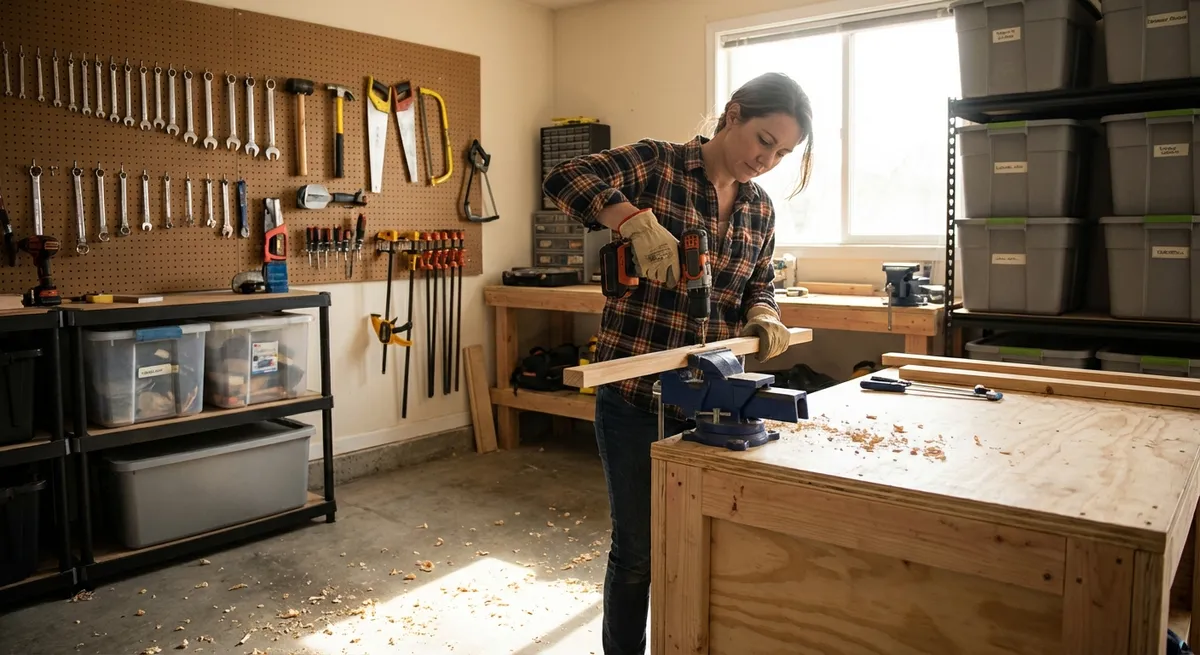
A solid workbench is the backbone of any DIY setup. It keeps your tools organized, gives you a safe surface to work on, and makes every project—from minor repairs to bigger builds—go faster and smoother. You don’t need a professional shop to get there. With some basic tools, a bit of planning, and a weekend, you can build a reliable workbench that fits your space and the way you work.
This guide walks you through planning, building, and outfitting a practical workbench with five clear, step-by-step sections. Each step includes straightforward tips to help you avoid common mistakes and get more out of your tools and equipment.
Step 1: Plan the Right Workbench for Your Space and Projects
Before you buy lumber or grab a saw, define what you actually need from your workbench. A little planning here will save you money, space, and frustration.
Start by measuring your available area. Note any obstructions: doors, garage overhead tracks, outlets, and low-hanging shelves. Ideally, you want enough room to walk fully around the bench on at least two sides, but a wall-mounted bench can work well in tighter spaces.
Next, match the bench height to your main use:
- General DIY and assembly: around 34–36 inches high
- Detailed work (electronics, fine woodworking): closer to 36–38 inches
- Heavy work (planing, hammering): around 32–34 inches for more leverage
A quick test: stand straight, let your arms hang naturally, and bend your elbows to 90 degrees. A comfortable bench height is usually 4–6 inches below your bent elbows.
Decide how mobile you want the bench. If you work in a shared garage, heavy locking casters may be worth it. If you do a lot of forceful work (chiseling, pounding, clamping), a fixed bench bolted to the wall or anchored to the floor will feel more solid and safer.
Finally, choose a basic style:
- Simple 2×4 frame with a plywood top (fast, affordable, rock-solid for most DIYers)
- Wall-mounted “ledger” bench (great for small garages or sheds)
- Modular bench with shelves below and tool storage above (for long-term setups)
Sketch your layout with rough dimensions. You don’t need pro-level drawings—just something clear enough that you’re not guessing once you start cutting.
Step 2: Choose Practical Materials and Essential Tools
The best workbench is the one you can actually build with the tools you already have—or can reasonably get. You don’t need fancy hardwoods or specialty hardware for a strong, long-lasting bench.
For most DIYers, these materials hit a good balance of cost, strength, and ease of use:
- Frame: kiln-dried 2×4 lumber (avoid twisted or badly bowed boards)
- Top surface: 3/4-inch plywood or MDF; plywood is more durable against moisture and impacts
- Lower shelf (optional): 1/2–3/4-inch plywood for tool or storage bins
- Fasteners: 3-inch wood screws or structural screws for the frame, 1 1/4–1 5/8-inch screws to attach the top
- Hardware (optional): corner brackets for extra rigidity, heavy-duty casters if you want mobility
Inspect every board at the store. Look down each edge for bowing and twisting. A straight frame makes building easier, keeps the bench flat, and helps tools (like levels and saws) work more accurately.
Core tools you’ll need:
- Tape measure and pencil
- Speed square or combination square (for accurate 90-degree cuts and marks)
- Circular saw or miter saw (hand saw works, but it’s slower)
- Drill/driver with wood bits and screw-driving bits
- Clamps (even two basic clamps can make assembly simpler and safer)
- Safety glasses and hearing protection
If you don’t own a saw, many home centers can make straight cuts for you. Bring your measurements and have them cut the 2×4s and plywood to length. Just confirm their cut limits and accuracy before you plan anything complex.
Step 3: Build a Strong, Square Frame
A solid frame is what keeps your bench from wobbling and your tools safe. Take your time on squareness and alignment—everything else depends on it.
Cut your legs and rails
- For a typical bench, you’ll need four legs (2×4s) cut to your desired height minus the top thickness (for a 36-inch bench with a 3/4-inch top, cut legs to 35 1/4 inches). - Cut the long rails (front and back) to match your bench length. - Cut the short rails (sides) to the desired bench depth (subtract 3 inches if you’re fitting between legs at the corners).
Assemble the top frame rectangle
- Lay two long rails and two short rails on a flat surface in a rectangle. - Use a speed square at each corner to ensure they’re 90 degrees. - Pre-drill and screw each corner together with two 3-inch screws per joint. - Measure diagonally from corner to corner—if both diagonals match, the frame is square. Adjust until they do.
Attach the legs
- Stand the frame up on its side. - Position each leg inside the corners so the top of the leg is flush with the top of the frame. - Clamp if you can, then pre-drill and drive at least two 3-inch screws through the frame into each leg on two adjacent sides. - Make sure the legs are all oriented the same way (wide face matching the load direction) for stability.
Add lower supports
- Decide how high you want a lower shelf (commonly 8–12 inches off the floor). - Cut and install lower long and short rails between the legs at this height, just like the top frame. - This creates a rigid box and gives you a place for a lower shelf to store heavier tools or bins.
Check for wobble and fix now
- Set the frame upright on a reasonably flat surface. Push from different sides. - Minor rocking can be fixed with adjustable feet, shims, or by slightly trimming a long leg. - If it feels loose, add diagonal braces at the back or sides with scrap 2×4s to stiffen it.
Taking accurate measurements, keeping everything square, and using enough screws are the main ingredients of a frame that doesn’t flex or shake, even under heavy use.
Step 4: Install and Protect the Work Surface
Your work surface takes all the abuse—drilling, clamping, spills, dropped tools—so build it to handle real-world use.
Cut and fit the top
- Cut your 3/4-inch plywood to the same size as your top frame, or slightly larger if you plan to trim flush later. - Dry-fit the panel on the frame to confirm fit and overhang. A small overhang (1/2–1 inch) on the front and sides is useful for clamping.
Secure the top properly
- Apply a line of construction adhesive or wood glue on the frame if you want a permanent top. - Set the panel in place and clamp if possible. - From above, pre-drill and drive 1 1/4–1 5/8-inch screws every 8–12 inches along the perimeter and across the supports. - Keep screws back from the edges slightly to avoid splitting.
Add a lower shelf (optional but highly recommended)
- Cut a 1/2–3/4-inch plywood panel to fit inside the lower frame. - Drop it onto the lower rails and secure it with shorter screws from above. - Use this area for toolboxes, power tools, and storage bins to keep your main top clear.
Protect and finish the surface
- Lightly sand the top with 120–150 grit to knock down splinters and sharp edges. - Seal with a few coats of polyurethane, water-based clear finish, or even boiled linseed oil to add some moisture resistance and easier cleanup. - Avoid a glass-smooth, slippery finish—a slightly matte surface helps keep materials from sliding around.
Plan for abuse, not perfection
- Don’t obsess over a flawless top. This is a work surface; it will get scratched and drilled into. - If you expect a lot of heavy-duty work, consider a replaceable sacrificial layer, like a thin MDF sheet screwed on top that you can swap out later.
A durable, slightly grippy, and easy-to-clean surface will make every project—cutting, gluing, layout, assembly—simpler and more enjoyable.
Step 5: Add Smart Tool Storage and Useful Accessories
Once the bench is built, you can turn it into a true DIY station by organizing your most-used tools and adding a few simple upgrades that make projects go faster and safer.
Mount a power strip within reach
- Attach a heavy-duty, surge-protected power strip to the front or side of the bench. - Keep the cord out of your main work area and route it along the wall if possible. - This cuts down on tripping hazards and makes swapping corded tools much easier.
Use pegboard or a tool rail above the bench
- Mount pegboard or a French cleat system on the wall behind the bench if space allows. - Hang frequently used tools: measuring tape, squares, screwdrivers, pliers, utility knives, and basic wrenches. - Label outlines or locations so things are easy to put back and find later.
Create “zones” on and under the bench
- Keep cutting tools (saws, blades) in one area, fastening tools (nailers, drills, screws) in another. - Use labeled bins or drawers for consumables like screws, anchors, sandpaper, and glue. - Store heavy tools low (on the shelf) to lower the center of gravity and make the bench more stable.
Add clamping and work-holding options
- Install inexpensive clamp racks on the side of the bench to keep clamps handy. - Consider drilling a few strategically placed dog holes (3/4-inch) in the top for bench dogs or hold-downs if you do woodworking. - Even a simple front overhang with a couple of F-clamps can dramatically improve your ability to hold work securely.
Improve lighting and visibility
- Use an LED shop light or articulated task light directly over the work surface. - If your bench is against a wall, a light bar under an overhead shelf can provide shadow-free lighting. - Good lighting reduces mistakes, improves cut accuracy, and helps you spot safety issues faster.
When you can quickly find the right tool, plug in safely, hold your work securely, and see clearly, your bench becomes more than just a table—it becomes a real, efficient home base for every project.
Conclusion
A well-built workbench transforms how you use your tools and how confident you feel tackling home projects. By planning to fit your space, using straightforward materials, building a solid frame, protecting the top, and adding smart storage and accessories, you end up with a bench that supports almost any DIY task you throw at it.
You don’t need a full workshop to work like you have one. Start with the structure outlined here, then keep refining over time as you learn what you reach for most. Your workbench can grow with your skills—and make every repair, build, and improvement easier and more enjoyable.
Sources
- U.S. Department of Labor – OSHA Hand and Power Tool Safety - Official safety guidelines for using tools in a shop or home environment
- Fine Woodworking – How to Build a Workbench - Example of practical workbench construction and layout considerations
- Family Handyman – DIY Workbench Plans - Step-by-step workbench project with clear photos and dimensions
- Lowe’s – How to Build a Workbench - Retailer guide covering materials, cuts, and assembly basics
- Home Depot – Selecting Plywood - Overview of plywood types and thicknesses relevant to workbench tops and shelves
Key Takeaway
The most important thing to remember from this article is that this information can change how you think about Tools & Equipment.