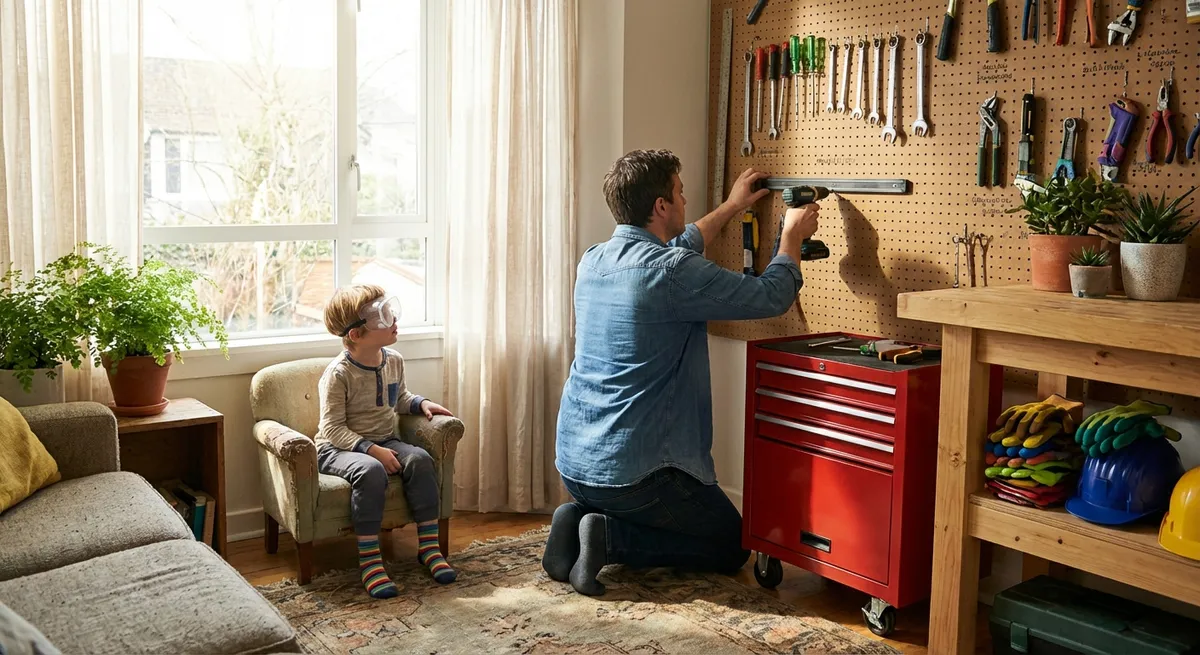
Even if you don’t have a full garage or workshop, you can still have a safe, efficient place to store and use your tools. A small, well-organized “tool corner” makes every DIY job faster and less stressful—and it can fit in a basement, hallway, spare room, or even a large closet. This guide walks you through exactly how to plan, set up, and maintain a compact tool corner that actually works for real projects.
Know Your Space and Your Projects
Before you buy anything, you need to match your setup to the space you actually have and the work you actually do. This prevents wasted money on storage that doesn’t fit or tools you never use.
Start by choosing a spot that’s:
- Dry (no obvious leaks or damp walls)
- Off the main traffic path
- Near an outlet if you use power tools
- Away from kids’ play areas and pet zones
- 5–10 tools you reach for most often
- 3–5 types of projects you do regularly
- The biggest, bulkiest tools you own (shop vac, miter saw, compressor, etc.)
Look at the kinds of projects you do (or want to do). Do you mostly hang shelves and fix small things? Or are you cutting lumber and using power saws? Write down:
This list will drive your layout. Heavy tools need ground-level space. Everyday tools need easy, front-and-center access. Rarely used items can live on higher shelves or in the back.
Step 1: Create a Safe, Stable Work Surface
A solid work surface is the backbone of a functional tool corner. It doesn’t need to be fancy, but it must be stable and safe.
- Measure your available wall width and depth.
- Allow at least 24 inches of depth for a comfortable work surface.
- Ensure you can still walk past safely; aim for at least 30 inches of clearance.
- Secure the bench to the wall if possible.
- Find studs with a stud finder and use appropriate lag screws or structural screws.
- Avoid anchoring only into drywall; it will not safely handle heavy loads or force from clamping.
- Check for level and stability.
- Use a spirit level on the surface.
- Press on the front corners and sides; if it rocks or flexes, add shims under the legs or tighten all fasteners.
- Protect the surface for long-term use.
- For wood tops, apply a polyurethane or oil finish so glue and spills don’t soak in.
- For light-duty desks, add a sacrificial sheet of ½" plywood you don’t mind drilling or cutting into.
Choose the work surface style that fits your space:
- Freestanding workbench: Best for basements or garages; look for steel or solid wood frames with a 500+ lb load rating. - Wall-mounted fold-down bench: Ideal for small spaces or shared rooms; folds up when not in use. - Repurposed furniture (solid desk or table): Fine for light to medium projects if it doesn’t wobble.
A safe, solid surface lets you clamp workpieces, drill without shaking everything, and avoid dangerous tool slips.
Step 2: Build an Efficient Vertical Tool Wall
Vertical space is your best friend in a small tool corner. A well-planned wall keeps tools visible and easy to grab—no more digging through random boxes.
- Choose a wall system: pegboard, slatwall, or French cleats.
- Pegboard (hardboard or metal): Budget-friendly and flexible; great for hand tools.
- Slatwall panels: Stronger and cleaner-looking; good for heavier items and modular hooks.
- French cleats (angled wood strips): Very strong and customizable; excellent for DIY tool holders.
- Install the backing correctly.
- For pegboard: install on furring strips (1x2s) over studs so hooks can go through and lock; don’t mount flush to the wall.
- For cleats or slatwall: secure directly into studs or use heavy-duty anchors rated for the expected load.
- Lay out your tools before hanging anything.
- Place your frequently used tools on the table and roughly group them:
- Measuring & marking (tape, square, pencil, level)
- Cutting (handsaws, utility knife, snips)
- Fastening (screwdrivers, drill bits, drivers, wrenches)
- Gripping & striking (pliers, clamps, hammers)
- Arrange these groups on the wall where your hand naturally reaches from your standing position at the bench.
- Mount tools with future changes in mind.
- Use hooks, small shelves, and simple DIY holders you can move around.
- Leave a bit of empty space so you can add tools later without redoing the whole wall.
- Label outlines or sections for quick return.
- Draw tool outlines on pegboard with a marker, or label sections (e.g., “Measuring,” “Drilling”).
- This makes cleanup faster and helps you instantly see what’s missing.
A good tool wall works like a visual checklist: if a tool isn’t there, you know it’s still somewhere else before you call a job “done.”
Step 3: Set Up Smart Storage for Power Tools and Accessories
Power tools and their accessories can easily turn into a mess of tangled cords, missing batteries, and lost bits. A simple, planned system saves time and keeps these tools safer.
- Designate a specific power tool zone.
- Use a lower shelf, cabinet, or rolling cart near your bench.
- Keep the power tools stored at or below chest height for easier lifting and to reduce drop risk.
- Create a dedicated charging station.
- Install a power strip (with surge protection) on the wall or under a shelf.
- Add small trays or bins for batteries and chargers; label each by tool brand/type.
- Keep chargers off the floor to avoid dust and accidental kicks.
- Match each tool with its accessories.
- Drill/driver → case or bin with bits, drivers, and extra batteries.
- Circular saw → bin or file box for blades and safety glasses.
- Multi-tool → pouch or small box with blades and sanding pads.
- Label each bin clearly with the tool’s name and main use.
- Use simple cord management.
- Wrap cords loosely using Velcro straps; don’t over-tighten and stress the cord.
- Hang coiled cords on hooks, not just tossed in a crate—this reduces kinks and damage.
- Store heavy tools low, light tools higher.
- Heaviest tools (miter saws, compressors, sanders) live on the floor or lowest shelf.
- Lighter tools (drills, sanders, detail tools) can go on middle shelves or the bench wall.
When every power tool has a “home” that includes its bits, blades, and batteries, you stop wasting time hunting and start actually doing the work.
Step 4: Make Safety Gear and Cleanup Tools Non-Negotiable
A functional tool corner is also a safety and cleanup corner. If safety gear and cleanup tools are annoying to get to, you’re less likely to use them.
- Create a visible safety station.
- Hang a small shelf or organizer at eye level near the entrance to your tool corner.
- Stock it with:
- Safety glasses
- Hearing protection (earmuffs or plugs)
- Dust masks or respirators (appropriate to your projects)
- Work gloves
- Store fire and first-aid equipment within reach.
- Mount a small Class ABC fire extinguisher on the wall outside your most crowded area.
- Keep a basic first-aid kit on a shelf or in a cabinet near the exit to the space.
- Dedicate a spot for dust control and cleanup.
- Keep a shop vac or compact vacuum in or near the corner with a long hose.
- Store a stiff broom, dustpan, and a few rags or shop towels where you can grab them quickly.
- If you sand or saw indoors often, consider a small, portable air filter or box fan with a furnace filter attached.
- Use containers for chemical and finish storage.
- Store paints, solvents, and finishes in a ventilated area, preferably in a metal cabinet or on a dedicated shelf.
- Keep them away from ignition sources like heaters, pilot lights, and direct sunlight.
- Make sure all containers are labeled and tightly closed.
- Build a habit of a 5-minute cleanup.
- At the end of each work session:
- Return every tool to its wall or bin.
- Vacuum or sweep the bench and floor.
- Empty the shop vac or filter when it’s getting full.
When safety and cleanup gear are integrated into your layout, you’re far more likely to use them—and your tool corner stays usable instead of slowly turning into a hazard zone.
Step 5: Maintain and Upgrade Your Setup Over Time
A tool corner is not a one-time project; it should evolve as your skills, tools, and projects change. A little ongoing maintenance keeps it efficient instead of cluttered.
- Schedule a quick monthly checkup.
- Tighten any loose screws or bolts on your bench and shelves.
- Inspect power cords for cuts or exposed wires; set damaged items aside for repair or replacement.
- Check that your fire extinguisher and first-aid kit are accessible and in date.
- Audit your tools every 3–6 months.
- Remove tools you haven’t used in the last year unless they’re truly specialized.
- Donate or sell duplicates or junk tools that never work right.
- Note any tools that are always missing or borrowed—these may need permanent dedicated spots.
- Refine your layout based on how you actually work.
- Move tools you reach for constantly to “prime real estate” at eye level near the center.
- Shift rarely used tools higher, lower, or further to the sides.
- Add small trays or magnetic strips where small parts tend to pile up.
- Upgrade storage before adding major new tools.
- Before buying a new big tool (like a miter saw or table saw), plan:
- Where it will live
- How you’ll store its accessories
- How you’ll keep the work area safe and clear around it
- If space is tight, consider folding or benchtop versions of larger tools.
- Keep a simple “improvement list” on the wall.
- Tape a notepad or whiteboard to the side of a cabinet.
- Whenever something annoys you (not enough light, nowhere to put clamps, missing pencil), jot it down.
- Once a month, knock out one or two of those small improvements.
Over time, these small tweaks turn your tool corner from “good enough” into a seriously efficient home base for DIY work.
Conclusion
A safe, smart tool corner doesn’t require a huge garage or a big budget. By building a solid work surface, using your wall space effectively, organizing power tools and safety gear, and doing simple ongoing maintenance, you can create a compact setup that makes every project easier. Start small: pick your corner, install a stable bench, and get your most-used tools on the wall. Once that foundation is in place, you can refine and expand it as your skills and projects grow.
Sources
- [U.S. Consumer Product Safety Commission – Power Tool Safety Tips](https://www.cpsc.gov/safety-education/safety-guides/tools-and-home-improvement/power-tool-safety-tips) - Official safety guidance for using and storing power tools at home
- [OSHA – Hand and Power Tools](https://www.osha.gov/hand-power-tools) - Workplace safety standards that also apply to safe DIY tool handling and setup
- [Family Handyman – Garage Workshop Ideas](https://www.familyhandyman.com/project/garage-workshop/) - Practical examples of small workshop layouts and storage solutions
- [This Old House – Build a Workbench](https://www.thisoldhouse.com/woodworking/21018746/how-to-build-a-workbench) - Step-by-step guidance and structural considerations for solid work surfaces
- [UL Solutions – Fire Extinguisher Selection and Placement](https://code-authorities.ul.com/about/fire-extinguisher-selection-installation-and-maintenance/) - Best practices for choosing and placing fire extinguishers in home work areas
Key Takeaway
The most important thing to remember from this article is that this information can change how you think about Tools & Equipment.