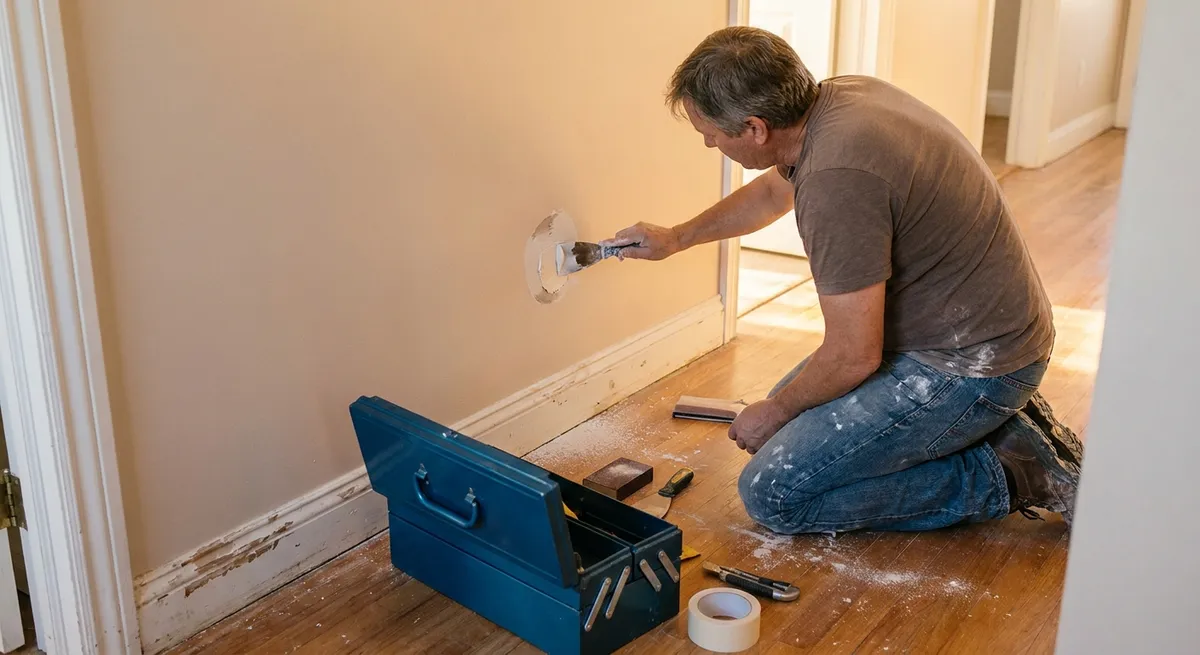
Drywall dings, nail pops, and random holes happen fast—moving furniture, kids’ toys, hanging shelves that didn’t work out. You don’t need a contractor for these, just a clear plan and a few basic tools. This guide walks you through practical, step‑by‑step DIY drywall fixes so your walls look solid again and are ready for paint.
Know Your Wall Damage Before You Start
Not all drywall damage is the same, and treating every problem the same way is how patches end up lumpy, cracking, or obvious under paint.
Most common types of damage in homes:
- Nail pops: Small, round bumps where drywall nails or screws push through the surface.
- Hairline cracks: Fine, usually straight or diagonal cracks near corners, windows, or doors.
- Small holes (pinholes to 1"): From nails, screws, and small anchors.
- Medium holes (1"–6"): From doorknobs hitting the wall, accidents, or removed fixtures.
- Larger holes or damage: Bigger than 6", often from plumbing/electrical work or impact.
- Tiny damage = patching compound only.
- Medium damage = patch with backing or a repair patch.
- Large damage = cut out and insert a new drywall piece.
General rule:
Before you start any repair, check:
- Is the area dry? Fix leaks first—never patch over moisture or mold.
- Is the wall secure? If the drywall flexes a lot, you may need to add or find a stud/screw before patching.
- Is there anything behind the wall? For big cuts, know where wires and pipes run (especially around kitchens, bathrooms, and outlets).
Once you know what you’re dealing with, you can choose the right repair approach and materials.
Step 1: Gather Tools and Materials That Actually Work
You don’t need a professional truck full of tools. A small, focused kit will handle most drywall repairs around the house.
Basic tools:
- 2"–4" putty knife (for small holes and tight spots)
- 6"–8" taping knife (for blending and feathering larger patches)
- Utility knife with fresh blades
- Sanding sponge or sanding block (120–220 grit)
- Drywall saw (for cutting out larger damaged sections)
- Drill or screwdriver (for securing loose drywall)
- Dust mask and safety glasses
Materials you’ll actually use:
- Pre‑mixed joint compound (a “lightweight all‑purpose” is ideal for most DIYers)
- Drywall repair patches (self‑adhesive mesh patches for holes about 1"–6")
- Paper or fiberglass mesh joint tape (for cracks and seams)
- Drywall screws (1 1/4" or 1 5/8" for standard 1/2" drywall)
- Small piece of drywall (for larger holes if needed)
- Primer (stain‑blocking or drywall primer)
- Matching paint (leftover from previous projects or freshly matched at a paint store)
Prep tips:
- Lay down an old sheet or drop cloth—drywall dust travels.
- Have a trash bag or box nearby for old tape, loose material, and used sandpaper.
- If you’re doing repairs in multiple rooms, move in a loop: apply compound in room 1, go to room 2, etc., so drying time feels shorter.
Step 2: Fix Nail Pops and Small Holes the Smart Way
Nail pops and small holes are quick wins if you prepare them correctly. The key is to secure the drywall, then patch.
Nail pops
- Find the stud.
Press lightly around the pop. You’re over a stud in most cases. Use a stud finder if you have one.
- Sink the old fastener.
Don’t pull the nail out; that can damage the paper. Use a hammer to tap it slightly below the surface. For screws, drive them in just below the surface without breaking the paper.
- Add a new screw nearby.
Drive a drywall screw 1"–2" above or below the pop into the stud. Sink it slightly below the surface—just enough to dimple the paper, not tear it.
- Apply first coat of compound.
Use a 2"–4" putty knife to spread a thin layer of joint compound over the area, covering both fasteners. Scrape off excess so it’s flat.
- Second coat and sand.
After the first coat dries, add a slightly wider second coat. When that dries, sand lightly until smooth and flush with the wall.
Small holes (nail and screw holes)
- Clean the hole.
Lightly scrape off loose paint or drywall around the hole with a utility knife or putty knife.
- Fill with compound.
Press joint compound into the hole with a putty knife, then smooth it flat. For deeper holes, you may need two thin applications instead of one thick one.
- Let dry fully.
Don’t rush this. If the compound still looks dark or feels cool, it’s not dry.
- Sand and touch up.
Sand flush with the wall, then wipe away dust with a dry cloth before priming and painting.
Pro tip: Avoid using thick, stiff “spackle” in a huge glob. Multiple thin coats of joint compound crack less and sand easier.
Step 3: Repair Hairline Cracks So They Don’t Come Back
Hairline cracks, especially near corners or above door frames, tend to reappear if you just fill them. The fix is to reinforce them with tape, not just compound.
- Open up the crack slightly.
Use a utility knife to gently widen the crack into a narrow V‑shape. This gives the compound something to grab.
- Remove loose material.
Scrape away flaking paint and dust with your putty knife. A clean surface bonds better.
- Apply a thin coat of compound.
Spread a narrow layer of joint compound along the crack with your 2"–4" knife.
- Embed tape in the compound.
- For straight cracks, fiberglass mesh tape is easier for beginners.
- For corners, paper tape works better and folds neatly.
Press the tape into the wet compound, then smooth it out with your knife, removing excess compound and air bubbles.
- Apply second and third coats.
Once the first coat dries:
- Apply a second coat that’s wider than the first by about 1" on each side.
- After that dries, add a third, even wider coat if needed to fully blend the patch into the wall.
- Sand and inspect.
Use a fine‑grit sanding sponge. Run your hand across the area—if you can feel a ridge, sand more lightly and extend the patch by a bit.
Pro tip: Don’t oversand to the point that you expose the tape. If you hit tape, stop, wipe dust away, and add a skim coat of compound.
Step 4: Patch Medium Holes with a Drywall Repair Patch
For holes roughly 1"–6" in diameter (like from a doorknob or removed wall anchors), a self‑adhesive drywall repair patch is quick and strong enough for most interior walls.
- Prep the damaged area.
Trim loose or crumbling drywall around the hole with a utility knife. You want a clean edge without hanging paper.
- Apply the patch.
Peel the backing from the self‑adhesive patch and center it over the hole. Press firmly so the mesh sticks flat to the wall with no bubbles or lifted edges.
- First coat of compound.
Using a 6" taping knife, apply a thin coat of joint compound over the entire patch and 1"–2" beyond its edges. Press compound into the mesh so it fills the texture.
- Feather the edges.
The goal is a gradual transition. Keep the center slightly higher and the edges thin. Scrape off extra compound from the outer edges to avoid a noticeable ridge.
- Second and optional third coat.
After the first coat dries:
- Sand lightly, just enough to knock down ridges.
- Apply a wider, thinner second coat.
- For very visible areas, a third, even wider skim coat can help hide the patch completely.
- Final sand and check under light.
Shine a work light or flashlight along the wall at an angle. This will highlight imperfections and humps that regular overhead lighting hides. Sand as needed.
Pro tip: When in doubt, go wider and thinner with each coat. Thinner coats reduce cracking and sanding time; wider coats hide the repair lines better.
Step 5: Blend, Prime, and Paint for an Invisible Finish
Even a perfect patch looks bad if you skip proper priming and painting. Fresh joint compound absorbs paint differently than the surrounding wall, and un‑primed patches often “flash” (show through) under light.
- Remove all dust.
After your final sanding, wipe the area with a dry microfiber cloth or lightly vacuum with a brush attachment. Dust left behind will ruin the finish.
- Prime the repaired area.
- Use a quality drywall or stain‑blocking primer.
- For small patches, you can spot‑prime; for many patches in one wall, consider priming the entire wall for a more even finish.
- Let primer fully dry.
Follow the time on the can. Paint applied too soon can peel or streak.
- Match your paint correctly.
- If you have the original paint can, you’re set. Stir it well.
- If not, carefully chip a quarter‑sized paint sample from an inconspicuous spot and have it color‑matched at a paint store.
- Use the right roller and technique.
- Match the roller nap to your wall texture (smooth walls usually use 3/8" nap; more textured walls can use 1/2" or more).
- Feather the edges of your paint out past the repaired area so it blends into the existing paint.
- Step back and check in different lighting.
Look at the wall during the day and at night with lights on. Tiny flaws are often only visible under certain angles.
Pro tip: If your existing wall paint is old, faded, or stained, it may be easier and better‑looking to repaint the whole wall instead of trying to blend just the patched spots.
Conclusion
Getting rid of wall scars doesn’t require a contractor—just patience, basic tools, and the right steps. By securing loose drywall, using tape where it matters, choosing the right patch for the hole size, and taking priming and painting seriously, you can make most drywall damage disappear.
Start with a small, out‑of‑the‑way repair to build confidence. Once you see how manageable these projects are, you’ll be able to walk through your home and systematically erase the dings, dents, and cracks that have been bothering you for years.
Sources
- USG Corporation – Joint Compound and Drywall Repair Basics - Explains different types of joint compound and their uses in drywall finishing
- Sherwin-Williams – How to Repair Drywall and Fix Holes - Step-by-step guidance on patching and painting drywall repairs
- Lowe’s – How to Patch and Repair Drywall - Visual overview of tools, materials, and patching techniques for various hole sizes
- Home Depot – How to Fix Cracks in Drywall - Focused instructions for reinforcing and repairing drywall cracks
- US EPA – Lead in Paint, Dust and Soil - Important safety information if you’re working on older painted surfaces that may contain lead
Key Takeaway
The most important thing to remember from this article is that this information can change how you think about DIY Projects.