A lot of DIY frustration doesn’t come from the work itself—it comes from fighting your tools. You waste time hunting for a bit, swapping batteries, realizing you bought the wrong blade, or discovering your “precision” level is anything but. This guide walks you through a practical, repeatable workflow for setting up and using your tools so every project runs smoother, safer, and faster.
We’ll cover five clear, step‑by‑step processes DIYers can actually use: choosing the right tool for the job, setting up a basic tool station, preparing tools before a project, using them safely and efficiently, and closing down so everything’s ready next time.
Step 1: Match the Tool to the Job (Before You Buy or Borrow)
Most mistakes start here—using the wrong tool, or the right tool in the wrong way.
- Define what you’re actually doing, not just the category.
Don’t just think “I’m hanging shelves.” Break it down: drilling into drywall or masonry? Anchors needed? Fastening into studs or hollow wall? Each detail changes the tool choice.
- Pick by material first, then by power.
- Wood: circular saw, jigsaw, miter saw, drill/driver.
- Masonry: hammer drill, masonry bits, impact driver with masonry-rated fasteners.
- Metal: metal-cutting blades or discs, step bits, files.
Once you know the material, decide: hand tool, corded, or cordless—based on how much material you’ll work with and how often.
- Check compatibility with what you already own.
If you’re buying cordless, stick to one battery platform (e.g., all DeWalt 20V, all Milwaukee M18, etc.). This saves money and space and keeps your charging setup simple.
- Start with “good enough” instead of “top of the line.”
For occasional DIY: a solid mid-range drill/driver, circular saw, and orbital sander will cover a lot of ground. Spend more only where precision or safety really matters (ladders, electrical testers, stud finders).
- Verify the tool can handle your environment.
- Tight spaces? Look for compact or right-angle tools.
- Dusty or outdoor work? Look for sealed switches, good dust collection attachments, or wet-rated tools.
- Overhead work? Lighter tools and good grip matter more than raw power.
- Read the spec sheet, not just the box claims.
Look for: RPM (speed), torque, blade size, maximum cut depth, battery amp-hours (Ah), and duty cycle (how long it can run before it needs rest). Match these to what your project actually demands.
- Have a “fallback” option in mind.
If the tool you planned to use isn’t strong enough or doesn’t fit where you need it, know what you’ll switch to: a hand saw, oscillating multi-tool, or a different bit or blade.
Step 2: Build a Simple, Efficient Tool Station (Even in a Small Space)
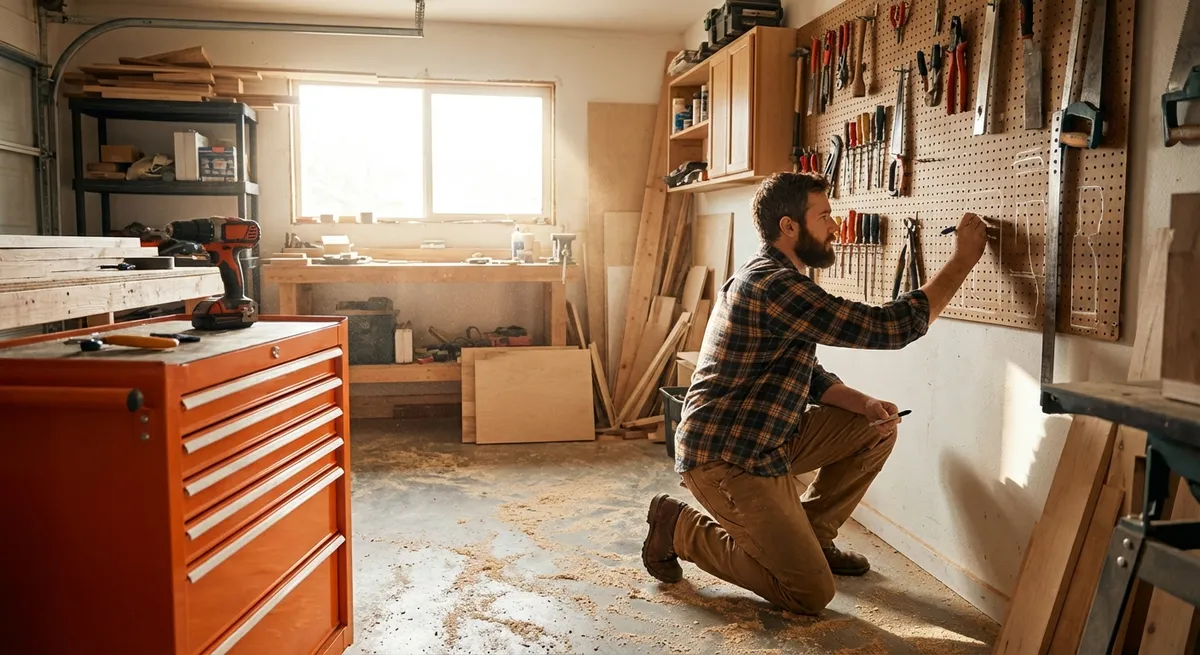
You don’t need a full workshop. You do need one predictable place for your gear.
- Choose a primary zone, not “wherever it fits.”
A corner of a garage, a closet with shelves, or a section of basement works. The key: tools always return to this same zone, even if you work somewhere else.
- Separate your station into clear “layers.”
- Wall or pegboard: frequently used hand tools (hammer, tape measure, screwdrivers, level).
- Bench or shelf: chargers, safety gear, small bins for fasteners.
- Lower shelves or totes: power tools in cases, extra blades, sanding discs, drill bits.
- Use one visual system and stick to it.
Labels, color-coded tape, or simple marker on boxes is enough. Example system:
This makes grabbing the right box faster when you’re in a hurry.
- Create a “staging tray” for active projects.
Use a shallow bin or tray as your project basket. Before you start work, load it with: the main tool, backup bits or blades, screws, anchors, pencil, tape measure, and a small magnet tray for fasteners. This prevents constant trips back to the station.
- Mount or park chargers in one dedicated spot only.
Plug strips or a small shelf with hooks for cords works well. Keep all battery chargers here and nowhere else. That way, “Where’s the battery?” always has the same answer.
- Reserve one drawer or small tote for safety gear.
Store safety glasses, hearing protection, dust mask/respirator, work gloves, and a first-aid kit together. If it’s easy to grab, you’re more likely to use it.
- Make teardown fast so you actually do it.
End-of-day rule: everything used goes back into the tool station, not left where you last used it. If that’s overwhelming, use a “parking bin” to collect tools during work, then put them away in one trip.
Step 3: Pre-Project Tool Prep That Prevents Mid-Job Headaches
Five to ten minutes of prep can save an hour of swearing and rework.
- Lay out the project steps and match tools to each one.
Write the sequence in simple verbs: measure → mark → cut → drill → fasten → finish. Under each step, quickly list what tool and accessory you’ll use (bit, blade, sandpaper, etc.).
- Check blades, bits, and abrasives before you start.
- Blades: look for missing teeth, warping, or burn marks.
- Bits: check for bent shanks, dull tips, or chips.
- Sandpaper: toss anything clogged or torn.
If you’re unsure, do one test cut or hole on scrap material.
- Install the right accessory and set it correctly.
- On saws: confirm blade direction matches the arrow on the guard.
- On drills: confirm bit is centered in the chuck and tightened fully.
- On sanders: attach paper or pads flat with no wrinkles.
Misinstalled accessories are one of the fastest ways to ruin material or hurt yourself.
- Test the tool on scrap that matches your real material.
Use off-cuts or a hidden area of the workpiece. Check for: tear-out, burning, slow cutting, or wandering drill bits. If something looks off, adjust speed, pressure, or switch to a better accessory before touching your real work.
- Charge and rotate batteries intentionally.
For cordless tools, charge all packs the day before, then:
- Mark them 1, 2, 3 with a marker.
- Start with #1 in the tool, #2 on the charger, #3 as backup.
Rotate in order so you’re not constantly running one battery to death.
- Set up basic dust and debris control.
- Connect a shop vac if your tool supports it.
- Put a drop cloth under drywall or wood cutting areas.
- For drilling overhead, hold an open plastic container or folded paper under the bit to catch dust.
This saves a lot of cleanup later and protects your lungs.
- Do a quick safety walk-around of your workspace.
Look for: trip hazards from cords, unstable ladders, flammable materials near sparks, or poor lighting where you’re about to cut or drill. Fix these now, not after an accident.
Step 4: Use Your Tools Safely and Efficiently, Not Just “Harder”
Most DIYers push too hard, run too fast, and let the tool dictate the result. Reverse that.
- Let the tool do the work—control speed and pressure.
- If a saw is burning the wood, you’re either moving too slow, using a dull blade, or running at the wrong speed.
- If a drill bit is smoking or squealing, back off, slow down, or step up bit sizes in stages instead of forcing one large bit.
- Set depth and stops whenever possible.
Use depth stops on drills, adjustable fences on saws, and bevel gauges. A few seconds setting a stop helps you make repeatable, accurate cuts and holes without constant measuring.
- Secure the workpiece before you start.
Clamp boards, doors, or trim instead of trying to hold them with one hand and operate the tool with the other. For awkward shapes, use scrap wood blocks and clamps to create stable “clamping points.”
- Work in a comfortable body position.
- Keep your weight centered, feet apart, and your line of sight clear of the blade or bit.
- Avoid reaching across the tool path. If you can’t reach comfortably, reposition the work or yourself.
Awkward posture leads to mistakes and accidents.
- Use the right personal protective equipment (PPE) for the tool.
- Drilling, cutting, grinding: safety glasses and hearing protection.
- Sanding, drywall, concrete work: dust mask or respirator.
- Angle grinders and metal cutting: face shield plus glasses, gloves, no loose clothing.
Put PPE on before you plug in or pull the trigger, not after the first spark.
- Take short breaks when tools or batteries heat up.
If a tool housing is getting hot or a battery feels very warm, stop for a few minutes. This extends tool and battery life and helps prevent overload shutdowns mid-task.
- Watch and listen for early signs of a problem.
Unusual vibration, burning smells, loss of power, or sudden noise changes usually mean: dull accessory, misalignment, or mechanical issue. Stop, inspect, and correct before going further.
Step 5: End-of-Project Routine So Your Tools Are Ready Next Time
Most “tool problems” at the next project are just leftovers from the last one.
- Power down and disconnect everything first.
Unplug corded tools and remove batteries from cordless ones before you clean or change accessories. This sounds basic, but skipping it is how accidental starts happen.
- Clean as if you’re putting the tool away for a year.
- Blow off dust with a brush or compressed air (avoid blowing dust into vents excessively).
- Wipe down surfaces with a dry or slightly damp cloth.
- For metal parts, lightly oil moving joints or wipe with a rust inhibitor if you’re in a humid area.
Even if you’ll use it again soon, this habit prevents buildup.
- Remove and inspect blades and bits before storage.
Don’t leave rust-prone accessories in the tool. Check them now: if dull, chipped, or warped, either replace or clearly mark them as “bad” so you don’t grab them later by mistake.
- Return every tool to its designated station spot.
Put the tool in its case or shelf, accessories in their labeled bin, and batteries back to the charging zone. Follow the same pattern every time so you build “muscle memory” of where things belong.
- Update a simple running list for next time.
On a notepad or your phone, jot down:
- Any blades/bits you used up or broke.
- Any tool that seemed weak, wobbly, or noisy.
- Any accessory you wished you’d had (e.g., longer bits, right-angle adapter, extra clamps).
This becomes your shopping or maintenance checklist.
- Store batteries and tools correctly.
- Store batteries in a cool, dry place—not in a hot car or damp shed.
- Don’t leave batteries on the charger indefinitely; remove them once charged if the manufacturer advises.
- Avoid packing tools away while still hot; let them cool first.
- Do a quick safety reset of the space.
Pick up stray screws or nails, coil cords, and sweep dust from walkways. A clean, safe area makes it easier and less stressful to start the next project.
Conclusion
Working smarter with tools isn’t about owning every gadget—it’s about having a simple, repeatable system. If you consistently:
- Choose the right tool for the material,
- Keep a designated tool station,
- Prep tools before you start,
- Use them with controlled speed, pressure, and proper PPE, and
- Close down properly after each project,
you’ll make cleaner cuts, straighter holes, and fewer emergency trips to the store. Start by adopting just one or two of these steps on your very next project and build from there. Over time, your tools—and your results—will start to feel a lot more “pro,” even if you’re still a DIYer working out of a garage corner.
Sources
- [OSHA Hand and Power Tools Safety](https://www.osha.gov/hand-power-tools) - Official safety guidance on using and maintaining common tools
- [Family Handyman – Power Tool Care and Maintenance](https://www.familyhandyman.com/project/power-tool-care-and-maintenance/) - Practical tips for cleaning and storing power tools at home
- [Fine Homebuilding – Choosing the Right Circular Saw Blade](https://www.finehomebuilding.com/2017/07/18/choose-right-circular-saw-blade) - Detailed explanation of blade types and how to match them to materials
- [Lowe’s – How to Choose a Drill](https://www.lowes.com/n/how-to/choose-a-drill) - Overview of drill types, features, and how to pick the right one for your projects
- [UL Research Institute – Lithium-Ion Battery Safety Tips](https://ul.org/news/lithium-ion-battery-safety-tips) - Guidance on safe use, charging, and storage of rechargeable tool batteries
Key Takeaway
The most important thing to remember from this article is that this information can change how you think about Tools & Equipment.