Building a solid DIY toolkit isn’t about owning everything—it’s about having the right tools, knowing how to use them, and keeping them ready when you need them. Whether you’re hanging shelves, fixing a leaky faucet, or tackling your first bigger project, the right tools and a clear plan can save time, money, and frustration.
This guide walks through five practical, step-by-step processes that help you choose, use, and care for tools in a way that actually supports real home projects.
Step 1: Build a Core Toolkit Around Real Projects (Not Wishful Thinking)
Before you buy another “must-have” gadget, match your tools to the work you actually do.
- Write down the last 5–10 fixes or projects you did (or wanted to do).
Examples: tighten a loose cabinet door, mount a TV, assemble furniture, patch a hole, swap a light fixture.
- Group those tasks by type of work.
Common categories: fastening (screws/bolts), measuring/layout, cutting, electrical, plumbing, patching/painting.
- Map each task to specific tools.
For example:
- Mounting a TV → stud finder, tape measure, drill/driver, level, socket set
- Patching a wall → utility knife, putty knife, sanding block, paint tools
- Identify your “core” tools that appear in multiple tasks.
These are high-value items you should prioritize for quality: tape measure, drill/driver, hammer, set of screwdrivers or bits, utility knife, level, adjustable wrench, pliers.
- Create a short “buy next” list based on gaps, not guesses.
Focus on tools that unlock several jobs at once. For instance, a cordless drill/driver plus a bit set will solve far more problems than a single-purpose gadget like a specialty screw extractor (until you actually need one).
Practical tip: If you’re unsure whether to buy or borrow a tool, ask: “Will I use this at least three times in the next year?” If not, rent or borrow first and wait to see if it becomes essential.
Step 2: Choose Between Manual, Cordless, and Plug-In Tools the Smart Way
Not every tool needs to be powered, and not every powered tool needs to be top-of-the-line. Use a simple decision framework to avoid overspending or underbuying.
- Start with how often and where you’ll use the tool.
- Occasional, light tasks in a small space → manual tools often make sense (hand saw, manual screwdriver).
- Frequent or medium-duty tasks, around the house or yard → cordless is usually best.
- Heavy, continuous work in one area (like a workshop) → corded (plug-in) can be more powerful and reliable.
- Consider control vs. speed.
- Manual tools give better feel and control for delicate jobs (e.g., tightening electrical plate screws, assembly).
- Power tools shine when you need speed or force (drilling multiple holes, driving long screws, cutting lumber).
- Match power to material.
- Light-duty cordless drill (12V) → perfect for drywall, light woodworking, assembly.
- Mid-range (18V/20V) → better for deck screws, drilling into studs, light masonry (with proper bits).
- Corded drill/saw → better for extended cutting or drilling harder materials.
- Check battery ecosystem before buying cordless.
Stick to one brand if possible—then batteries and chargers can be shared across tools. This saves money long-term and reduces clutter.
- Read the specs that actually matter.
- For drills: torque settings, clutch, RPM range, and chuck size (3/8" vs 1/2").
- For saws: blade size, cutting depth, and whether it supports the materials you use (wood, metal, PVC).
- For sanders: type (orbital vs detail), dust collection options.
Practical tip: If you’re choosing your very first power tool, a cordless drill/driver with an adjustable clutch is usually the highest-impact purchase for home DIY.
Step 3: Set Up a Simple, Fail-Proof Tool Storage System
Tools you can’t find are functionally useless. A basic, clear system is more valuable than an expensive toolbox you never organize.
- Pick one main “home base” for tools.
Ideally: a spot that’s dry, easy to access, and close to where you usually work—garage wall, basement corner, or closet shelf.
- Separate tools by how often you use them.
- Every project: tape measure, utility knife, drill/driver, hammer, level, screwdrivers.
- Sometimes: stud finder, plumbing wrench, pry bar, caulk gun.
- Rarely: specialty bits, tile tools, rental-level equipment.
- Assign a clear storage method for each group.
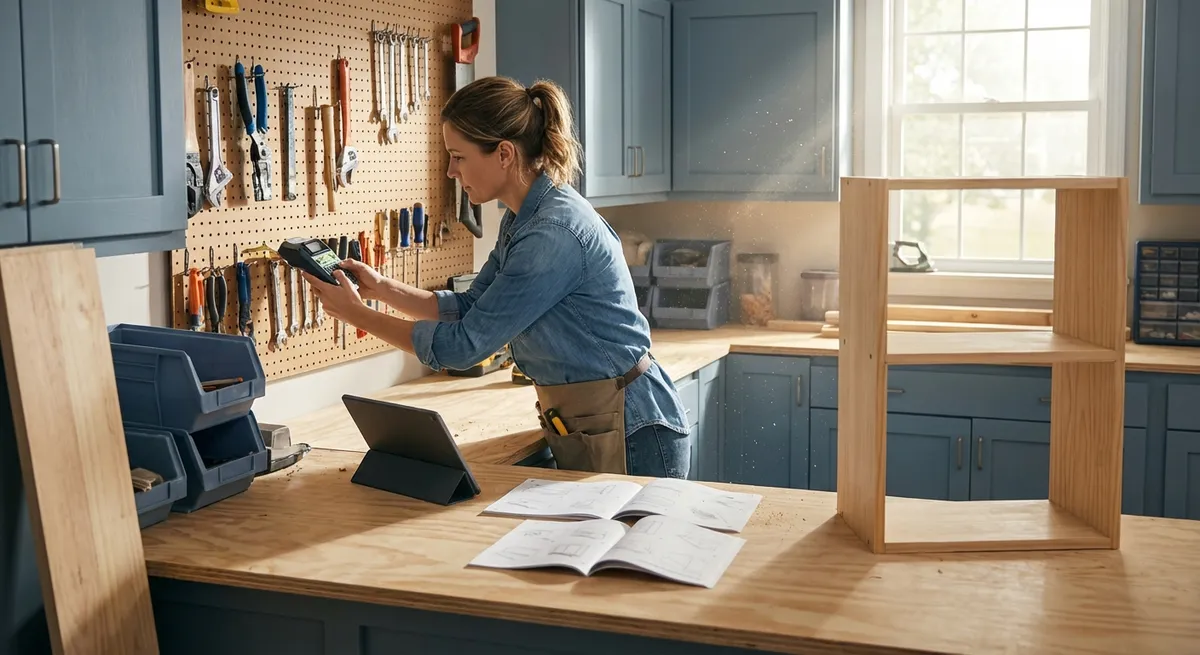
- Everyday tools → pegboard, open tote, or wall rack where you can see everything.
- Sometimes tools → labeled bins or drawers (e.g., “Plumbing,” “Electrical,” “Painting”).
- Rare tools → top shelf or back of cabinet in labeled containers.
- Label in plain language, not just brand names.
Instead of “Milwaukee” or “DeWalt,” write “Drill and Batteries,” “Wood Cutting Blades,” or “Wall Anchors and Screws.” That helps future you find what you need fast.
- Do a 5-minute reset after each project.
- Wipe down dusty tools.
- Put bits and blades back in their cases.
- Recharge batteries immediately.
- Toss broken or stripped fasteners so they don’t sneak back into your projects.
Practical tip: Keep a small “go bag” or toolbox with your most-used tools. That way you don’t need to haul your entire setup for quick fixes in another room, or when helping a friend.
Step 4: Use 3 Core Measuring & Marking Habits for Cleaner Results
Good tools can’t fix bad measurements. A few consistent habits go further than buying more gear.
- Commit to one measuring system per project.
Don’t mix inches and centimeters on the same job. Stick to one tape measure, and avoid switching mid-project—it’s a common cause of misaligned shelves and cuts.
- Use the right tool for each type of measurement.
- Tape measure: room dimensions, lumber, large layouts.
- Combination square or speed square: checking 90° cuts, marking straight lines on boards.
- Level: checking plumb (vertical) and level (horizontal) for shelves, cabinets, and frames.
- Stud finder: locating studs behind drywall before drilling or mounting.
- Mark clearly and consistently.
- Use a sharp pencil or fine marker, not a dull one that adds “mystery width” to your lines.
- Mark with small, precise ticks rather than long, thick lines.
- When cutting, always decide: cut on the line, or just to one side? Then do that consistently.
- “Test fit” on the wall before committing to holes.
- Use painter’s tape to outline where items will go.
- Hold the real object temporarily in place and step back.
- Confirm height, spacing, and alignment with existing features (windows, furniture, outlets).
- Double-check “invisible” locations before you drill.
- Scan with a stud finder on “AC” or “metal” mode to avoid electric lines and pipes when possible.
- Avoid drilling directly above or below outlets and switches where wires commonly run.
- When in doubt, use shallower anchors or change position.
Practical tip: Keep a small “layout kit” together—tape measure, pencil, level, combination square, painter’s tape, and stud finder. Grabbing that kit before you reach for power tools reduces mistakes.
Step 5: Maintain and Inspect Tools So They’re Safe When You Need Them
Maintaining tools isn’t about perfection—it’s about avoiding failures and accidents in the middle of a job.
- Do a quick visual inspection before each use.
- Check cords for cuts, frays, or exposed wires.
- Make sure guards and safety covers move freely and aren’t removed.
- Verify that bits, blades, and attachments are tight and properly seated.
- Keep cutting tools sharp and clean.
- Dull blades require more force, slip more easily, and produce rough cuts.
- Wipe blades after cutting resinous wood or adhesive-backed materials.
- Replace utility knife blades early; they’re cheap and safer when sharp.
- Protect power tools from dust and moisture.
- Don’t leave them on damp concrete floors for long periods.
- Store in cases or on shelves, not open on the ground.
- Use dust ports and shop vacs where possible to keep motors cleaner.
- Care for batteries the way manufacturers recommend.
- Avoid leaving batteries in extreme heat or cold (garage in winter/attic in summer).
- Don’t run lithium-ion batteries completely dead whenever you can avoid it.
- Every few months, check contacts for corrosion and gently clean if needed.
- Set a simple recurring maintenance reminder.
Once or twice a year:
Practical tip: Treat safety gear (goggles, hearing protection, dust masks/respirators, work gloves) as part of your tool set, not an afterthought. Keep them stored with your tools so you actually use them.
Conclusion
Owning the “right” tools isn’t about size or brand—it’s about fit: fit for your projects, your space, and your habits. By building your toolkit around real tasks, choosing power where it matters, organizing for quick access, measuring with care, and maintaining what you own, you set yourself up for smoother, safer, and more satisfying DIY work.
Start small: pick one step from this guide—like creating a core toolkit list or setting up basic storage—and put it into action this week. Your future projects will go faster, feel easier, and produce results you’re actually proud to show off.
Sources
- U.S. Consumer Product Safety Commission – Power Tool Safety Tips - Covers essential safety practices for using and maintaining power tools at home
- OSHA – Hand and Power Tools - Provides guidelines on safe selection, use, and upkeep of hand and power tools
- Family Handyman – Must-Have Tools for Homeowners - Practical overview of core tools that support common home projects
- This Old House – Tool Storage Ideas - Offers strategies for organizing and storing tools efficiently
- Home Depot – Drill Buying Guide - Explains key drill features, power options, and use cases for different DIY needs
Key Takeaway
The most important thing to remember from this article is that this information can change how you think about Tools & Equipment.