Every DIY win starts long before you drive the first screw. It starts with the tools you pick, how you set them up, and how safely and efficiently you use them. You don’t need a pro-level workshop to get solid, repeatable results—but you do need a system that keeps your tools ready, organized, and safe.
This guide walks through practical, step‑by‑step ways to choose, store, and use tools so your projects run smoother and your gear lasts longer.
Step 1: Choose the Right Tool for the Job (Without Overbuying)
A lot of DIY frustration comes from forcing the wrong tool to do a job it was never meant for. Before you buy or grab anything, slow down and match the tool to the task.
- Define the actual job, not just the “idea.”
Instead of “I’m building shelves,” break it down: cutting boards to length, drilling pilot holes, driving screws, sanding edges, finishing surfaces. Each action points to a specific tool type.
- Decide what must be precise vs. “good enough.”
- Structural or safety‑critical work (railings, deck framing, stair treads) needs accurate cutting and fastening tools.
- Non-structural décor (simple wall shelves, planters) can tolerate more basic tools.
This helps you know when a cheap tool is fine and when it’s a bad idea.
- Start with versatile tools, then add specialty gear.
For most home projects, prioritize:
- A quality drill/driver with adjustable clutch
- A circular saw or miter saw for straight cuts
- A random orbital sander
- A reliable tape measure, speed square, and level
Only add specialized tools (like a biscuit joiner or rotary hammer) when a specific project clearly demands it.
- Check compatibility before you buy.
- Battery platforms: Sticking with one brand’s battery system saves money and shelf space.
- Accessories: Confirm the blades, bits, and pads you can get easily in your area—no point buying a tool you can’t feed.
- Look at power, not just price.
For power tools, pay attention to:
For occasional DIY, mid-range tools from major brands are usually the sweet spot.
Step 2: Set Up a Safe, Practical Work Zone Before You Plug Anything In
Your tools are only as effective as the space you use them in. A rough but well-thought-out setup beats a beautiful but unsafe “Pinterest workshop” every time.
- Claim a consistent workspace, even if small.
- Garage corner, basement wall, or a section of a spare room all work.
- The key is repeatability—you want tools and supplies to “live” in the same place every time.
- Plan a clear, flat working surface.
- Use a sturdy workbench, folding work table, or even two sawhorses with a sheet of plywood.
- The surface should not wobble when you lean on it; if it does, brace or replace it.
- Control your power situation.
- Use heavy-duty, grounded extension cords rated for your tool’s amperage.
- Keep cords away from water, sharp edges, and cutting paths.
- Don’t daisy-chain power strips; pull power directly from a grounded outlet or a single heavy-duty strip.
- Think about where dust and debris will go.
- When cutting or sanding, position yourself so dust blows away from your face when possible.
- Use a shop vacuum or attach dust bags/ports where available.
- Never sand or cut lead paint or unknown materials without researching safe methods first.
- Make safety gear easier to grab than the tools.
- Keep safety glasses, hearing protection, and a dust mask or respirator right at your workstation.
- Store gloves, knee pads, and a basic first aid kit nearby.
If safety gear is annoying to reach, you’re less likely to use it.
Step 3: Handle Power Tools Safely, Step by Step
Safe handling isn’t about being scared of your tools; it’s about clear, repeatable habits. The goal is to make the safe way the automatic way.
- Do a quick pre-use check every time.
For each power tool:
- Inspect cord or battery terminals for damage.
- Confirm guards are present and move freely.
- Check that the bit/blade/disc is tight and not cracked or badly worn.
- Set up your body position before you start.
- Stand with feet shoulder-width apart, one foot slightly forward.
- Arrange materials so you can cut or drill without reaching awkwardly or twisting.
- Plan where the tool will go if it kicks back—don’t block its path with your body.
- Secure the workpiece, not the tool.
- Clamp boards or parts to your work surface; never try to hold them with your free hand when using a saw.
- Use a vise or clamps for drilling small parts.
- If you must hold the material, the tool is likely wrong for the situation.
- Follow a consistent power-on routine.
- Confirm the switch is in the “off” position before plugging in or inserting a battery.
- Clear the tool’s path—nothing under the blade, bit, or disc that shouldn’t be cut or hit.
- Let the tool reach full speed before entering the material; don’t “start in contact” with the work.
- Respect cool-down and storage.
- Let blades and bits stop completely before setting the tool down.
- Keep cutting edges away from cords, clothing, and your hands while they cool.
- Unplug or remove batteries when changing accessories or when storing the tool.
Step 4: Organize and Store Your Tools So You Actually Use Them
You won’t reach for tools you can’t find. A simple, consistent system beats a fancy but confusing setup.
- Group tools by function, not by brand.
- Cutting: saws, blades, utility knives
- Drilling and fastening: drills, drivers, bits, screw assortments
- Measuring and layout: tape measures, levels, squares, pencils
- Safety and support: clamps, vises, PPE
This helps you grab entire “categories” quickly for a project.
- Choose storage that matches how you work.
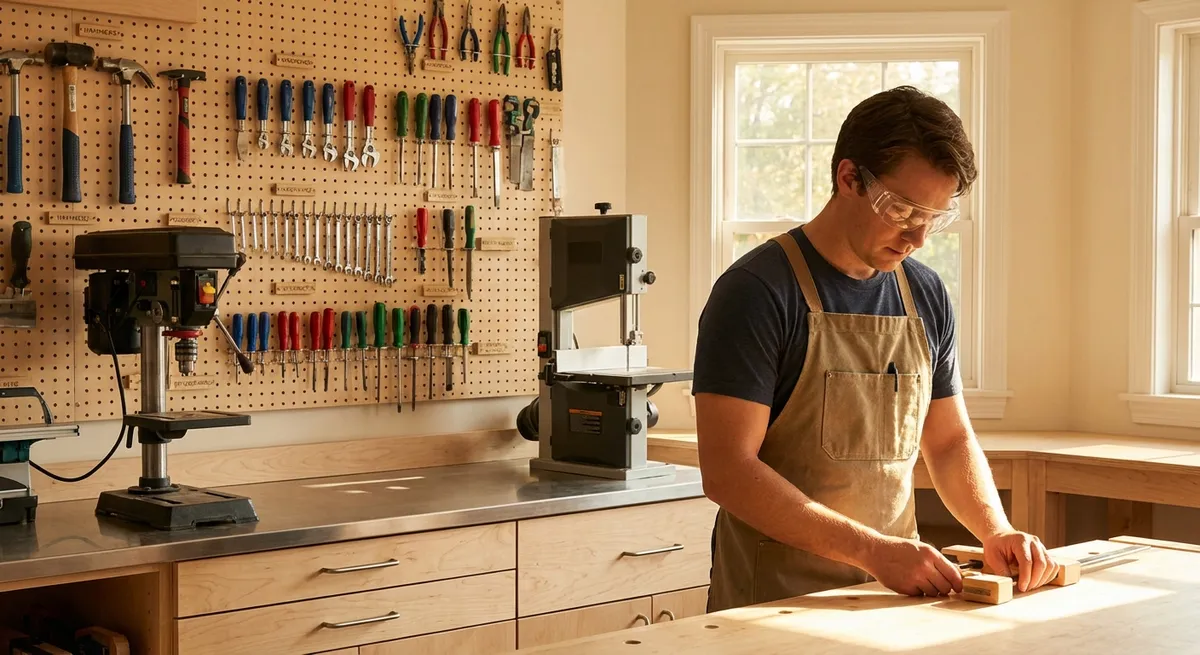
- Wall-mounted pegboard or track systems if you stay in one place.
- Tool bags or stackable cases if you move between rooms or properties.
- Clear bins for fasteners and small parts so you can see what’s inside without opening everything.
- Give every tool a fixed parking spot.
- Outline tools on pegboard or label shelves and bins.
- Store frequently used tools at chest-to-waist height; heavy tools below waist height, light items higher up.
The goal: you should notice immediately when something is missing.
- Protect tools from moisture and temperature swings.
- Keep hand tools dry and off bare concrete floors; use shelves, racks, or cabinets.
- Store power tools and batteries in a relatively stable, dry area—extreme heat and cold shorten battery life.
- Add silica gel packs or a dehumidifier in damp basements or garages.
- Do a quick reset after each project.
- Wipe down tools, remove sawdust and debris, and check for damage.
- Return every item to its designated spot.
- Toss stripped screws and bent nails instead of putting them back “for later.”
Ten minutes of reset makes your next project start faster and with less frustration.
Step 5: Maintain and Inspect Your Tools for Long-Term Reliability
Well-maintained tools are safer, more accurate, and far less frustrating. A little regular care goes a long way.
- Clean as you go, not once a year.
- After cutting or sanding, blow or vacuum dust out of vents and moving parts.
- Wipe metal surfaces with a light oil or rust inhibitor if you’re in a humid climate.
- Keep handles and grips free of oil and debris for better control.
- Keep edges sharp and consumables fresh.
- Replace dull blades, bits, and sanding discs; forcing dull tools leads to slips and kickback.
- Use a basic file or sharpening stone for chisels and hand planes, or have them professionally sharpened.
- Mark the date on new blades/consumables so you know how long they’ve been in service.
- Check fasteners and moving parts on a schedule.
- Tighten loose screws, nuts, and bolts on tools with moving components.
- Lubricate hinges, slides, and pivot points as recommended by the manufacturer.
- Replace cracked or damaged guards and handles promptly—don’t “work around” missing parts.
- Inspect cords, plugs, and batteries carefully.
- Look for cuts, exposed wires, or melted insulation on cords. Replace damaged cords; don’t tape and ignore.
- Check plugs for bent or loose prongs.
- Store batteries at partial charge if not used for a long time, and avoid leaving them on chargers indefinitely unless the manufacturer specifically allows it.
- Retire or repair tools that are no longer safe.
- If a tool vibrates excessively, smells like burning insulation, or trips breakers repeatedly, stop using it.
- Consult manufacturer service centers or a qualified repair shop for evaluation.
- Dispose of batteries and electronic tools through proper recycling programs, not the household trash.
Conclusion
You don’t need every tool in the catalog to build a solid, reliable home setup. What you do need is a clear approach: pick tools that match your real projects, set up a safe and consistent workspace, use power tools with intentional habits, organize your gear so it’s easy to reach, and maintain everything so it works when you need it.
Treat your tools like a system—not a random collection—and every DIY project gets faster, safer, and less stressful.
Sources
- Occupational Safety and Health Administration (OSHA) – Hand and Power Tools - Federal safety guidelines for selecting and using hand and power tools
- Consumer Product Safety Commission – Power Tool Safety Tips - Practical recommendations for preventing injuries with power tools
- Family Handyman – Must-Have Tools for Homeowners - Overview of core tools useful for most household projects
- Fine Woodworking – Tool Maintenance Basics - Guidance on cleaning, sharpening, and caring for tools
- U.S. Department of Energy – Energy Saver: Home Workshop Safety - Safety and setup considerations for home workshops and DIY spaces
Key Takeaway
The most important thing to remember from this article is that following these steps can lead to great results.