Keeping your hand tools in top shape is one of the simplest ways to make home projects faster, safer, and less frustrating. A quick maintenance routine can turn a stiff tape measure, rusty pliers, and dull chisels into reliable, accurate tools you actually enjoy using.
This guide walks through five practical, step-by-step routines you can apply to almost any hand tool you own—no fancy equipment required.
Step 1: Clean Off Grime and Surface Rust the Right Way
Before you sharpen, adjust, or lubricate anything, you need a clean surface. Dust, old grease, and rust all get in the way of smooth operation and accurate work.
- Gather basic cleaning supplies. You’ll need: shop rags or microfiber cloths, a soft-bristle brush (an old toothbrush works), mild dish soap, warm water, and optional: mineral spirits or isopropyl alcohol for stubborn gunk, plus fine steel wool (0000 grade) or a non-scratch scrub pad for rust.
- Dry clean first. Use a dry cloth and brush to knock off loose dust, sawdust, and debris. Pay attention to moving joints, teeth, and grooves where grime packs in.
- Spot-clean with soap and water. Lightly dampen a cloth with warm, soapy water. Wipe metal and plastic surfaces, avoiding soaking wooden handles and any parts that can trap water inside. Immediately dry with a second cloth.
- Tackle sticky residue and old grease. For tape measures, pliers, and wrenches that feel “gummy,” apply a small amount of mineral spirits or alcohol to a cloth and rub the affected areas. Keep chemicals away from printed markings and plastic parts as much as possible.
- Remove light surface rust. Gently rub rusty areas with fine steel wool or a non-scratch pad. Use light pressure and work in one direction. Wipe away the dust, then immediately dry. For severe rust, work slowly—removing too much material can affect tool accuracy.
- Prevent water damage. Never leave tools air-drying. Wipe them completely dry, especially around pivots, screws, and crevices. A quick blast of compressed air (if you have it) helps clear moisture from tight spots.
Practical tip: Do a quick wipe-down after any project that generates dust or moisture (like cutting treated lumber, mixing concrete, or working outdoors). This 2-minute habit drastically extends tool life.
Step 2: Sharpen Cutting Tools for Cleaner, Safer Work
Dull blades make you work harder and increase the risk of slips and injuries. A sharp tool does the work for you and gives cleaner results.
- Identify which tools need sharpening. Common candidates: utility knife blades, chisels, hand plane irons, pruning shears, and scraper blades. If cutting requires extra force or leaves crushed edges, it’s time to sharpen or replace.
- Start with the easiest win: replaceable blades. Swap out dull utility knife or snap-off blades instead of fighting them. It’s cheap, fast, and instantly safer.
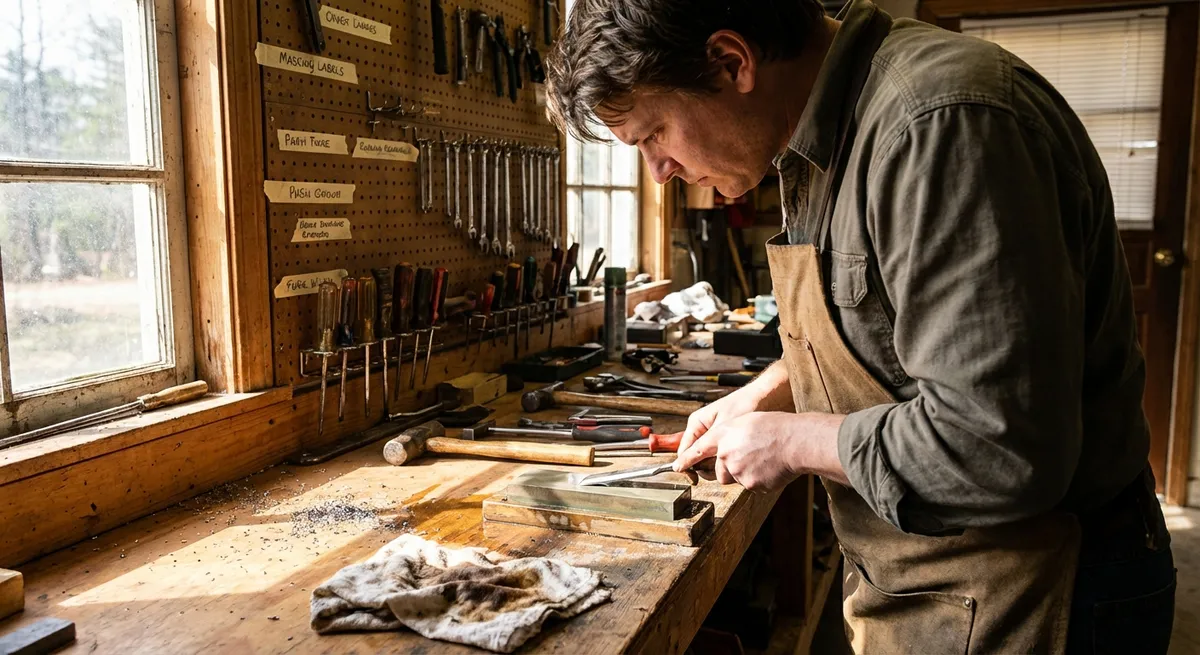
- Set up a basic sharpening station. For chisels and plane irons, a simple setup includes: a sharpening stone (double-sided coarse/fine is ideal), a small container of water (for water stones) or light oil (for oil stones), and a flat surface with good light.
- Maintain the factory angle. Place the bevel of the chisel or plane iron flat against the stone so you feel full contact. Push or pull in smooth strokes, keeping that angle consistent. It’s better to use moderate pressure with consistent motion than to push hard and wobble.
- Work from coarse to fine. Use the coarse side of the stone until you can feel a slight burr (raised edge) on the back side of the blade. Flip to the fine side and repeat with lighter pressure to refine the edge.
- Flatten the back. Lay the back of the chisel or iron flat on the stone and move it in slow, even strokes. You’re not trying to curve the back—just polish the first half-inch or so near the cutting edge.
- Sharpen garden and shop shears. For pruning or tin snips, clamp the tool gently in a vise or hold firmly. Use a flat file or diamond hone, matching the factory bevel. File in one direction, away from your body, and avoid grinding the back side unless the manufacturer recommends it.
Practical tip: Label a small plastic bin “Dull/Sharpen” and toss blades and tools in as you work. When the bin fills up, do a dedicated sharpening session instead of stopping mid-project.
Step 3: Lubricate Moving Parts So Tools Don’t Fight You
Friction wears out tools and your patience. The right lubricant keeps mechanisms smooth and prevents rust—especially on tools with hinges, sliders, or internal springs.
- Choose the right lubricant. For general use: a light machine oil (like 3‑in‑One) or a dedicated tool oil works well. For cleaning plus lubrication in tight spots, a penetrating oil is useful. For locks and some sliding mechanisms, a dry lubricant (like graphite or silicone-based) is often better than oil.
- Clean before you oil. Old, dirty grease turns into abrasive sludge. After Step 1’s cleaning, ensure surfaces are dry and free of grit before you apply fresh lubricant.
- Lubricate pivot points. On pliers, snips, and scissors, apply a drop of oil right at the joint. Open and close the tool several times to work the oil in, then wipe away the excess. Tools should move freely but not feel greasy.
- Treat sliding mechanisms and tapes. For tape measures, pull out the tape fully, wipe it clean, then lightly spray a silicone lubricant on a cloth and run it along the tape. Avoid soaking the inside of the case—too much lubricant inside can attract dirt.
- Handle locking and ratcheting tools. For ratcheting wrenches, socket wrenches, or adjustable wrenches, add a very small amount of oil to the moving gear areas. Work the mechanism back and forth to distribute it, then wipe off extra.
- Avoid over-lubrication. More is not better. Thick, wet layers cause dust and sawdust to stick. A thin, even coat is enough for most tools.
Practical tip: Store a small, leak-proof oil bottle and a rag in a clear plastic container labeled “Tool Lube Kit.” Keeping it all in one place makes quick maintenance an easy habit instead of a chore.
Step 4: Check, Tighten, and Align for Accuracy and Safety
Even if tools are clean and sharp, loose fasteners and misalignments can cause bad cuts, stripped screws, and unsafe operation.
- Inspect handles and grips. Look for cracks, splinters, or loose handles on hammers, screwdrivers, chisels, and garden tools. Replace cracked wooden handles; don’t rely on tape as a long-term fix.
- Tighten screws and bolts. Use a screwdriver or hex key to snug up loose fasteners on levels, squares, utility knives, and adjustable wrenches. Hand-tight plus a slight additional turn is usually enough—over-tightening can strip threads.
- Check alignment of measuring tools. For a speed square or framing square, place it along a factory edge (like a sheet of plywood). If you see light between the edge and the tool, or it rocks, it may be bent and not suitable for precise work.
- Verify screwdriver tips and wrench jaws. Rounded or chipped tips on screwdrivers strip fasteners. Similarly, worn adjustable wrench jaws will slip and damage bolt heads. Retire or repurpose badly worn ones (for non-critical work) and replace when needed.
- Evaluate clamps and locking tools. Test the full range of motion for clamps, locking pliers, and similar tools. They should lock firmly and release smoothly. If threads are damaged or the tool won’t hold pressure, repair or replace before using on important workpieces.
- Test after adjustment. After tightening and tweaking, do a quick real-world test: drive a screw, cut a small scrap, or clamp a piece of scrap wood. Tools should feel positive and predictable.
Practical tip: Keep a small “tool tune-up” driver set (Phillips, flat, hex) in your main toolbox. If you notice something loose mid-project, fix it immediately instead of “later,” when it’s easy to forget.
Step 5: Store Tools So They Stay Ready, Not Rusty
Good storage is low effort but high payoff. The goal is simple: keep moisture, dust, and impact damage away from your tools so they’re ready to go when you are.
- Choose a dry, stable location. Avoid damp basements or uninsulated sheds if possible. If your only option is a humid space, consider desiccant packs, a small dehumidifier, or even sealing key tools in plastic bins with moisture absorbers.
- Separate by type and frequency of use. Keep your most-used hand tools (screwdrivers, pliers, tape measure, hammer) together in an easily accessible toolbox or wall rack. Less-used specialty tools can live in labeled bins or drawers.
- Use basic protection for metal surfaces. After cleaning and light oiling, consider an extra barrier on high-risk tools (like planes, chisels, and saws). A wipe of paste wax on exposed metal can reduce rust risk without leaving a greasy surface.
- Avoid tool piles. Throwing tools into a single deep box causes damage and makes it harder to find what you need. Use trays, foam inserts, pegboards, or simple dividers so tools don’t slam against each other.
- Store sharp tools safely. Cover chisel and plane blades with caps or homemade guards (a slit piece of hose or folded cardboard taped in place works). Hang saws and put knife-type tools in racks or sheaths—not loose in a drawer.
- Do quick visual checks when putting tools away. As you wrap up a project, glance at each tool: Is it wiped down? Any new damage? This habit catches small issues—like a chipped screwdriver or loose plier joint—before they become bigger problems.
Practical tip: Pick one toolbox drawer or one tool category each weekend to inspect and tidy. In 10–15 minutes a week, you can cycle through everything you own in a month or two without a huge time commitment.
Conclusion
A simple maintenance routine turns your tools from “good enough” to “reliable partners” on every project. Clean surfaces, sharp edges, smooth movement, solid alignment, and smart storage all add up to better results and fewer headaches.
You don’t need a dedicated workshop or expensive equipment—just a few basic supplies and a bit of consistency. Start with the tools you use most, work through these five steps, and you’ll notice the difference on your very next home improvement project.
Sources
- [Occupational Safety and Health Administration (OSHA) – Hand and Power Tools](https://www.osha.gov/hand-power-tools) - Safety-focused guidance on proper tool use, condition, and maintenance
- [Fine Woodworking – How to Sharpen a Chisel](https://www.finewoodworking.com/2010/03/24/how-to-sharpen-a-chisel) - Detailed technique and best practices for sharpening edge tools
- [University of Missouri Extension – Care and Maintenance of Hand Tools](https://extension.missouri.edu/publications/g2727) - Comprehensive overview of cleaning, sharpening, and storing common tools
- [Clemson Cooperative Extension – Pruning Tools: Care and Maintenance](https://hgic.clemson.edu/factsheet/pruning-tools-care-and-maintenance/) - Practical advice on sharpening and lubricating cutting tools, especially for outdoor use
- [3-IN-ONE Official Site – Tool Maintenance Tips](https://www.3inone.com/how-to/tool-maintenance/) - Manufacturer recommendations for lubricating and protecting hand tools
Key Takeaway
The most important thing to remember from this article is that this information can change how you think about Tools & Equipment.