Most DIY projects fail before they even start—not because of skill, but because tools are scattered, dull, or buried in a plastic tote under holiday decorations. A functional tool setup doesn’t need a huge garage or expensive storage system. It just needs a clear plan, a little time, and a few smart habits. This guide walks you through practical steps to turn whatever space you have into a ready-to-go DIY workstation.
Step 1: Choose the Right Spot for Your Workspace
Before you buy a single organizer, pick a location that actually works for how you live.
Look for a space that is:
- Dry and reasonably clean – Moisture ruins tools and encourages rust.
- Accessible – If it’s a pain to reach, you won’t use it.
- Ventilated – Especially important if you’ll be sanding, staining, or cutting.
- Near power – Outlets make everything easier and safer than stretching long cords.
Good candidates: a section of the garage, a corner of the basement, a utility room, or even a closet you can convert with wall-mounted storage.
If your space is small:
- Go vertical: pegboards, wall rails, and over-door storage are your best friends.
- Use folding options: a wall-mounted fold-down workbench or a sturdy table you can tuck away.
- Keep “active tools” only: store rarely used tools in a separate bin or high shelf so your core setup stays uncluttered.
Once you pick the spot, clear it completely. Empty shelves, move boxes, and give yourself a blank slate to work with.
Step 2: Sort, Purge, and Group Your Tools
This step feels tedious, but it makes every future project faster and less frustrating.
Spread out all your tools and equipment where you can see them. Then:
Sort into categories
Make loose piles: - Measuring & layout (tape measures, squares, levels) - Cutting (handsaws, utility knives, snips) - Driving & fastening (screwdrivers, drills, impact drivers, nail sets) - Gripping & holding (pliers, clamps, vises) - Finishing & sanding (sandpaper, sanding blocks, files) - Safety gear (glasses, hearing protection, gloves, masks)
Remove duplicates and junk
- Toss or recycle broken tools that can’t realistically be fixed. - Keep one or two of each core tool in good shape instead of five worn-out versions. - Set aside tools you never use for donation or a community tool swap.
Identify your “core kit”
These are tools you reach for on nearly every project—keep them easiest to access: - 16–25 ft tape measure - Combination square or speed square - Hammer (16 oz claw is fine for most DIY) - Screwdriver set or multi-bit driver - Adjustable wrench - A pair of pliers (slip-joint or groove-joint) - Utility knife - Cordless drill/driver (if you have one) - Safety glasses and hearing protection
Label this mentally (or on paper) as your “every project” kit. This set will live in your prime storage area, not in a random box.
Step 3: Build a Simple, Practical Storage System
You don’t need fancy cabinets to keep tools organized; you need clear, consistent homes for everything.
Aim for three layers of storage:
1. Daily-use zone (arm’s reach)
This is your pegboard, rail system, or top drawer where the core kit lives.
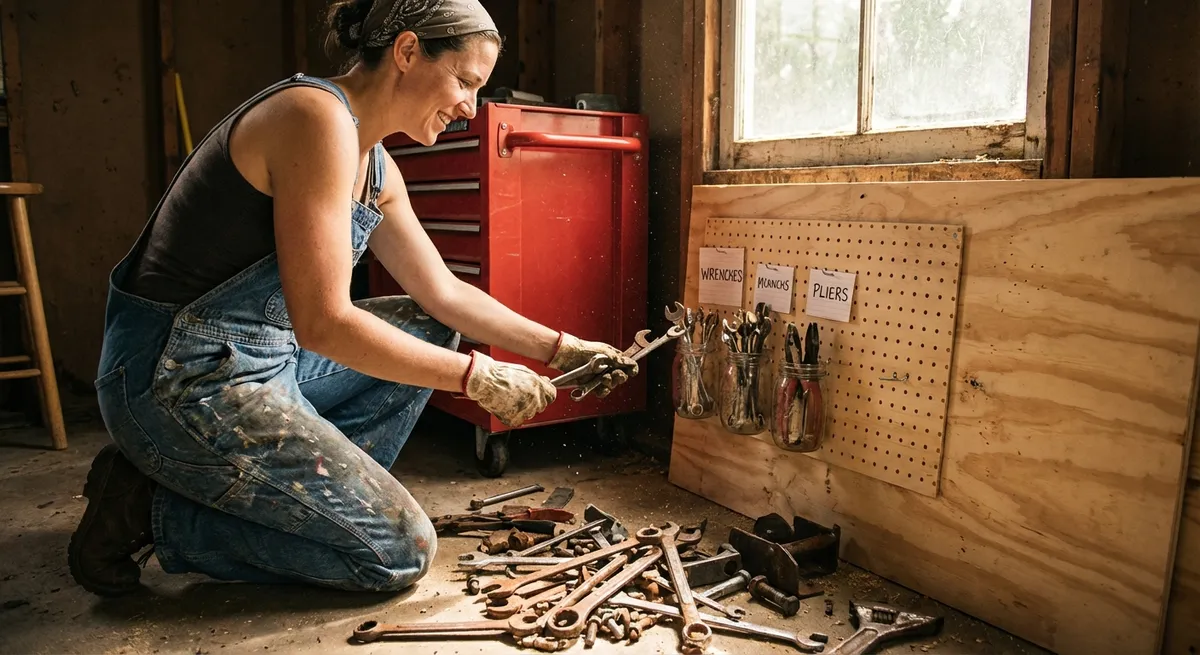
- Pegboard:
- Hang the tools you use constantly: hammer, tape measure, squares, screwdrivers, pliers, clamps.
- Trace outlines or add labels so tools go back to the same spot.
- Magnetic strip:
- Great for screwdrivers, drill bits, small wrenches, and metal rulers.
- Small parts bins or boxes:
- Use clear containers for screws, nails, anchors, and picture hangers.
- Label each bin with size and type (e.g., “1 ¼" wood screws,” “drywall anchors,” “finish nails”).
2. Project-use zone (within a step or two)
Store tools you use regularly but not daily:
- Power tools like circular saws, jigsaws, sanders, and routers.
- Clamps, specialty pliers, paint supplies, and caulking tools.
- Put these on sturdy shelves, in stackable tool boxes, or in pull-out bins.
3. Occasional-use zone (up high or out of the way)
This is where seasonal or rarely used items live:
- Tile tools, hole saw kits, specialty bits, or heavy-duty demolition tools.
- Keep them labeled in totes or heavy-duty boxes so you can identify them quickly.
Key tips:
- Use consistent labels: clear, simple, and big enough to read at a glance.
- Keep heavy tools low: to prevent injuries and damage if something falls.
- Store sharp tools protected: blade guards on saws and knives, sheaths where possible.
Step 4: Create a Ready-to-Grab Project Tool Kit
Even with a well-organized workspace, you’ll often be working in another room, outside, or at a neighbor’s house. A pre-packed project kit saves you from constant trips back and forth.
Use a basic tool bag, tote, or small toolbox and stock it with:
- Tape measure
- Utility knife with spare blades
- Multi-bit screwdriver (flat and Phillips at minimum)
- Pliers (combination or groove-joint)
- Adjustable wrench
- Small level (9"–12")
- Pencil and permanent marker
- A few common fasteners: wood screws, drywall anchors, assorted nails
- Roll of painter’s tape
- Safety glasses and ear plugs
Set a simple routine:
- Before a project:
- Add any project-specific tools (e.g., stud finder, caulk gun, putty knife).
- After a project:
- Return every tool to its place in the bag.
- Restock consumables (screws, tape, blades).
This “go bag” approach means most simple home fixes—tightening hinges, hanging shelves, adjusting doors—can start right away without a half-hour of hunting around.
Step 5: Maintain and Protect Your Tools So They Last
Well-maintained tools are safer, more accurate, and much less frustrating to use.
Build these simple habits into your routine:
Clean as you go
- Wipe down hand tools after dusty or dirty work. - Blow dust out of power tools using a small brush or compressed air (follow the manual). - Don’t put tools away wet—dry them fully to prevent rust.
Control moisture and rust
- Use silica gel packs or a small dehumidifier in damp basements or garages. - For metal hand tools, a light wipe with a machine oil or rust inhibitor a few times a year helps. - Keep tools off bare concrete floors; store them on shelves or in cabinets.
Care for batteries (cordless tools)
- Avoid fully draining lithium-ion batteries regularly. - Store them in a cool, dry place (not a hot car or in direct sunlight). - Use the charger designed for that brand and voltage.
Check cords and plugs
- Inspect power tool cords for cuts or exposed wire. - Replace damaged cords instead of taping over serious damage. - Use grounded outlets and appropriate extension cords rated for your tools.
Sharpen and replace wear items
- Replace utility knife blades frequently—dull blades are more likely to slip. - Swap out worn-out sanding discs or belts; they just burn material and waste time. - Follow manufacturer guidance for saw blade or bit replacement.
Consider a simple maintenance calendar: once every few months, spend 30 minutes checking your most-used tools, wiping them down, and tightening any loose screws or handles.
Conclusion
A functional DIY workspace isn’t about having every tool on the market—it’s about quickly finding, using, and putting away the tools you actually need. By choosing a smart location, sorting and grouping your tools, building a simple storage system, keeping a ready-to-go project kit, and maintaining your gear, you turn home projects from stressful guesswork into straightforward tasks.
Set aside a single afternoon to work through these steps. The payoff is huge: less time searching, fewer duplicate purchases, and a setup that makes every Fix Ready project easier to start and easier to finish.
Sources
- [Occupational Safety and Health Administration (OSHA) – Hand and Power Tools](https://www.osha.gov/hand-power-tools) - Guidance on safe use and basic maintenance practices for hand and power tools
- [The Family Handyman – Workshop and Garage Organization Ideas](https://www.familyhandyman.com/list/workshop-and-garage-storage-ideas/) - Practical examples of tool storage systems, pegboards, and workspace layouts
- [This Old House – Setting Up a Workshop](https://www.thisoldhouse.com/shops/21015232/how-to-set-up-a-workshop) - Advice on choosing a location, adding storage, and organizing a functional DIY shop
- [Energy.gov – Proper Use and Care of Power Tools](https://www.energy.gov/energysaver/articles/power-tools) - Tips on using and caring for power tools efficiently and safely
- [UL Solutions – Lithium-Ion Battery Safety Tips](https://www.ul.com/news/lithium-ion-battery-safety-tips-consumers) - Best practices for storing, charging, and handling cordless tool batteries
Key Takeaway
The most important thing to remember from this article is that this information can change how you think about Tools & Equipment.