Most closets are wasted space: one shelf, a sagging rod, and a pile of stuff on the floor. You don’t need a full renovation or custom cabinetry to fix that. With a few smart DIY upgrades, you can turn a basic closet into storage that actually works for you—and looks like it was planned on purpose.
This guide walks through five practical, step-by-step projects you can tackle with common tools. Mix and match them to fit bedrooms, entry closets, or even a utility closet.
1. Map Your Closet and Make a Simple Storage Plan
Before buying anything, you need a plan. A 30-minute assessment saves you from random organizers that don’t fit or get used.
- Empty the closet completely. Take everything out so you can see the structure—walls, depth, height, and where studs might be. This is the only way to spot wasted space and bad layout choices.
- Measure and write it down. Measure width, depth, height, and door opening. Sketch a quick rectangle and note dimensions. Mark outlet locations, switches, or vents so you don’t block them later.
- Sort your stuff into three piles. Keep, relocate, donate/toss. Be strict. If it doesn’t belong in that closet’s “job” (clothes, cleaning, linens, etc.), move it. Your storage plan should serve one main purpose, not five.
- Group what remains by type and frequency of use. Example: daily wear, seasonal clothes, shoes, bags, bulk items. Keep “daily use” items between knee and eye level, “sometimes” above or below, and “rarely” at the very top.
- Rough-in zones on your sketch. Use your drawing to decide where hanging space, shelves, and bins will go. Label zones like “short hang,” “long hang,” “shoes,” and “overflow.” If you can, reserve at least one vertical corner for floor-to-ceiling shelving.
Tip: Take a photo of your sketch and measurements and keep it on your phone. You’ll need it at the store when you’re staring at a wall of shelf brackets.
2. Add a Second Closet Rod for Double Hanging Space
Most closets waste the bottom half of the wall. Adding a second hanging rod can almost double storage for shorter items like shirts and pants.
- Decide what goes on each rod. Typically, use the upper rod for shirts and jackets, and the lower rod for pants and skirts. If you have lots of dresses or coats, reserve one section of the closet for full-length hanging.
- Mark standard heights. For a typical 8-foot ceiling: upper rod at about 80–84 inches, lower rod at about 36–42 inches from the floor. Adjust if your household is very tall/short, or if you use long hangers.
- Find studs or use solid anchors. Use a stud finder and mark where studs run vertically. If you can’t hit a stud where you need the bracket, use heavy-duty wall anchors rated for at least 50–75 pounds, and follow the manufacturer’s instructions.
- Install the brackets and rods. Use a level to draw straight lines at your chosen heights. Pre-drill for screws to avoid splitting trim or drywall anchors. Secure the brackets, then cut your rod to length (if needed) with a hacksaw and file any sharp edges.
- Test with weight before loading fully. Hang several heavy items (coats, jeans) and gently lift down on the rod to check for flex or looseness. Tighten any screws that shift and upgrade anchors if the wall feels weak.
Tip: If you rent or want something less permanent, consider a tension-mounted or clamp-on lower rod that hangs from the existing one. It’s not as strong, but it’s quick and easily removable.
3. Install Adjustable Shelving for Flexible Storage
Fixed shelves lock you into one layout. Adjustable shelving lets you adapt as your needs change—better for long-term use and easy upgrades.
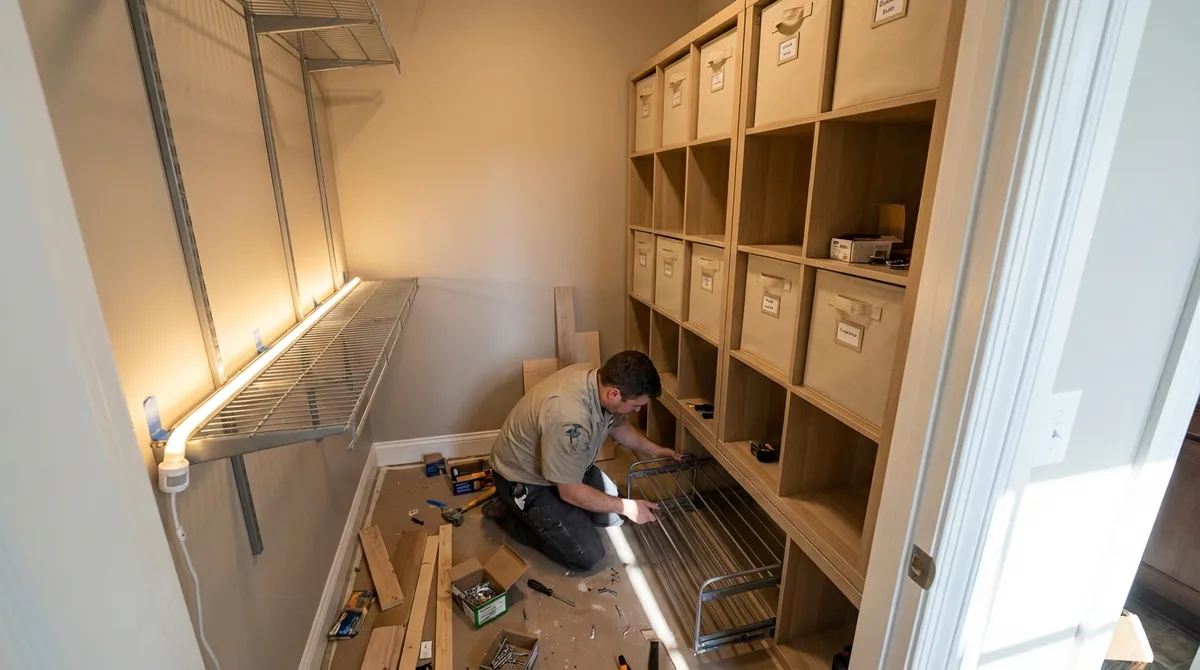
- Choose your system. Look for track-and-bracket (standards-and-brackets) systems or rail-based closet systems that screw into studs. Wire shelving is often cheaper; laminated wood looks more finished. Make sure the hardware and shelves are compatible.
- Lay out vertical supports. On your sketch (or directly on the wall), plan vertical tracks about 16–24 inches apart. Line them up with wall studs when possible for maximum strength. For heavy loads (tools, bulk items), closer spacing is safer.
- Install the tracks or rails. Use a level to keep everything plumb and straight. Pre-drill screw holes at studs; where there’s no stud, use appropriate anchors. The top of the track/rail should be a few inches below the ceiling so you can still use the uppermost shelf.
- Cut shelves to fit and dry-fit them. Measure the inside width between tracks and cut shelves if needed. Test-fit each shelf on brackets to make sure they sit level and don’t rock. Sand rough edges on wood shelves and seal unfinished ends to reduce warping.
- Set up shelf spacing to match real items. Place bins, shoe boxes, folded sweaters, or cleaning bottles on a shelf, then adjust bracket positions until everything fits with minimal wasted height. Lock in your favorite layout, but know you can easily change it later.
Tip: Dedicate at least the top 12–18 inches for “deep storage” bins labeled for off-season items, like winter gear or extra linens. That keeps everyday shelves free from clutter.
4. Build a Simple Custom Shoe and Small-Item Zone
Shoes, hats, and small accessories are what usually end up in piles on the floor. A defined zone keeps them contained and easier to grab.
- Measure the floor footprint. After planning rods and shelves, see how much floor or low-wall space remains—width, depth, and height. This will guide whether you use stacked shelves, cubbies, or a low bench.
- Pick a strategy: shelves, rack, or cubbies.
- Narrow shallow space: angled shoe shelves or a slim vertical rack.
- Wider space: 2–3-tier flat shelves or a DIY box-style “step” platform.
- Entry closet: a low bench with a shelf or cubbies beneath for shoes and baskets.
- Build or install your base unit. For a simple DIY platform: cut a piece of 3/4" plywood just smaller than your closet width and 12–14 inches deep. Screw on 2x4 blocks as legs at corners and midpoints, then place it at the back or sidewall. Or install off-the-shelf shoe shelves per the instructions.
- Add organizers for small items. Above the shoe zone, add hooks or a shallow shelf for hats, bags, scarves, or umbrellas. Use small labeled bins or baskets on this shelf—one per person or per item type.
- Test real-world use. Put your most-used shoes and accessories in their new spots and go through a typical morning. Adjust height/position if anything feels cramped or hard to reach. If kids use the closet, keep their items on the lowest level.
Tip: If moisture is a concern (entry or mudroom), use plastic or metal racks and a boot tray instead of wood directly on the floor. It’s easier to clean and won’t absorb water.
5. Brighten and Label Everything So It Stays Organized
A functional closet still fails if you can’t see or identify what’s inside. Light and clear labeling are the low-cost upgrades that keep your system working long-term.
- Upgrade the lighting safely.
- If there’s an existing light fixture: replace the bulb with a bright, cool-white LED (about 4000K) for clear visibility.
- If there’s no wiring: use battery-powered, motion-sensor puck lights or LED bars mounted to the ceiling or underside of shelves. Avoid halogen or hot bulbs in small spaces.
- Position lights to avoid shadows. Place fixtures near the front of shelves or center of the ceiling so light spreads evenly. For deep closets, two smaller lights (front and middle) are usually better than one large one.
- Choose consistent containers. Use a few types of bins or baskets in predictable sizes rather than a random collection. Clear plastic bins make it easy to see contents; opaque or woven baskets are nicer for bedrooms but should be clearly labeled.
- Label in plain language. Use a label maker, painter’s tape with marker, or clip-on tag labels. Keep it simple: “Winter Accessories,” “Sports Gear,” “Guest Linens,” “Kids’ Art Supplies.” Place labels where you see them as you open the door, not on the back of a bin.
- Set a quick reset routine. Once the closet is done, do a 5–10 minute “reset” every few weeks: return items to labeled bins, pull anything that doesn’t belong, and note if a zone isn’t working. Adjust shelf heights or bin assignments as your needs change.
Tip: Snap “after” photos of the organized closet. If it ever starts drifting back to chaos, compare to the original layout and restore the zones you know worked.
Conclusion
You don’t need custom built-ins or a contractor to turn a basic closet into efficient storage. By planning the space, doubling your hanging area, adding adjustable shelving, defining a shoe and small-item zone, and finishing with good lighting and labels, you can get a closet that actually makes daily life easier.
Tackle these projects one at a time over a few evenings or a weekend. Each upgrade stands on its own, but together they add up to a closet that feels custom-built—without the custom price.
Sources
- [U.S. Department of Energy – LED Lighting Basics](https://www.energy.gov/energysaver/led-lighting) - Explains benefits and characteristics of LED lighting, useful for choosing efficient closet lights
- [Family Handyman – How to Install Wire Shelving](https://www.familyhandyman.com/project/how-to-install-wire-shelving/) - Step-by-step guidance on installing track-based and wire shelving systems
- [This Old House – Closet Makeover Tips](https://www.thisoldhouse.com/closets/21017956/closet-makeover) - Practical ideas for rethinking closet space and layout
- [Consumer Reports – Closet Organizing Systems Buying Guide](https://www.consumerreports.org/home-organizing/closet-organizing-systems-buying-guide-a6397768208/) - Overview of different closet systems and what to consider when choosing components
- [OSHA – Walking-Working Surfaces Standard](https://www.osha.gov/walking-working-surfaces) - General safety principles that reinforce secure mounting and stable walking areas when modifying home storage spaces
Key Takeaway
The most important thing to remember from this article is that this information can change how you think about DIY Projects.