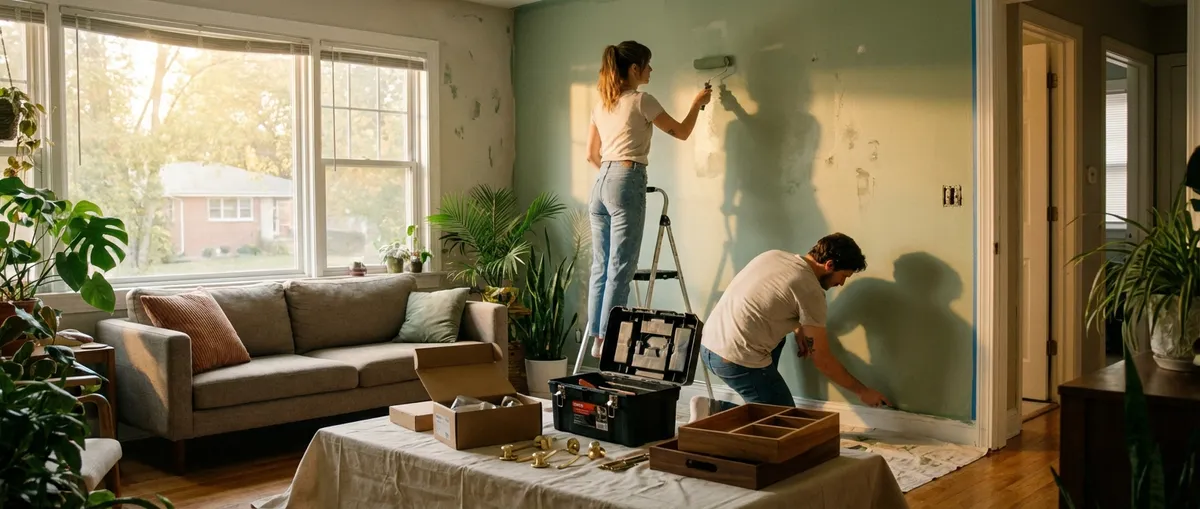
You don’t need a full renovation to make your home work better and look sharper. With a few basic tools, a free weekend, and the right plan, you can knock out projects that actually change how your space feels day to day. This guide walks you through five practical DIY upgrades—each with clear steps, simple materials, and tips to avoid common mistakes.
Project 1: Install a Sturdy Wall Shelf Without Guesswork
A solid wall shelf adds storage and display space almost anywhere. Done right, it won’t sag, tilt, or rip out of the wall.
Tools & Materials
- Shelf board and brackets (or a pre-made shelf kit)
- Drill/driver and drill bits
- Level and tape measure
- Stud finder
- Pencil
- Wall anchors (if you can’t hit studs)
- Screws (usually included with brackets/shelf kits)
- Safety glasses
Step-by-Step Instructions
Choose the right location and height
Decide what will live on the shelf first—books, decor, pantry items. For eye-level display shelves, aim for 4.5–5 feet from the floor. Avoid placing shelves where doors, windows, or light switches will interfere. Mark a rough height with pencil.
Find studs and mark your layout
Run a stud finder along the wall and mark stud centers with light pencil lines. Measure your shelf length and decide how far in from each end to place brackets (typically 2–4 inches from each edge). Lightly mark bracket positions along your height line.
Level your bracket marks
Use a level to draw a straight, horizontal line through your bracket marks. This is your reference line for the top of the brackets. A crooked line now means a crooked shelf later, so take your time.
Pre-drill and install brackets
For studs: pre-drill pilot holes slightly smaller than your screw shank and drive screws through each bracket into the studs. For drywall (no stud): use appropriate wall anchors rated for your shelf load, following the package directions. Make sure every bracket is snug and doesn’t wobble.
Attach the shelf and test the load
Place the shelf on the brackets, center it, and check with a level. Secure the shelf to the brackets with the provided screws (or short wood screws). Gently load a few items and watch for movement. If anything shifts, tighten hardware before fully loading the shelf.
Project 2: Refresh Old Cabinets with New Hardware
Swapping cabinet knobs and pulls is one of the fastest, least expensive ways to modernize a kitchen, bath, or laundry room.
Tools & Materials
- New knobs or pulls (count existing hardware first)
- Drill/driver and bits
- Screwdriver
- Hardware installation template (or cardboard template you make)
- Painter’s tape
- Tape measure
- Pencil
Step-by-Step Instructions
Match or change your hole spacing
Remove one existing pull or knob. For pulls, measure the distance between screw holes (center to center). If your new pulls match that spacing, you can reuse the holes. If not, plan on filling old holes and drilling new ones—or choose hardware that fits.
Remove old hardware and clean the surface
Unscrew all knobs and pulls. Wipe cabinets with a mild degreaser or dish soap solution to remove hand oils and cooking residue. Clean surfaces make new hardware sit flush and look better.
Use a template for consistent placement
For doors: use a store-bought cabinet hardware template or make one from cardboard. Mark where knob or pull holes should go, then align the template at the top corner (for base cabinets) or bottom corner (for upper cabinets) consistently each time. Mark holes with a pencil.
Drill pilot holes carefully
Place a piece of painter’s tape where you’ll drill to help prevent chipping. Use a bit slightly larger than the screw diameter. Drill straight through the door or drawer front—don’t angle the bit. Support the backside with a scrap block of wood if possible.
Install and align hardware
From the backside, push screws through and attach knobs or pulls from the front. Start all screws loosely, then tighten once everything is aligned. Stand back and visually check that heights and angles are consistent; adjust any pieces that look off before fully tightening.
Project 3: Add a Simple Backsplash with Peel-and-Stick Tiles
Peel-and-stick backsplash tiles are a beginner-friendly way to update a kitchen or bath without grout or wet saws.
Tools & Materials
- Peel-and-stick backsplash tiles (measure first, then add 10–15% extra)
- Utility knife and sharp blades
- Straightedge or metal ruler
- Tape measure
- Level
- Pencil
- Degreaser or TSP substitute
- Clean rags
Step-by-Step Instructions
Measure the backsplash area
Measure length and height of the wall area you’ll cover. Multiply to get square footage and buy enough tile with extra for mistakes and cuts. Note any outlets or windows you’ll need to cut around.
Prep the wall thoroughly
Remove outlet and switch covers. Clean the wall with a degreaser or TSP substitute to remove grease and residue. Rinse with clean water and let it dry completely—peel-and-stick won’t hold on dirty or glossy, greasy walls. Lightly scuff glossy paint with fine sandpaper if needed.
Snap a level starting line
Walls and countertops aren’t always perfectly straight. Use a level to draw a horizontal line where the bottom of your first row will sit. This keeps the pattern straight even if the counter has slight variations.
Apply the first tile and work outward
Peel the backing and lightly press the first tile into place, aligning it with your level line. Don’t press hard until you’re sure it’s straight. Continue adding tiles, interlocking edges if your product is designed that way. Work from the center outward to minimize visible cut pieces at the ends.
Cut tiles to fit edges and around outlets
Measure the gap or opening, transfer measurements to the tile, and cut carefully with a utility knife and straightedge. Make multiple shallow passes instead of trying to cut through in one go. Press all tiles firmly once aligned, paying attention to seams and corners for a tight bond.
Project 4: Seal Drafty Windows with Removable Weatherstripping
Drafty windows make your home uncomfortable and waste energy. Removable weatherstripping is an easy DIY fix you can adjust seasonally.
Tools & Materials
- Self-adhesive foam or rubber weatherstripping
- Measuring tape
- Scissors or utility knife
- Mild cleaner and cloth
- Optional: removable caulk for gaps around trim
Step-by-Step Instructions
Identify where the drafts are coming from
On a breezy day, close windows and run your hand around the frame, paying attention to where sashes meet and where the frame meets the wall. You can also hold a lit incense stick or candle near edges (carefully); watch for flickering smoke or flame to spot air movement.
Clean the surfaces you’ll seal
Weatherstripping adheres best to clean, dry surfaces. Wipe down window stops and sash contact points with mild cleaner and let them dry completely. If existing old, crumbling weatherstripping is present, peel it away and scrape off any residue.
Measure and cut new weatherstripping
Measure the sides and top of the window sash where it contacts the frame. Cut strips of foam or rubber weatherstripping to length with scissors or a utility knife. It’s better to cut slightly long and trim than end up with gaps.
Apply weatherstripping to contact points
Peel off the adhesive backing and press the strip firmly onto the frame where the sash presses closed. Close the window and check for a snug fit: the window should latch without excessive force, and the weatherstripping should compress slightly without buckling.
Seal additional gaps as needed
For gaps between the window frame and the wall trim, use removable caulk along the seam. Smooth it with a damp finger. This adds an extra layer of draft protection and can be peeled away later without damaging paint or trim.
Project 5: Upgrade Lighting With a Simple Dimmer Switch Swap
Replacing a standard light switch with a dimmer lets you control brightness and cut energy use with compatible bulbs.
Safety note: If you’re uncomfortable working with electricity or your wiring looks old/damaged, stop and consult a licensed electrician.
Tools & Materials
- Compatible dimmer switch (check it matches bulb type and wattage)
- Screwdrivers (flathead and Phillips)
- Voltage tester (non-contact preferred)
- Wire strippers (if needed)
- Electrical tape
- Switch plate cover (often reusable)
Step-by-Step Instructions
Turn off power and confirm it’s off
At your breaker panel, switch off the circuit controlling the light. Back at the switch, try turning the light on and off—nothing should happen. Use a non-contact voltage tester at the switch wires to confirm no live current is present before touching anything.
Remove the old switch
Unscrew the switch plate cover. Remove the two screws holding the switch to the electrical box. Gently pull the switch out, keeping track of how wires are attached. Take a photo for reference.
Identify wires and disconnect
Typically, you’ll see a hot wire (often black), a load wire (also often black or red), and sometimes a ground (bare copper or green) and neutral (white). Loosen terminal screws and detach wires or release them from push-in connections according to the manufacturer’s instructions.
Connect the new dimmer
Match wires on the dimmer to the wires in the box as directed in the dimmer’s instructions: usually hot to hot, load to load, ground to ground. Twist wires together with wire connectors if required, then secure with electrical tape. Gently tuck wires back into the box, avoiding sharp bends.
Mount, test, and adjust
Screw the dimmer into the box and reinstall the cover plate. Turn the circuit breaker back on. Test the switch: the light should turn on and dim smoothly. Some dimmers have a small adjustment dial behind the faceplate—use it to set the lowest dimming level that keeps bulbs stable (no flicker).
Conclusion
Targeted DIY projects can quickly make your home more functional, comfortable, and visually pulled together—without needing a truckload of tools or a contractor. Focus on upgrades that solve daily annoyances (like drafts or bad lighting) and ones that give you visible payoff (like a backsplash or new hardware). Work methodically, respect safety basics, and tackle one project at a time. The more you practice, the more confident you’ll be taking on bigger fixes down the road.
Sources
- [U.S. Department of Energy – Weatherstripping](https://www.energy.gov/energysaver/weatherstripping) - Guidance on selecting and installing weatherstripping to reduce drafts and save energy
- [Energy Star – Lighting Basics](https://www.energystar.gov/products/lighting) - Overview of efficient lighting, bulb compatibility, and benefits of dimming
- [Family Handyman – How to Install a Dimmer Switch](https://www.familyhandyman.com/project/how-to-install-a-dimmer-switch/) - Step-by-step example of replacing a standard switch with a dimmer
- [Lowe’s – How to Install a Tile Backsplash](https://www.lowes.com/n/how-to/install-a-tile-backsplash) - General backsplash installation principles that also apply to peel-and-stick products
- [This Old House – How to Hang Shelves](https://www.thisoldhouse.com/storage-organization/21015236/how-to-hang-shelves) - Additional tips on securing shelves safely to walls
Key Takeaway
The most important thing to remember from this article is that this information can change how you think about DIY Projects.