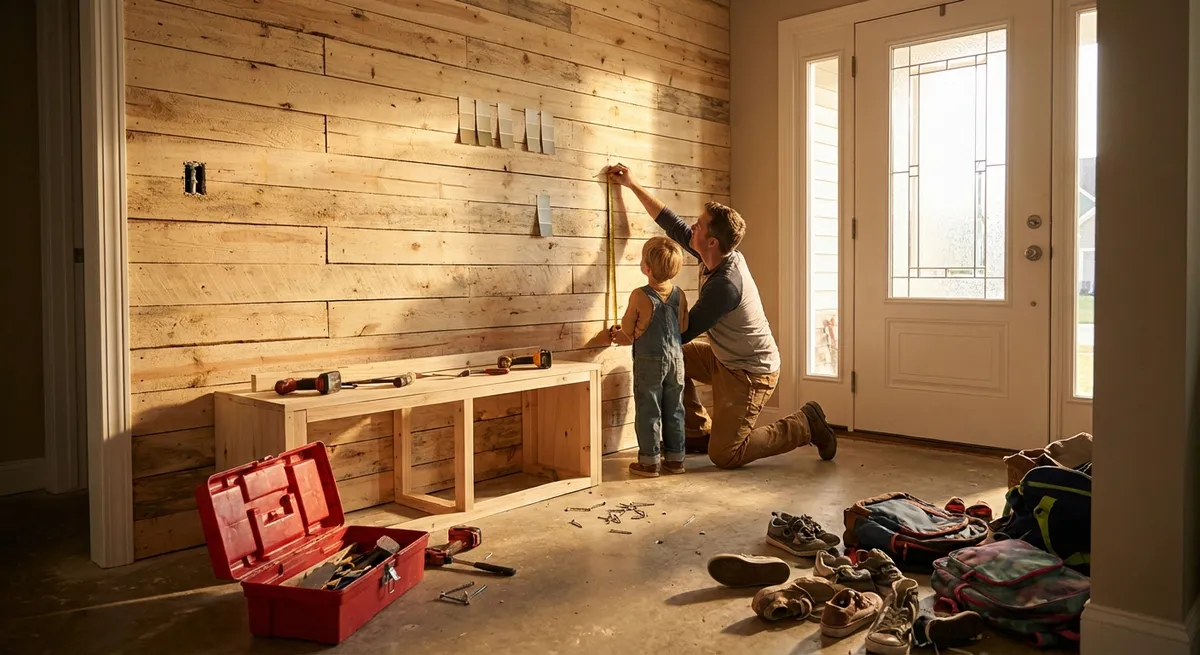
A cluttered entryway makes the whole home feel chaotic. Shoes pile up, keys disappear, bags end up on the floor, and mail lands wherever there’s a flat surface. Instead of fighting the mess, you can build a small, efficient “drop zone” that gives everything a place to land the second you walk in. This project is beginner‑friendly, uses basic tools, and can be adapted to apartments, rentals, or larger homes without major renovation.
Below is a clear, step‑by‑step guide to planning, building, and installing a simple entryway drop zone with hooks, a shelf, and shoe storage you can actually keep tidy.
Plan Your Drop Zone Around Real-Life Habits
Before you pick up a tool, get specific about how your household actually uses the entryway. This prevents you from building something that looks nice but never gets used.
Think through:
- What piles up near the door? (Shoes, coats, backpacks, mail, dog leash, sports gear.)
- Who uses the space? Adults, kids, guests, pets—all have different needs and reach heights.
- What space do you have? A narrow hallway, a small wall by the door, or a full mudroom.
Measure your space:
- Measure wall width where you’ll put the drop zone.
- Measure ceiling height and note obstructions (thermostats, switches, vents).
- Measure floor depth from wall to nearest obstruction (door swing, opposing wall, stairs).
Decide on the main elements you need:
- Wall hooks for coats, bags, and keys.
- A shallow wall shelf for wallets, sunglasses, and small items.
- Low shoe storage: a bench with space underneath, a narrow shoe rack, or baskets.
- Optional: a mirror above the shelf and a small tray for mail.
Sketch a simple front view with rough sizes. This doesn’t need to be perfect—just enough to guide your cut list and shopping list.
Gather Tools, Materials, and Safe Working Space
Once you know the space and rough layout, get what you need in one go so you don’t have to stop mid‑project.
Typical tools:
- Tape measure and pencil
- Stud finder
- Level (24" or longer is ideal)
- Drill/driver with appropriate bits
- Screwdrivers
- Saw (a basic hand saw or circular saw; many stores will cut boards to length)
- Sandpaper (120–220 grit)
- Safety glasses and hearing protection
Common materials for a simple wall-mounted drop zone:
- 1x8 or 1x10 boards for the top shelf and optional backer board (pine or poplar)
- Hooks (double hooks for coats/bags; small hooks or key rack for keys)
- Brackets for the shelf (L‑brackets or decorative shelf brackets)
- Mounting hardware:
- Wood screws for going into studs
- Wall anchors for spots between studs (rated for your expected load)
- Finishing supplies:
- Primer (if painting bare wood)
- Paint or stain and a clear topcoat
- Wood filler (for countersinking and hiding screw heads, if desired)
Prepare your workspace:
- Lay down a drop cloth or cardboard to protect floors.
- Work in a ventilated area if you’re painting or staining.
- Keep kids and pets away from cutting and drilling areas.
Step 1: Mark the Layout on the Wall
Transferring your plan to the actual wall keeps mistakes small and easily fixable.
Decide on hook height:
- Adult coats: 66–70" from floor. - Kids’ hooks (if needed): 42–48" from floor. 2. Mark a horizontal line where the main row of hooks will go using a level.
Mark shelf height:
- Typically 72–78" off the floor, depending on ceiling height and user height. - Maintain enough space above hooks so coats don’t block the shelf.
Find studs:
- Use a stud finder along the lines where hooks and shelf will go. - Lightly mark stud centers with a small vertical pencil line.
Plan anchor points:
- Ideally, at least two hook screws and two bracket screws should land in studs. - For areas between studs, plan to use wall anchors rated for the weight.
Stand back and visually check the layout lines. This is the easiest time to adjust heights or spacing before drilling anything.
Step 2: Cut, Sand, and Pre-Finish the Wood
Working on boards before installation is easier, cleaner, and usually gives better results.
Cut boards to length:
- Shelf: Cut a 1x8 or 1x10 to match or slightly under your wall width. - Optional backer board: Cut a matching piece to mount behind hooks for a more finished look.
Round sharp edges:
- Lightly sand edges and corners by hand or with a sanding block. - Focus on front edges where hands and coats will brush against.
Sand surfaces:
- Start with 120–150 grit to smooth rough spots. - Finish with 180–220 grit for a clean surface ready for paint or stain.
Pre-drill hook locations (optional but helpful):
- Mark even spacing for hooks on the backer board (e.g., 6–8" apart). - Pre-drill small pilot holes so wood doesn’t split and hooks go in straight.
Apply finish:
- If painting: prime first, then apply 1–2 coats of paint, sanding lightly between coats if needed. - If staining: apply stain, wipe off excess, then seal with a clear topcoat.
Let everything fully dry before installation. Pre-finishing saves masking and touch-up work after the boards are on the wall.
Step 3: Mount the Backer Board and Shelf
Installing the backer board and shelf creates the backbone of your drop zone.
Attach the backer board (if using):
- Hold the painted/stained board on the hook height line. - Use a level to check it’s perfectly horizontal. - Pre-drill through the board into stud locations. - Fasten with wood screws into studs (2–3" screws, depending on wall and board thickness). - Where there’s no stud, use wall anchors rated for the weight of coats and bags.
Install brackets for the shelf:
- Mark bracket locations: one near each end and one near the middle if the shelf is long. - Align top of bracket with your shelf height line. - Fasten brackets to studs where possible; otherwise, use appropriate anchors.
Set and secure the shelf:
- Place the shelf on the brackets. - Check for level front-to-back and side-to-side. - Pre-drill small pilot holes through bracket holes into the underside of the shelf. - Secure with short screws (be sure they don’t poke through the top surface).
If you skipped the backer board, you can still mount hooks directly to the wall, but the board adds visual cohesion and helps distribute weight.
Step 4: Add Hooks, Shoe Storage, and Small-Item Solutions
This is where your drop zone becomes truly functional.
Install hooks on the backer board:
- Use your pre-drilled holes as guides, or mark fresh spacing. - Fasten hooks with the screws provided, making sure each is fully snug. - For a cleaner look, keep all hook bases aligned with a level as you go.
Add a separate key hook or key rail:
- Mount it higher or to the side to keep keys away from kids. - Use small wall anchors if there’s no stud.
Set up shoe storage:
- For a bench: pick a sturdy, narrow bench and position it under the hooks, leaving room for walking. - For baskets: choose baskets or bins that fit below hooks, and assign one per person if possible. - For a slim shoe rack: ensure it doesn’t block door swing or trip the traffic flow.
Contain small items:
- Add a tray or shallow basket on the shelf for wallets, sunglasses, and earbuds. - Place a small container or upright file for incoming mail so it doesn’t spread everywhere.
Walk through the space as if you’re coming home: hang a coat, drop a bag, stash shoes, set down keys. Adjust hook spacing or basket placement now while it’s easy.
Step 5: Finish with Safety Checks and Daily-Use Tweaks
The final step is making sure the setup is safe, secure, and realistically maintainable.
Check load-bearing points:
- Gently pull down on hooks and the shelf to simulate weight. - If anything wobbles, upgrade anchors, add more screws, or tie into studs where possible.
Check door clearance:
- Open and close nearby doors fully. Ensure they don’t hit hooks or the shelf. - If needed, move the whole setup a few inches or swap deep hooks for shallower ones.
Adjust for kids and accessibility:
- Add lower hooks for children so they can hang their own coats and bags. - Keep daily-use items between waist and eye level for most users.
Label or zone the space (optional but effective):
- Assign hooks by person: “Mom,” “Dad,” “Ava,” “Guest.” - Use tags or discreet labels on baskets for shoes, scarves, or pet gear.
Create a simple habit rule:
- For example: “Coat on a hook, shoes under the bench, keys on the tray every time you walk in.” - The drop zone only works if it becomes the default landing spot.
Live with the setup for a week, then make small adjustments: move a hook that’s too high, add another basket, or swap in sturdier hardware if something feels strained.
Conclusion
A well-planned entryway drop zone is a small, approachable DIY project that pays off every single day. You’re not renovating an entire room or buying custom cabinetry—you’re creating a simple, durable system that matches how you actually live. With a few boards, basic hardware, and careful mounting, you can turn a chaotic doorway into a predictable, easy-to-use landing strip that keeps the whole home calmer and cleaner.
Sources
- [U.S. Consumer Product Safety Commission – Anchor It!](https://www.anchorit.gov) - Guidance on safely anchoring furniture and wall-mounted items to prevent tip-overs and injuries
- [Family Handyman – How to Use a Stud Finder](https://www.familyhandyman.com/project/how-to-use-a-stud-finder/) - Practical overview of finding studs reliably before drilling or mounting
- [This Old House – How to Install Wall Shelves](https://www.thisoldhouse.com/shelves/21015054/how-to-install-wall-shelves) - Step-by-step advice on securely installing shelves and choosing proper fasteners
- [Lowe’s – Types of Screws and When to Use Them](https://www.lowes.com/n/how-to/types-of-screws) - Explains screw types, lengths, and appropriate applications for wood and drywall
- [The Spruce – How to Paint Wood](https://www.thespruce.com/how-to-paint-wood-1821106) - Covers surface prep, priming, and painting techniques for a durable finish on wood projects
Key Takeaway
The most important thing to remember from this article is that this information can change how you think about DIY Projects.