Cyber Monday headlines are packed with “tech deals so good your bank account might forgive you,” and a lot of those “tech” offers this year are actually power tools, laser levels, smart tape measures, and cordless combo kits. Big-box retailers and brands like DeWalt, Milwaukee, Makita, Ryobi, and Bosch are all pushing aggressive bundles and discounts right now—especially on cordless platforms and smart measuring gear.
If you’re a DIYer, it’s tempting to just click “Buy” on the biggest bundle you see. But the tools you grab during these sales will shape what you can build for the next decade. Instead of chasing the biggest discount, use this moment to build a smarter, more efficient setup that actually fits the projects you want to do.
Below is a step‑by‑step guide to upgrading your tools in a way that matches how you work, not just what’s on sale.
Step 1: Choose Your Cordless “Ecosystem” Before You Chase Any Deal
Cordless tools are where the real action is this season. Brands are competing hard on battery platforms—20V MAX (DeWalt), M18 (Milwaukee), 18V LXT (Makita), ONE+ (Ryobi), CORE18V (Bosch), and others. Almost every Cyber Monday flyer you’ll see is built around “buy a kit, get a free tool” tied to one of these ecosystems.
Here’s how to decide which lane to commit to:
Define your project level
- Occasional DIY (shelves, small repairs): Ryobi, Craftsman, Skil can be good value. - Serious DIY / light trade: DeWalt, Makita, Bosch. - Heavy construction / daily professional use: Milwaukee M18, DeWalt XR/FLEXVOLT tiers.
Check what you already own
If you already have two or more batteries from one brand, it’s usually smarter to double‑down on that ecosystem than to start from scratch with a competing platform.
Look at the battery roadmap, not just one tool
Go to the brand’s website and see how many tools share the same battery (outdoor equipment, nailers, shop vacs, lights, etc.). A $199 drill/impact kit that eventually powers your mower and tile saw is a better investment than a cheaper orphan tool.
Avoid mixing systems “just because it’s on sale”
Two brands means two chargers on the bench, two battery inventories, and double the headaches on long project days. If you do mix (many pros do), do it intentionally: e.g., Milwaukee for heavy work, Ryobi for lightweight or “loaner” tools.
Check “bare tool” pricing
Strong ecosystems make it easy to expand. If the brand you’re eyeing has reasonably priced bare tools (no battery), that’s a sign you can build a flexible setup over time without overpaying later.
Bottom line: Pick the ecosystem first, then look at deals inside that system—never the other way around.
Step 2: Split Your Budget Between “Workhorse” Tools and “Job-Specific” Helpers
Many of today’s tech deal lists lump everything together—drills next to TVs, routers next to gaming consoles. For DIYers, that’s a quick way to buy the wrong gear. Instead, split your tool budget into two buckets: workhorses and job‑specific helpers.
Identify your 3–4 workhorse tools
For most homeowners, these are: - Drill/driver - Impact driver or impact drill - Circular saw or jigsaw - Shop vac or cordless blower (for cleanup)
These are worth buying at a higher quality tier, because they’re used on nearly every project.
Then list the jobs you actually plan to tackle in 2025
Examples: - “Install LVP flooring in the basement” - “Build a simple deck or replace railings” - “Refresh kitchen with new cabinet hardware and shelves” - “Organize garage with wall storage”
Match each job to a job‑specific tool
- Flooring → oscillating multi‑tool, flooring stapler, better knee pads - Deck → impact driver, 7‑1/4" circular saw, outdoor‑rated screws and bits - Cabinet hardware → compact drill, quality drill bit set, cabinet hardware jig - Garage storage → stud finder, laser level, impact driver for lag screws
Allocate budget: 60–70% workhorses, 30–40% helpers
Don’t pour everything into one flashy miter saw if you don’t own a basic drill that can reliably sink screws. Start with the core tools that will get you through most tasks.
Use bundles strategically
If a brand is offering a Cyber Monday‑style “buy a starter kit, choose a free tool,” choose your free tool based on the real jobs above, not what looks coolest. A free oscillating tool you’ll use ten times beats a spotlight you’ll use once.
Step 3: Upgrade Your Measuring and Layout Game With Modern “Tech” Tools
A lot of the “tech deals” trending right now aren’t just gadgets—they’re tools that make your work more accurate and faster. You’ve probably seen offers on laser distance measurers, cross‑line lasers, and even Bluetooth stud finders. Used right, these tools can quietly level up every project you do.
Start with a basic, reliable tape measure and square
Even with all the gadgets, a 25' tape, speed square, and 4' level are still essential. If yours are bent, worn, or unreadable, replace them first. Accuracy starts here.
Decide if a laser distance measurer actually fits your work
These are great for: - Sizing rooms for flooring, paint, or trim - Measuring ceiling heights - Quick material takeoffs for online orders
If you’re only measuring short runs (like one board at a time), a standard tape may be enough.
Consider a cross‑line laser level for layout
Current sales often feature compact cross‑line lasers from Bosch, DeWalt, and others. They shine for: - Installing wall cabinets at a consistent height - Tiling backsplashes or bathroom walls - Laying out chair rail or picture ledges - Hanging multiple frames in a straight line
Look for features like self‑leveling and a magnetic base or clamp.
Be skeptical with “smart” stud finders
Some app‑enabled stud finders are great, others overpromise. For most DIYers, a good quality electronic stud finder plus a small nail and painter’s tape will do the job. If you do go smart, read current reviews and make sure it works with your phone OS and updates.
Create a small “layout kit” you can grab instantly
Put these in one pouch or box: - Tape measure - Speed square - Pencil and fine marker - Small torpedo level - Stud finder - Optional: cross‑line laser, chalk line
This kit should live where you actually work, not lost at the bottom of a tool bag.
Step 4: Build a Small, Realistic Safety Loadout You’ll Actually Use
This year’s big retailers are quietly bundling more PPE (personal protective equipment) into tool deals—safety glasses with combo kits, hearing protection with jobsite radios, etc. That’s not just marketing; modern cordless tools are powerful, and they can hurt you if you skip protection.
Instead of grabbing random safety gear, build a small, realistic kit that matches what you actually do.
Protect your eyes first
- Get two pairs of safety glasses: one clear, one tinted (for outdoor cutting or deck work). - Look for anti‑fog coating and comfortable temples so you actually wear them.
Add hearing protection that doesn’t annoy you
- Over‑ear muffs are simple, cheap, and effective, especially for saws and hammers. - If you’re often working around loud tools, consider Bluetooth muffs so you can listen to instructions, podcasts, or music without removing protection.
Use better dust control, not just a paper mask
- Hook a shop vac to your sander and saw when possible. - For sanding drywall or cutting MDF, consider a reusable respirator with proper filters instead of disposable masks that don’t seal well.
Gloves: choose for task, not looks
- Thin, flexible gloves for carpentry and general work. - Heavier cut‑resistant gloves if you’re working with metal or demolition. - Don’t use bulky winter gloves for detail cutting; you’ll lose dexterity.
*Store safety gear where you start your work, not where you end it
If your glasses are buried in a toolbox, you won’t walk back to get them. Keep a small bin or hook by the garage door or shop entrance labeled “SAFETY FIRST GRAB THIS.”
A well‑planned safety kit costs less than one ER visit and lets you work longer without fatigue.
Step 5: Create a Simple Storage and Charging Station So Your Tools Are Always Ready
One reason people don’t finish projects is simple: the tool they need is dead, missing, or buried. With battery‑powered gear so central to current tool deals, a small charging and storage station is now essential shop infrastructure—not an optional extra.
Pick a fixed location (even a small one) and commit to it
A 3–4 ft section of wall or a corner of a shelf in the garage, basement, or utility room is enough. The key is consistency: this is where tools live and charge, every time.
Mount a basic power strip or surge protector
- Secure it to a wall or bench so it doesn’t slide around. - Keep chargers plugged in and labeled if you use multiple brands. - If possible, use a strip with an on/off switch so you can cut power when not charging.
Add simple wall storage for your go‑to tools
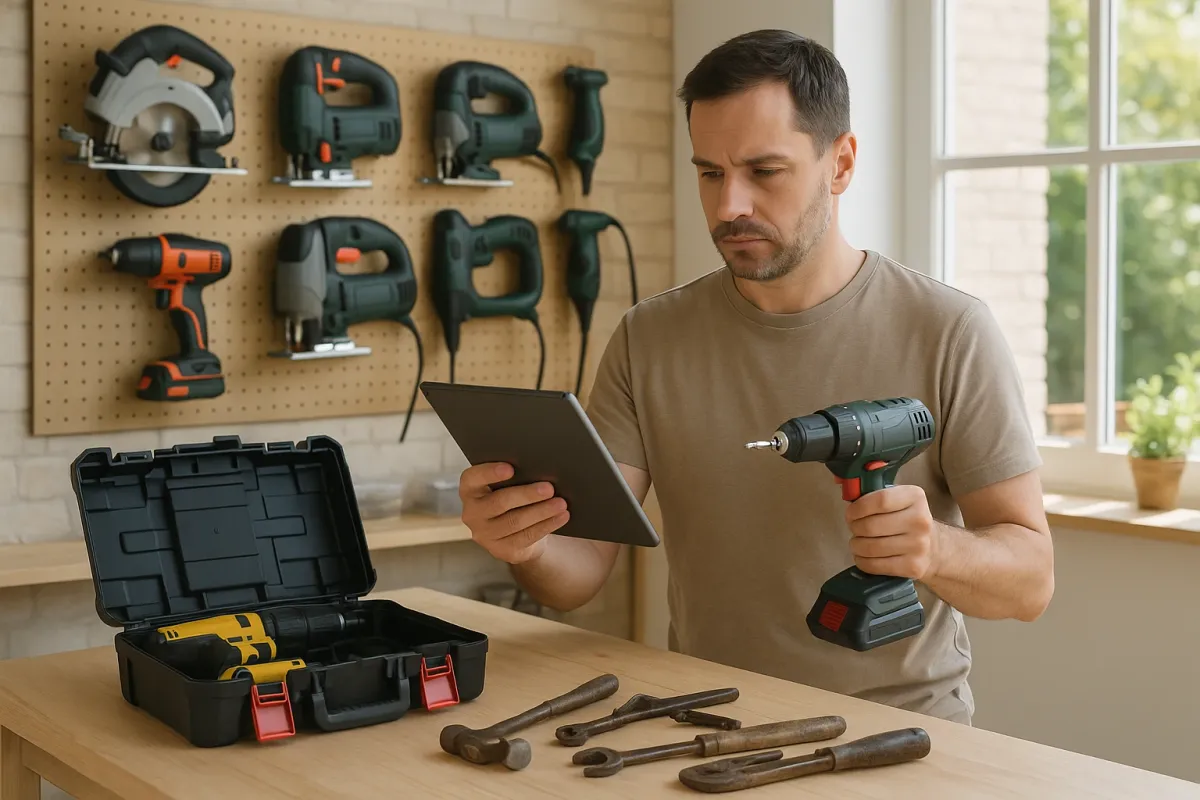
- Use a cheap metal pegboard, French cleats, or even a 2x4 rack with hooks. - Hang your drill, impact driver, measuring kit, and layout tools where you can see them. - If your brand sells molded tool holders that mount to the wall, this is where they go.
Set a charging habit, not just a charging spot
- At the end of every work session, put dead batteries on chargers and return tools to their hooks. - Don’t leave batteries on the charger indefinitely; once charged, pull and store them with the tool, especially if you don’t use them daily.
Keep a small “project box” beside the station*
- This is for the screws, bits, small hardware, and instructions for your current project. - When you start work, grab your tools and the box. When you finish, everything goes back. This keeps your home from turning into a permanent “mid‑project” zone.
A basic charging and storage setup might not look as exciting as a new impact driver, but it’s the difference between projects that drag on for months and projects you actually finish.
Conclusion
With Cyber Monday and year‑end “tech” deals putting power tools, lasers, and smart measuring gear front and center, it’s easy to get swept up by discounts. But the tools you buy right now will shape what you’re able to build in 2025 and beyond.
Focus on five things: commit to a cordless ecosystem, invest in true workhorse tools, upgrade your measuring and layout game, build a safety loadout you’ll use, and set up a simple charging station. Do that, and every deal you grab this season becomes more than a bargain—it becomes part of a tool setup that actually helps you finish the projects you care about.
Key Takeaway
The most important thing to remember from this article is that following these steps can lead to great results.