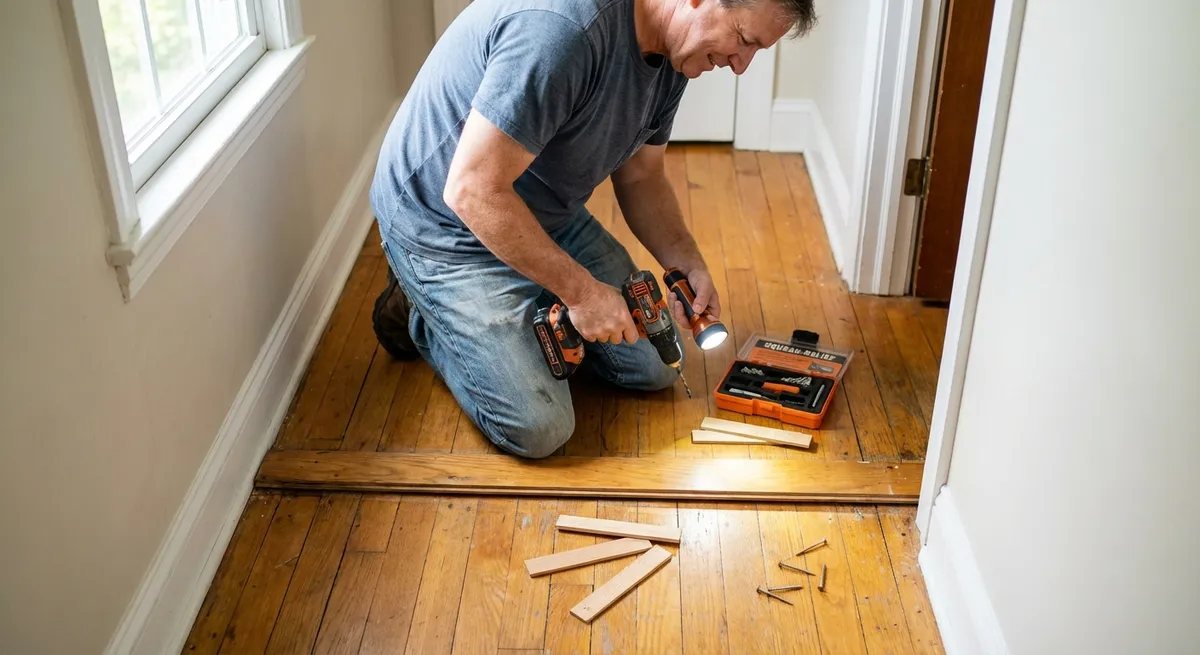
Noisy, soft, or bouncy floors make a home feel older than it is—and they can hint at real problems below the surface. The good news: you can often quiet squeaks and firm up “spongy” spots without a full remodel. With a few tools and some smart techniques, DIYers can tackle the most common floor issues from above or below, often in a single weekend.
This guide walks you through identifying what’s really going on and then fixing it step by step, whether you have carpet, hardwood, or access from a basement or crawlspace.
Know What Your Floor Is Telling You
Before you grab a drill, you need to understand what type of problem you’re dealing with. That will tell you whether you can fix it from above, from below, or if you should call in a pro.
A floor usually complains in three main ways:
- Squeaking or creaking – movement between wood pieces (subfloor and joists, subfloor and nails, or floorboards rubbing together).
- Spongy, springy, or bouncy feel – flexing in the subfloor or joists when you step.
- Localized dip or sag – structural issues below, like undersized joists, water damage, or long-term settling.
Check these first:
Walk the area slowly
Mark squeaks and soft spots with painter’s tape or sticky notes. Step firmly on each marked spot to see how much movement you feel.
Check below if you can
From a basement or crawlspace, look for: - Cracked, notched, or sagging joists - Dark stains or crumbly wood (possible rot or termites) - Gaps between joists and subfloor - Loose or missing fasteners and metal hangers
Note your floor type above
Your approach changes depending on whether you have: - Carpet over a wood subfloor - Hardwood or engineered wood - Laminate or luxury vinyl (often floating) - Tile (usually a separate problem if squeaky)
If you see major rot, obvious structural sag, or insect damage, stop and bring in a licensed contractor or structural engineer. DIY is great, but structural repairs need expert eyes.
Step 1: Map Problem Spots and Check for Hidden Damage
Start by creating a simple “floor map” so you’re not guessing once you pull tools out.
- Draw the room on a piece of paper or in a notes app: doors, windows, and main furniture.
Mark every squeak and soft spot
- Use painter’s tape on the floor where you hear squeaks. - Put a matching mark on your room sketch so you know where each one is.
Have a helper walk while you listen
One person walks, another listens and watches from below (if you have access) to see which joists move when weight is applied.
Look for patterns
- Squeaks in a line: could be a joist or seam in the subfloor. - Soft spots in a cluster: possibly water damage or a poorly supported area.
Check for moisture sources
- Is the problem near a bathroom, kitchen, or exterior wall? - Look underneath for plumbing lines or previous leaks.
If you find mold, damp insulation, or active leaks, deal with the moisture source first. A floor fix won’t last if the wood keeps getting wet.
Step 2: Tighten Floors from Below (Best Option When Accessible)
If you have a basement or crawlspace, fixing squeaks and bounce from below is often the cleanest, most durable method. You avoid messing with finished flooring and you can see what you’re doing.
Tools and materials
- Cordless drill/driver
- 3" wood or structural screws
- Construction adhesive (subfloor-rated)
- Wood shims
- Flashlight or work light
- Safety glasses and dust mask
How to reinforce from below
Pull the subfloor down to the joists
- Have a helper walk on a squeaky spot above so you can see where wood moves. - Drive 3" screws up through the joist into the subfloor (not through the finished floor). - Angle them slightly if needed to get a solid bite, spacing screws about every 6–8" along squeaky seams.
Add adhesive where there’s a visible gap
- If you can slide a thin putty knife between joist and subfloor, there’s room for glue. - Run a bead of construction adhesive along the top of the joist, then press the subfloor tight by having someone stand above while you screw from below.
Use shims carefully for small gaps
- For gaps that don’t close fully with screws, gently tap a wood shim coated in construction adhesive between joist and subfloor. - Don’t overdrive the shim—you’re filling a gap, not jacking up the floor.
Stiffen bouncy joists
- Sistering: Fasten a new piece of lumber (same height as the joist) alongside the existing joist using construction adhesive and staggered screws. - Blocking/bridging: Add perpendicular pieces of lumber between joists to share the load and reduce bounce.
Retest above
- After reinforcing each marked area, walk on the floor again. - Add more screws or blocking where needed.
If the squeak disappears underneath but you still hear a noise on top, the problem may be between finished flooring and subfloor, which you’ll tackle from above.
Step 3: Quiet Squeaks Under Carpet Without Removing It
Carpeted rooms often squeak because the subfloor has loosened from the joists, but you can fix this without pulling up the entire carpet.
Tools and materials
- Stud finder (to locate joists)
- Squeak-specific repair kit (like “Squeeeeek-No-More” or similar), or:
- 2–3" breakaway or trim-head screws
- Screwdriver bit and depth stop
- Painter’s tape
- Vacuum
How to fix squeaks through carpet
Find the joists under the carpet
- Use a stud finder along the noisy area to locate joists (they’re usually 16" or 24" apart). - Confirm by carefully pushing a thin nail through the carpet into the subfloor in an inconspicuous area to feel for solid wood below.
Mark screw lines
- Run painter’s tape along the joist centerline on top of the carpet. - Mark the worst squeak spots on the tape.
Install screws through the carpet
- Using the special screw and alignment tool from a squeak repair kit (or a trim screw with a depth stop), drive screws straight down into the joist at your marked spots. - The goal is to clamp the subfloor tight to the joist without catching and twisting the carpet backing.
Hide the fasteners
- Most squeak-repair systems use breakaway screw heads so the visible portion snaps off below the carpet surface. - If you’re using standard trim-head screws, stop just below the carpet surface and gently work the carpet fibers back over the screw location by hand.
Test and repeat
- Walk over the area again. If you still hear squeaks, add a couple more screws along the joist line on each side of the noise until it disappears. - Vacuum to lift the carpet pile and remove any stray fibers.
Avoid nails for carpet squeak fixes—nails can back out over time and bring the squeak back.
Step 4: Secure Loose Hardwood or Laminate from Above
When the finished floor itself is moving (common with hardwood, engineered wood, and floating laminate), noise comes from boards rubbing against each other or against fasteners.
For nail-down hardwood or engineered wood
Locate the joist below
- Use a stud finder along the squeak. - Joists usually run perpendicular to the floorboards.
Drill a pilot hole
- Choose a thin drill bit slightly smaller than your screw’s shaft. - Drill at a slight angle through the tongue side of the board if possible; this hides the repair better.
Drive a trim screw
- Use a 2–2½" trim-head screw designed for flooring repairs. - Countersink the head just below the surface of the wood.
Fill and finish
- Use a color-matched wood filler or wax stick to hide the screw hole. - Wipe off excess and lightly buff once dry.
Check for board-on-board squeaks
- If the sound seems to come from two boards rubbing, dust the seams with a small amount of powdered graphite or talc, then work it in by stepping on the area. - Wipe away residue so it doesn’t track.
For floating laminate or click-lock floors
These floors should not be rigidly fastened to the subfloor because they need to expand and contract.
Check expansion gaps
- Carefully remove a baseboard or quarter-round trim near the noisy area. - There should be a small gap (often ¼") between the floor edge and the wall. If it’s tight, boards may be pinched and squeaking.
Trim tight edges
- Use a multi-tool or oscillating saw with a depth guide to shave a little off the laminate edge where it hits the wall, restoring the gap. - Reinstall the trim afterward.
Add underlayment where possible
- If the noise is due to friction between laminate and a rough subfloor, the long-term fix usually requires lifting boards and adding proper underlayment. - For smaller spots, some DIYers inject a little powdered graphite into joints, but this is more of a temporary workaround.
If a floating floor is severely noisy across a large area, it may have been installed without the right underlayment or expansion spacing; that’s often beyond a quick DIY patch.
Step 5: Reinforce a Spongy Subfloor from Above (Without Full Demo)
A “spongy” or soft patch can sometimes be fixed from above if the subfloor is mostly sound but not well supported. This is more advanced DIY but still manageable in a small area.
Tools and materials
- Circular saw or oscillating multi-tool
- Pry bar
- ¾" plywood (for patches)
- Construction adhesive
- 2½–3" construction screws
- Safety gear (glasses, mask, hearing protection)
How to firm up a small weak area
Mark the soft zone
- Use painter’s tape to outline the area where you clearly feel sponginess. - Find underlying joists with a stud finder and mark their centerlines.
Cut only as much flooring as needed (if possible)
- For hardwood or tile, this is tricky—replacing finished surfaces neatly takes skill. For vinyl sheet or older laminate that’s already in poor shape, you may choose to remove and plan a later cosmetic upgrade. - If you decide not to disturb the finished floor, focus on strengthening from below (Step 2) or call a pro.
Remove damaged subfloor
- Once the finished surface is up, set your saw depth to the subfloor thickness (commonly ⅝" or ¾"). - Cut out the soft area, keeping edges centered over joists whenever possible.
Add support to edges
- Screw short “cleats” (blocks of 2×4 or 2×6) along the cut edges that don’t land on a joist, so the new patch has solid support all around. - Use construction adhesive plus screws for a rigid connection.
Install a new subfloor patch
- Cut ¾" plywood to fit snugly. - Run construction adhesive along joists and cleats, then set the patch in place. - Screw it down every 6–8" along edges and 8–10" in the field.
Prepare for new flooring
- Make sure the patch is flush with surrounding subfloor. - Sand any high spots. Once everything is solid and noise-free, you can install replacement flooring or plan a future surface upgrade over the entire area.
If you uncover extensive rot, insect damage, or more than a couple joists affected, stop and get a professional assessment. That’s beyond a spot repair.
Conclusion
Squeaky, soft, or bouncy floors are annoying, but they’re often fixable with smart, targeted repairs—not a full renovation. By mapping the problem, working from below when possible, using the right screws and adhesives, and reinforcing only where needed, you can make your floors feel solid and quiet again.
Pay attention while you work: recurring moisture, widespread sagging, or crumbling wood are warning signs that call for professional help. But for most everyday squeaks and minor spongy spots, a careful DIY approach can restore comfort, cut noise, and add years of useful life to your floors—without tearing your house apart.
Sources
- [U.S. Department of Housing and Urban Development – Residential Rehabilitation Inspection Guide (Chapter on Floors)](https://www.hud.gov/sites/documents/DOC_9835.PDF) - Technical reference on evaluating floor conditions, structural issues, and common defects
- [International Association of Certified Home Inspectors – Inspecting Floor Problems](https://www.nachi.org/floor-problems.htm) - Explains causes of squeaks, bounce, and sagging floors and typical repair approaches
- [This Old House – Stop Squeaks From Above or Below](https://www.thisoldhouse.com/flooring/21015126/how-to-quiet-squeaky-floors) - Step-by-step tips and product suggestions for fixing squeaky floors under carpet and hardwood
- [The Spruce – Repairing a Bouncy or Spongy Floor](https://www.thespruce.com/soft-spots-in-flooring-1822874) - Overview of the causes of soft or spongy floors and when DIY repairs are appropriate
- [Oregon State University Extension – Moisture Problems in Homes](https://extension.oregonstate.edu/housing/maintenance/moisture-problems-homes) - Background on how moisture affects wood framing and subfloors, and why leaks must be fixed before floor repairs
Key Takeaway
The most important thing to remember from this article is that this information can change how you think about Home Repair.