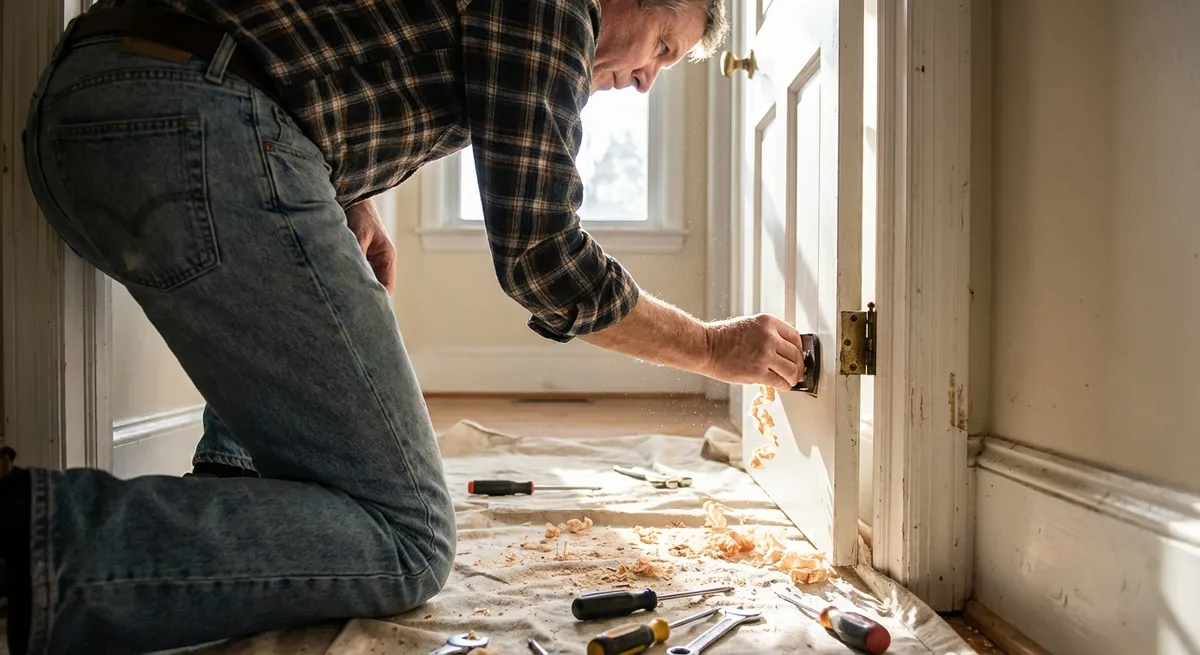
A sticking interior door is one of those small annoyances that can make your whole home feel off. The good news: you usually don’t need a new door or a contractor to fix it. With a few simple tools and a methodical approach, you can get the door opening smoothly, protect your trim, and avoid creating bigger problems down the line.
This guide walks you through a practical, step‑by‑step process DIYers can use to diagnose and fix most sticky interior doors.
Step 1: Find Exactly Where the Door Is Sticking
Before you grab tools, you need to know the real cause of the problem. A door can stick for several reasons: humidity making the wood swell, loose hinges letting the door sag, or the frame shifting over time.
- Open and close the door slowly. Note where you feel resistance: top, bottom, latch side, or hinge side.
- Look for rub marks. Check the door edges and frame for shiny spots, scuffed paint, or exposed wood where surfaces are scraping.
- Use a piece of paper. Close the door on a sheet of printer paper and slide it around the perimeter. Where the paper catches or tears, the door is tight.
- Check the latch. If the door closes but the latch won’t catch or you have to push hard to latch it, the strike plate may be misaligned rather than the door actually “sticking.”
- Note any seasonal patterns. If the problem is worse in humid months and better in dry months, swelling wood and humidity are likely contributing.
Understanding where and why it’s sticking helps you decide whether hinge adjustments alone will solve it, or whether you need to remove material from the door.
Step 2: Tighten and Adjust the Hinges First
Many sticking doors are caused by loose or worn hinges that allow the door to sag. Fixing this is often the fastest, cleanest solution and avoids unnecessary sanding or planing.
- Inspect each hinge. With the door slightly open, gently lift up on the doorknob. If you feel noticeable movement, the hinges may be loose.
- Tighten the screws. Use a screwdriver (not just a drill) to snug up all hinge screws in both the door and the frame. Hand‑tightening reduces the risk of stripping holes.
- Replace short or stripped screws.
- If a screw just spins and won’t tighten, it may be stripped.
- Remove it and replace with a longer wood screw (often 2–2.5" for the top hinge into the stud) to pull the door back into alignment.
- Adjust the top hinge first. The top hinge has the most influence on sagging. Tightening or using a slightly longer screw here can lift the latch side of the door enough to stop sticking at the top or along the latch side.
- Check the door swing again. Open and close the door several times. If the sticking is significantly reduced or gone, you may not need to sand or plane at all.
If tightening hinges improves but doesn’t completely fix the problem, move on to carefully removing small amounts of material.
Step 3: Mark and Sand High Spots for Minor Sticking
If the door only sticks slightly—usually due to paint buildup or minor swelling—careful sanding is often enough. You want to remove as little material as possible to avoid creating a gap.
- Mark the contact areas.
- Close the door until it just begins to stick.
- Use a pencil to lightly mark the edge of the door where it rubs the frame.
- Alternatively, rub a bit of chalk or lipstick on the frame where you suspect contact; open and close the door, and the transfer marks the problem spots on the door.
- Take the door off the hinges (if needed).
- For light sanding on the latch edge, you may be able to work with the door in place.
- For more control and safety, tap out hinge pins with a nail and hammer, then lift the door off and lay it across two sturdy supports.
- Sand gradually.
- Use 80–120 grit sandpaper on a sanding block to keep edges straight.
- Sand along the length of the edge, focusing only on marked areas.
- Remove a little material, then test the fit.
- Test often. Rehang or partially close the door after a few passes of sanding. It’s much easier to sand more than to fix an over‑sanded door.
- Smooth the edge. Once the door closes without sticking, finish with 150–220 grit sandpaper for a smooth edge ready for sealing or painting.
For more pronounced sticking or doors that bind at the top or bottom, you may need to plane, not just sand.
Step 4: Plane and Refinish for Heavier Binding
When a door is significantly binding—especially at the top edge or along a long section—the most reliable approach is to remove the door and use a hand plane or power planer. Precision here matters: you want a consistent gap all the way around.
- Remove the door safely.
- Place a wedge or block under the door to relieve pressure on the hinges.
- Tap the hinge pins out from bottom to top using a nail and hammer.
- Lift the door off the hinges with a helper if it’s heavy.
- Identify where to plane.
- Stand the door upright or lay it flat.
- Use your earlier marks and re‑check the frame to confirm where the gap is tight.
- Plan your cut.
- Most interior doors need about a 1/8" gap around the sides and top, and slightly more at the bottom (to clear flooring and rugs).
- Use a pencil and straightedge to mark a line along the edge where material will be removed.
- Use a hand plane or power planer carefully.
- Work in the direction of the wood grain to avoid tear‑out.
- Take light passes, frequently checking your progress.
- Do not rush; over‑planing can create a noticeable gap or uneven edge.
- Test and fine‑tune.
- Temporarily rehang the door and close it to test the fit.
- If it still binds slightly, mark new spots and repeat light planing or sanding.
- Seal the exposed wood.
- Any newly exposed wood should be primed and painted or sealed to protect against moisture.
- Skipping this step can lead to future swelling and sticking, especially at the top edge where humidity collects.
Step 5: Adjust the Latch and Strike Plate for a Clean Close
Sometimes the door doesn’t technically “stick,” but you have to force it into the frame or pull hard to open it. This is usually a latch and strike plate alignment problem, not a door edge problem.
- Inspect latch alignment.
- Close the door slowly and watch how the latch meets the strike plate.
- If the latch hits too high, low, or on the face of the strike plate instead of entering smoothly, you’ve found the issue.
- Try a simple bend first.
- Remove the strike plate screws.
- Gently bend the lip of the plate outward slightly with pliers, then reinstall.
- This can help guide the latch into place more smoothly.
- Adjust the strike plate position.
- If the latch is slightly off vertically or horizontally, loosen the strike plate screws and shift it within the existing screw hole play.
- Tighten and test. Sometimes this tiny adjustment is enough.
- Re‑mortise the strike plate (for bigger misalignments).
- If the latch is clearly too high or low, remove the strike plate.
- Use a utility knife and chisel to carefully enlarge the mortise (recess) in the needed direction.
- Fill any over‑cut area with wood filler or a wood shim glued in place for a snug fit.
- Fill and re‑drill screw holes if needed.
- If the strike plate needs to move farther than the existing holes allow, fill old holes with wood filler or glued‑in wooden toothpicks/dowels.
- Let dry, sand flush, then pre‑drill new pilot holes and install the plate in the new position.
Once the latch and strike plate are properly aligned, the door should close and latch with a light push and open without sticking or snapping free.
Conclusion
Fixing a sticking interior door doesn’t have to turn into a full‑blown carpentry project. By starting with simple diagnostics, tightening hinges, and only then moving on to sanding, planing, and latch adjustment, you can solve most issues with basic tools and a methodical approach.
Take your time, test often, and remove as little material as necessary. With a few careful steps, you’ll turn an annoying, stubborn door into one that opens and closes smoothly—making your space feel more finished, more comfortable, and a little more “fixed and ready.”
Sources
- [Family Handyman – How to Fix a Sticking Door](https://www.familyhandyman.com/project/how-to-fix-a-sticking-door/) – Practical overview of diagnosing and correcting common door‑sticking issues.
- [This Old House – How to Plane a Door](https://www.thisoldhouse.com/doors/21015121/how-to-plane-a-door) – Detailed instructions and safety tips for planing doors properly.
- [Lowe’s – How to Install and Adjust Door Hinges](https://www.lowes.com/n/how-to/install-door-hinges) – Guidance on tightening, replacing, and adjusting door hinges.
- [Home Depot – Door Latch and Strike Plate Adjustment Tips](https://www.homedepot.com/c/ah/how-to-adjust-a-door-latch/9ba683603be9fa5395fab901b8a90d9) – Step‑by‑step instructions for aligning latches and strike plates.
Key Takeaway
The most important thing to remember from this article is that this information can change how you think about Home Repair.