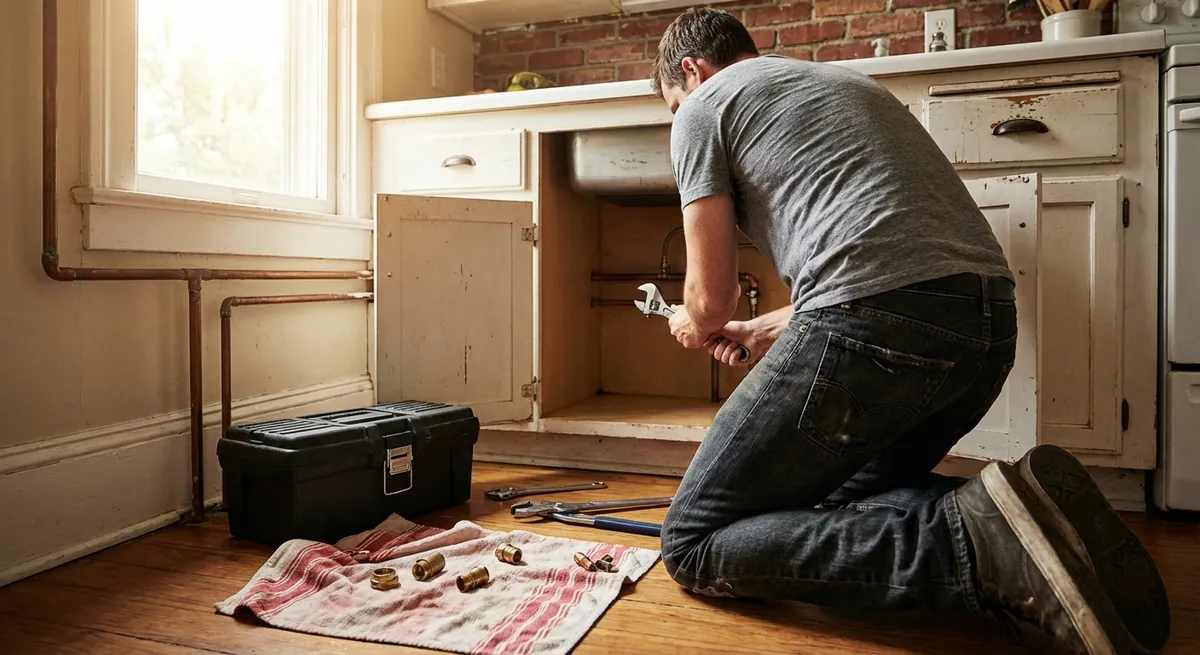
Home repairs don’t have to be confusing or expensive. With a few reliable skills and the right approach, you can solve a lot of everyday problems yourself—without guessing, improvising, or making things worse. This guide walks you through five practical, step‑by‑step repairs that most DIYers can tackle with basic tools, plus tips to keep the work safe and efficient.
These are the kinds of fixes that save you money, prevent damage, and make your home feel solid and dependable.
Step 1: Stop a Dripping Faucet the Right Way
A dripping faucet wastes water and drives up your bill. Most of the time, the fix is a worn cartridge, washer, or O‑ring—not a whole new faucet.
Tools & materials:
- Adjustable wrench or basin wrench
- Screwdrivers (Phillips and flathead)
- Replacement cartridge or washers/O‑rings (match to brand/model)
- Plumber’s grease
- Rag or towel
How to do it:
- Shut off the water supply.
Look under the sink for shutoff valves and turn them clockwise. If none are present or they’re stuck, shut off the main water supply to the house. Open the faucet to relieve pressure and confirm water is off.
- Disassemble the faucet handle.
Pry off decorative caps to reveal screws. Remove the handle and trim pieces. Take clear photos as you go so you know how to reassemble everything.
- Identify and remove the cartridge or stem.
For single‑handle faucets, you’ll usually find a cartridge secured by a nut or clip. For two‑handle faucets, you’ll find stems with rubber washers. Loosen with a wrench, being careful not to overtighten or twist nearby pipes.
- Inspect and replace worn parts.
Look for cracked rubber washers, flattened O‑rings, or mineral buildup. Take the old part to a hardware store to match size and brand. Install the new parts, adding a light coat of plumber’s grease to O‑rings and seals (don’t overdo it).
- Reassemble and test.
Rebuild the faucet in the reverse order of disassembly. Turn the shutoff valves back on slowly while watching for leaks. Run both hot and cold for a minute—if the drip is gone and nothing’s leaking underneath, you’re done.
Pro tip: If you’re unsure of the model, many brand websites let you identify your faucet by photos or characteristics. This helps you buy the exact replacement cartridge instead of guessing.
Step 2: Firm Up a Loose Towel Bar or Wall Anchor
A wobbly towel bar or hook can tear out of drywall and leave a bigger repair later. Fixing the anchor properly now prevents damage and keeps the fixture solid.
Tools & materials:
- Screwdriver
- Utility knife
- Drill with bits
- Drywall anchors (toggle bolts or self‑drilling anchors)
- Spackle or joint compound
- Putty knife
- Sanding sponge or fine sandpaper
- Touch‑up paint (optional)
How to do it:
- Remove the loose fixture.
Unscrew the brackets from the wall. If the screws just spin or pull out easily, the drywall is likely stripped or damaged.
- Assess the damage.
If there’s a ragged hole, use a utility knife to clean up the edges so you have a neat, slightly larger opening. For badly damaged areas, it’s often better to patch and move the anchor a couple of inches over.
- Patch old, unusable holes.
Fill damaged holes with joint compound. Let it dry, sand smooth, and apply a second coat if needed. Once fully dry, sand and paint to match the wall if appearance matters.
- Install new, stronger anchors.
For towel bars and anything that bears weight, avoid simple plastic expansion anchors in drywall. Use metal toggle bolts or high‑load self‑drilling anchors. Drill a pilot hole if required, insert the anchor as directed, and make sure it’s tight to the wall.
- Reinstall the bracket and check for movement.
Attach the bracket to the new anchors and gently pull on it. If it doesn’t move, install the bar or hook. If it does wiggle, remove and step up to a stronger anchor or adjust your pilot hole size.
Pro tip: Whenever possible, mount heavy or frequently used items into a wall stud using wood screws instead of drywall anchors. A stud finder makes this much easier.
Step 3: Fix a Door That Won’t Latch or Keeps Swinging Open
Doors that won’t stay closed or that swing by themselves are often caused by hinge issues, not the latch itself. Fixing the alignment usually solves the problem without replacing hardware.
Tools & materials:
- Screwdrivers
- Longer wood screws (2.5–3 inches)
- Wood glue (optional)
- Wooden toothpicks or small wood shims
- Utility knife or chisel
- Sandpaper
How to do it:
- Check the hinges first.
Open the door halfway and lift it gently by the doorknob. If you feel movement, the hinge screws are likely loose. Look for gaps between the hinge leaf and the jamb or door edge.
- Tighten existing screws.
Use a screwdriver (not just a drill) to snug each hinge screw. Power drivers can strip old screw holes if you’re not careful.
- Reinforce stripped screw holes.
If a screw spins without tightening, remove it. Pack the hole with wood glue and several wooden toothpicks or a small wood sliver. Let the glue set briefly, trim flush with a utility knife, then drive the screw back in. For top hinges, consider replacing one short screw with a 2.5–3 inch screw driven into the framing behind the jamb.
- Test the door latch.
Close the door slowly. If the latch hits too high or low on the strike plate, you may see rub marks. A slight misalignment can usually be fixed by tightening/loosening hinge screws in small increments to shift the door.
- Adjust the strike plate if needed.
If adjustments at the hinges don’t solve it, remove the strike plate and gently enlarge the mortise or the latch opening using a file or chisel. Reposition the plate slightly up or down and secure with screws. Test until the latch engages cleanly.
Pro tip: For doors that swing open or closed on their own, slightly bend the hinge pin. Remove the center hinge pin, tap it gently in the middle with a hammer to create a slight bow, then reinstall. The added friction often stops the unwanted swinging.
Step 4: Patch a Small Hole in Drywall So It Blends In
Small dents, nail holes, and minor dings are easy to ignore—until you repaint and every flaw stands out. A clean patch makes walls look “like new” when you’re done.
Tools & materials:
- Lightweight spackle (for small holes) or joint compound (for larger areas)
- Putty knife (2–4 inches)
- Sanding sponge (medium and fine grit)
- Damp cloth
- Primer and touch‑up paint
- Self‑adhesive patch (for holes ~1/2 inch to 2 inches)
How to do it:
- Prep the surface.
Use a putty knife to knock off loose material and high spots. For glossy paint, lightly scuff the area with sandpaper so compound can adhere better. Wipe with a damp cloth to remove dust.
- Fill small holes with spackle.
For nail and screw holes, press lightweight spackle into the hole with the putty knife, then scrape off the excess so it’s flush with the wall. Slightly overfill if needed—spackle shrinks as it dries.
- Use a patch for larger holes.
For holes bigger than a pencil but smaller than a fist, apply a self‑adhesive mesh patch over the hole. Spread joint compound over the patch, feathering the edges outward. Let dry completely (often several hours or overnight).
- Sand and re‑coat as needed.
Once dry, sand lightly until smooth, being careful not to expose the patch. Apply a second thin coat of joint compound to feather the edges further. When that dries, sand again with fine grit for a smooth finish.
- Prime and paint.
Bare compound and patches can flash (show through) paint. Apply primer over the patched area, let it dry, then paint to match the existing wall. For best blending, paint from corner to corner or at least across the entire section, not just a small spot.
Pro tip: Use a work light or shine a flashlight across the wall at a low angle. This “raking light” shows ridges or low spots that are hard to see in normal lighting.
Step 5: Reseal a Tub or Backsplash with Fresh Caulk
Old, cracked, or moldy caulk around tubs, sinks, and backsplashes doesn’t just look bad—it can let water get behind surfaces and cause hidden damage. Recaulking is mostly about prep and patience.
Tools & materials:
- Caulk remover tool or utility knife
- Painter’s tape
- Silicone or siliconized acrylic caulk (labeled for kitchen/bath)
- Caulk gun (if using cartridge)
- Rubbing alcohol or mild cleaner
- Paper towels or clean rags
- Small bowl of water with a drop of dish soap (for smoothing)
How to do it:
- Remove the old caulk completely.
Use a caulk remover tool or utility knife to cut along both edges of the bead, then peel it away. Don’t rush here—leftover caulk is the main reason new beads fail. Scrape off residue gently to avoid scratching surfaces.
- Clean and dry the area.
Wipe the joint with rubbing alcohol or a suitable cleaner to remove soap scum, oils, and dust. Let it dry fully; moisture trapped under fresh caulk can lead to mold and poor adhesion.
- Mask the joint with painter’s tape.
Run tape on both sides of the joint, leaving a gap as wide as you want your caulk line. This keeps the bead straight and clean, especially helpful if you’re new to caulking.
- Apply a steady bead of caulk.
Cut the caulk tube tip at a 45‑degree angle, starting with a small opening. Run a smooth, continuous bead along the joint, keeping consistent pressure on the caulk gun trigger. Don’t stop and start more than necessary.
- Tool the bead and remove tape.
Dip your finger in the soapy water and gently smooth the bead in one direction to press it into the joint and shape it. Wipe excess on a rag. Pull the painter’s tape off slowly while the caulk is still wet, then let the caulk cure per product instructions before getting the area wet.
Pro tip: Use 100% silicone for areas that stay wet (like tubs and showers) and siliconized acrylic where you might repaint. Always choose a product labeled “mold- and mildew-resistant” for bathrooms and kitchens.
Conclusion
Home repair doesn’t have to be all‑or‑nothing or “call a pro or do nothing.” When you know a few solid techniques—fixing a drip, reinforcing wall anchors, tuning a door, patching drywall, and renewing caulk—you can handle a surprising amount of everyday maintenance yourself.
Start with one repair, take your time, and document your steps with photos as you go. The more you learn these fundamentals, the more confident you’ll be tackling the next fix—and the less likely you are to let small problems turn into big ones.
Sources
- [U.S. Environmental Protection Agency – Fix a Leak](https://www.epa.gov/watersense/fix-leak-week) – Information on water waste from leaks and why fixing drips matters
- [Family Handyman – How to Fix a Leaky Faucet](https://www.familyhandyman.com/project/how-to-fix-a-leaky-faucet/) – Detailed faucet repair guidance and component breakdowns
- [This Old House – How to Repair Drywall](https://www.thisoldhouse.com/walls/21017637/how-to-repair-drywall) – Step‑by‑step instructions and visuals for wall patching
- [Lowe’s – How to Caulk a Bathtub or Shower](https://www.lowes.com/n/how-to/how-to-caulk-a-bathtub-or-shower) – Practical overview of removing and applying caulk in wet areas
- [U.S. Consumer Product Safety Commission – Home Maintenance Safety Tips](https://www.cpsc.gov/Safety-Education/Safety-Education-Centers/Safety-Guides/home-maintenance-and-construction) – Safety considerations to keep in mind when doing home repairs
Key Takeaway
The most important thing to remember from this article is that this information can change how you think about Home Repair.