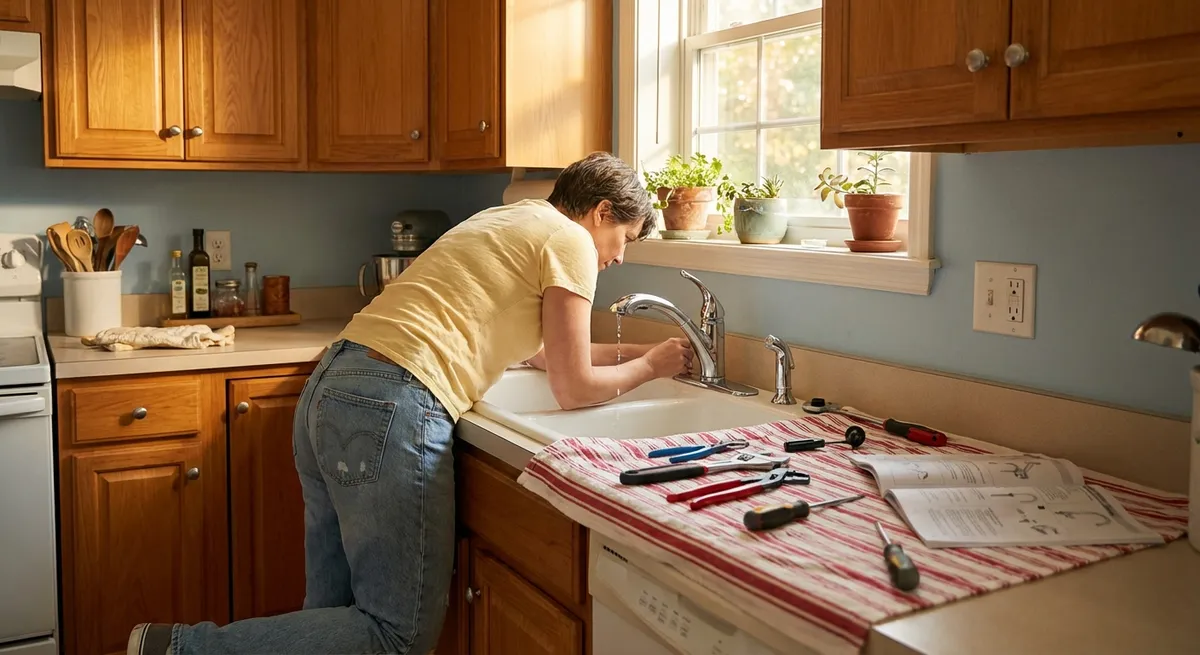
Small problems rarely stay small in a house. A loose tile, a hairline crack, or a sticky door is easy to ignore—until it turns into a leak, a draft, or a repair bill you weren’t ready for. This guide walks you through five practical, step-by-step home repairs that DIY enthusiasts can handle with basic tools and a little patience.
Each repair is geared toward preventing bigger issues, saving money, and making your home work better day to day.
Step 1: Stop a Small Wall Crack from Becoming a Big Problem
Minor drywall cracks often show up near doors, windows, or ceilings. They’re usually from normal settling, not structural failure—but if you ignore them, they grow and are harder to hide later.
What you’ll need:
- Utility knife
- Putty knife (2–4 inch)
- Joint compound or lightweight spackle
- Fiberglass mesh tape (for longer cracks)
- Sanding sponge or fine sandpaper (120–220 grit)
- Primer and matching paint
How to do it:
- Check the crack first.
If it’s wider than 1/4 inch, jagged, or accompanied by doors/windows sticking or visibly shifting, pause and consider professional evaluation. Hairline to small cracks are usually fine for DIY.
- Open up the crack slightly.
Use a utility knife to gently widen the crack into a “V” shape. This feels counterintuitive, but it gives the compound a better bite and reduces the chance of the crack reappearing along the same line.
- Clean the area.
Brush or vacuum dust out of the crack and wipe the area with a slightly damp cloth. Dry surfaces help compound bond properly.
- Reinforce if needed.
For cracks longer than about 6 inches, stick fiberglass mesh tape directly over the crack, pressing it flat. This adds strength and reduces future movement.
- Apply joint compound in thin layers.
Spread compound over the crack (and tape if used), feathering the edges out several inches beyond the damage. Let it dry fully, then sand lightly. Repeat with a second thin coat to blend it into the wall.
- Prime and paint.
Prime the patched area (joint compound absorbs paint differently than the wall). Once dry, paint with matching wall paint, feathering your brush or roller out to blend.
Pro tip: Take pictures before you repair. If similar cracks keep coming back in the same spot, you’ll have a record to show a contractor or inspector.
Step 2: Fix a Loose Floor Tile Before It Breaks
A loose ceramic or porcelain tile in a kitchen, hallway, or bath is more than annoying—it’s a trip hazard and can crack under pressure. Repairing one tile now is far easier than replacing several later.
What you’ll need:
- Safety glasses and work gloves
- Grout saw or oscillating tool with grout blade
- Putty knife or chisel
- Thin-set mortar (for floors) or tile adhesive (per manufacturer)
- Notched trowel (typically 1/4 inch)
- Tile spacers (if needed)
- Grout and grout float
- Sponge and bucket
How to do it:
- Remove the grout around the loose tile.
Use a manual grout saw or oscillating tool to carefully cut out grout on all sides of the tile. Work slowly to avoid chipping neighboring tiles.
- Lift the tile out.
Slide a putty knife or thin chisel under the tile edge and gently pry up. If it resists, continue removing grout until it loosens. Try to keep the tile intact—matching an old tile can be very difficult.
- Clean the base.
Scrape away old adhesive or thin-set from both the subfloor and the back of the tile. Vacuum dust. The surface should be smooth, clean, and solid.
- Check for underlying issues.
If the subfloor is soft, spongy, or visibly damaged, you may need to repair or replace that section before reinstalling the tile. Don’t just glue over rot or moisture damage.
- Re-set the tile.
Mix thin-set mortar per the bag directions. Use the notched trowel to spread a thin, even layer on the floor. Press the tile back into place, aligning with surrounding tiles. Use spacers if needed for even joints. Wiggle the tile slightly to seat it, then wipe away excess mortar from joints.
- Allow to set, then regrout.
Once the mortar has cured (typically 24 hours), mix grout and pack it into joints with a grout float. Wipe off residue with a damp sponge, rinsing often. Buff haze after it dries.
Pro tip: Keep one or two spare tiles from any new tiling project and a small bag of matching grout labeled and stored. Future you will be grateful.
Step 3: Silence a Squeaky Interior Door
A squeaky, sticky, or poorly closing door usually boils down to hinge issues or subtle shifts in the frame. It’s a simple fix that makes your home feel better instantly.
What you’ll need:
- Screwdriver (usually Phillips)
- Lubricant (silicone spray or petroleum jelly; avoid cooking oils)
- Wood toothpicks or wooden matchsticks
- Wood glue (optional)
- Level (optional, but helpful)
How to do it:
- Tighten hinge screws first.
Open the door halfway and support its weight (with a wedge or another person). Tighten all hinge screws in the door and the frame. Loose screws often cause sagging and rubbing.
- Fix stripped screw holes.
If a screw keeps spinning, the hole is likely stripped. Remove the screw and pack the hole with wood toothpicks or matchsticks dipped in wood glue. Let it set, then drive the screw back in. This gives the screw something solid to bite into.
- Lubricate the hinges.
Pull one hinge pin at a time (tap it up from the bottom with a nail and hammer if needed). Apply a small amount of lubricant to the pin and inside the hinge barrel, then reinstall. Open and close the door several times to work it in.
- Check for rubbing or binding.
Close the door slowly and look for spots where it rubs the frame or floor. You may see scuff marks where contact happens. Slight rubbing at the top can mean the door has sagged.
- Adjust door positioning.
For mild sagging, slightly loosen the screws on the top hinge and lift the door gently into a better alignment, then retighten. If the gap is still uneven, you can add a thin cardboard shim behind a hinge leaf to adjust the angle.
Pro tip: If you’re repainting doors, don’t paint hinge barrels or pins. Paint build-up is a common cause of squeaks and poor closing.
Step 4: Refresh a Failing Caulk Line Around a Tub or Sink
Cracked, moldy, or missing caulk around tubs, showers, and sinks doesn’t just look bad—it invites water into walls and under fixtures. Recaulking is one of the highest-impact, lowest-cost repairs you can do.
What you’ll need:
- Caulk remover (optional but helpful for old, stubborn caulk)
- Utility knife and/or caulk removal tool
- Painter’s tape
- 100% silicone or mold-resistant tub/shower caulk (bath areas)
- Caulk gun (for standard tubes)
- Paper towels or rags
- Bowl of water with a drop of dish soap (for smoothing)
How to do it:
- Remove the old caulk completely.
Use a caulk removal tool or utility knife to cut and peel away the old bead. Scrape residue carefully without gouging the tub or countertop. Chemical caulk remover can help with stubborn sections—follow label directions.
- Clean and dry the area.
Wipe the joint with a mild cleaner, rinse, and let it dry thoroughly. Moisture trapped under new caulk shortens its life and can trap mold.
- Mask for clean lines.
Run painter’s tape parallel to the joint, leaving the gap you want to fill exposed. This makes it much easier to create a neat, straight bead, especially if you’re new to caulking.
- Apply a steady bead of caulk.
Cut the caulk tube tip at a 45° angle, starting with a small opening. Apply constant pressure and move the gun at a steady pace, filling the joint without big gaps or blobs.
- Tool the caulk for a smooth finish.
Dip a finger in the soapy water and gently run it along the bead to smooth and press it into the gap. Wipe excess on a paper towel as you go.
- Remove tape and let it cure.
Pull painter’s tape away at a 45° angle while the caulk is still wet for crisp edges. Let the caulk cure as directed (typically 24 hours) before using the tub or sink normally.
Pro tip: Use silicone caulk marked specifically for “kitchen & bath” or “tub & tile” with mold/mildew resistance in wet areas. Use paintable latex caulk only where you plan to paint over it, like trim or baseboards.
Step 5: Secure a Loose Electrical Outlet (Without Rewiring)
A loose outlet that shifts when you plug something in is more than an annoyance. Over time it can stress wires and crack faceplates. You can usually secure it without touching any wiring—just the mounting.
Safety first: If you feel unsure at any point, stop and contact a licensed electrician.
What you’ll need:
- Flathead and Phillips screwdrivers
- Outlet spacers or electrical box extenders (often plastic or fiber shims)
- Needle-nose pliers (optional)
- Non-contact voltage tester (strongly recommended)
How to do it:
- Turn off power at the breaker.
Don’t rely on a wall switch. Go to your electrical panel, find the correct circuit breaker, and switch it off. Use a non-contact voltage tester at the outlet to confirm power is off.
- Remove the faceplate.
Unscrew and remove the cover plate. Set screws and plate aside where you won’t lose them.
- Check the outlet’s mounting screws.
Gently pull the outlet forward just enough to see how it’s mounted to the electrical box. There will be one or two screws securing it to the box. If they’re simply loose, tighten them gently and see if that stabilizes the outlet.
- Add spacers if the box is recessed.
If the electrical box sits too far back behind the wall surface, the outlet can’t tighten firmly. Use outlet spacers or plastic shims behind the outlet’s mounting ears to bring it flush with the wall. Tighten the screws snugly, but don’t overtighten and crack the plastic.
- Reinstall the faceplate and test.
Put the cover plate back on, turn the breaker back on, and test with a plug. The outlet should feel firm, not move around, and the faceplate should sit flat against the wall.
Pro tip: If you see scorched marks, melted plastic, loose or damaged wires, or an overloaded box when you remove the outlet, stop and call an electrician. That’s beyond a simple mechanical fix.
Conclusion
Tackling small home repairs before they escalate is one of the smartest things a DIYer can do. Tightening up a door, re-securing a tile, or sealing a tub edge doesn’t require fancy tools, but it does require attention and a bit of method.
Use these five repairs as a starting playbook:
- Address minor wall cracks
- Secure loose tiles
- Tune up squeaky interior doors
- Refresh failing caulk lines
- Stabilize loose outlets safely
Build the habit of fixing small issues as you spot them. Over time, your home will feel more solid, look better, and cost less to maintain—and you’ll build real, repeatable repair skills instead of just patching problems when they’re already big.
Sources
- U.S. Consumer Product Safety Commission – Home Electrical Safety Checklist - Guidance on safe practices around outlets, circuits, and basic electrical safety.
- University of Missouri Extension – Repairing Drywall - Detailed instructions and diagrams for patching and repairing common drywall issues.
- Family Handyman – How to Re-Caulk a Bathtub or Shower - Practical walkthrough of removing old caulk and applying a clean, durable new bead.
- The Tile Council of North America (TCNA) - Industry recommendations and FAQs on tile installation and repair best practices.
- Energy.gov – Doors and Windows - Explains how properly functioning doors and frames affect comfort and energy efficiency.
Key Takeaway
The most important thing to remember from this article is that this information can change how you think about Home Repair.