When an interior door starts sticking, dragging, or refusing to latch, it can make your home feel older and more frustrating than it really is. The good news: most stuck-door problems are fixable in an afternoon with basic tools. This guide walks you through the most common causes and gives you clear, step-by-step instructions to get your doors swinging smoothly again—without calling a contractor.
Diagnose Why Your Door Is Sticking
Before you start planing, sanding, or pulling hinge pins, figure out what’s actually going wrong. A quick diagnosis saves time and avoids making the problem worse.
Look at where the door is binding. Does it rub the floor, the top of the frame, or the latch side? Close the door slowly and watch:
- If it hits the top or side of the frame: the door or frame may be out of alignment, or the hinges may be loose.
- If it drags on the floor or carpet: the door may have sagged or swollen, or the flooring may have changed.
- If it won’t latch cleanly: the strike plate or latch may be misaligned, or the door might not be fully closing at the top.
Use a pencil to lightly mark the spots where the door rubs. Slide a piece of paper between the door and the frame all the way around; places where the paper catches show tight spots. Also check for gaps that are wider at the top or bottom on the latch side—that usually means the door is sagging on the hinges.
Moisture can also be a factor. If the door is worse during humid seasons, wood swelling may be part of the issue. Keep that in mind as you decide how much material to remove later; you don’t want to over-trim a door that will shrink again when the air dries out.
Step 1: Tighten Hinges to Fix a Sagging Door
A surprising number of sticky doors are caused by nothing more than loose hinge screws. Tightening them is the simplest fix and should always be your first move.
- Open the door fully so you can easily reach the hinges. Support the door lightly with a wedge, stack of books, or doorstop under the latch side if it feels like it’s sagging.
- Inspect all hinge screws on both the door and the frame (jamb). Look for screws that are backed out, stripped, or missing.
- Tighten each screw with a screwdriver, not a drill, so you don’t over-torque and strip the wood. Start with the top hinge on the frame side—this hinge carries most of the door’s weight.
- Replace stripped screws with longer ones (2½"–3") that reach into the wall framing, not just the jamb. Use screws with the same head style and finish as the existing hardware when possible.
- Check the swing and latch after tightening. Close the door slowly and see if the rubbing or misalignment has improved. Sometimes this step alone solves everything.
If the door still sags after tightening, you may need to use longer screws in the top hinge on the frame side to pull the door back toward the jamb. Drive a long screw in, then test the swing after each partial turn; you’re effectively tweaking the door’s position by tiny amounts.
Step 2: Adjust Hinge Position Without Rebuilding the Frame
If tightening doesn’t fully fix the problem, you can often re-position hinges slightly to adjust how the door hangs. This is more precise but still doable with basic tools.
- Identify which direction the door needs to move.
- If the gap is too tight at the top latch side, you need to pull the top hinge (on the frame) inward.
- If the door is binding near the bottom latch side, you may need to move the bottom hinge in or the top hinge out slightly.
- Loosen the hinge screws slightly on the jamb (frame) side only. Don’t remove them yet—just back them off enough that the hinge leaf can shift with a bit of pressure.
- Use cardboard or playing-card shims if you need to move the hinge away from the wood. Place a thin shim behind the hinge leaf on the door or jamb, depending on which direction you want the door to move.
- Press or tap the hinge into the new position. For pulling the hinge tighter to the jamb, you can drive a long screw (as in Step 1) to draw it in. For pushing it outward, the shim behind the hinge will hold the new position.
- Re-tighten all screws and test the door. Open and close it several times. If it still binds in places, make small adjustments rather than big ones—fractions of a millimeter make a noticeable difference.
Take your time with this step. It’s often better to do two or three small adjustments with testing in between than to move a hinge too far and have to undo your work.
Step 3: Plane or Sand a Swollen Door Edge
If the door binds in one tight area even after hinge adjustments, the wood itself is probably too wide or has swollen from humidity. Planing or sanding that area is the next step.
- Remove the door from the hinges.
- Place a wedge or sturdy object under the door to support it.
- Tap the hinge pins up and out with a nail set or small screwdriver and hammer.
- Carefully carry the door to a pair of sawhorses or a flat work surface.
- Mark the problem area clearly. Use the pencil marks you made earlier, and extend them around the edge so you know where to remove material.
- Decide how much to remove. Start conservatively—usually 1–2 mm is enough. Remember that wood can shrink and swell with seasons; taking off too much can create a permanent gap in drier weather.
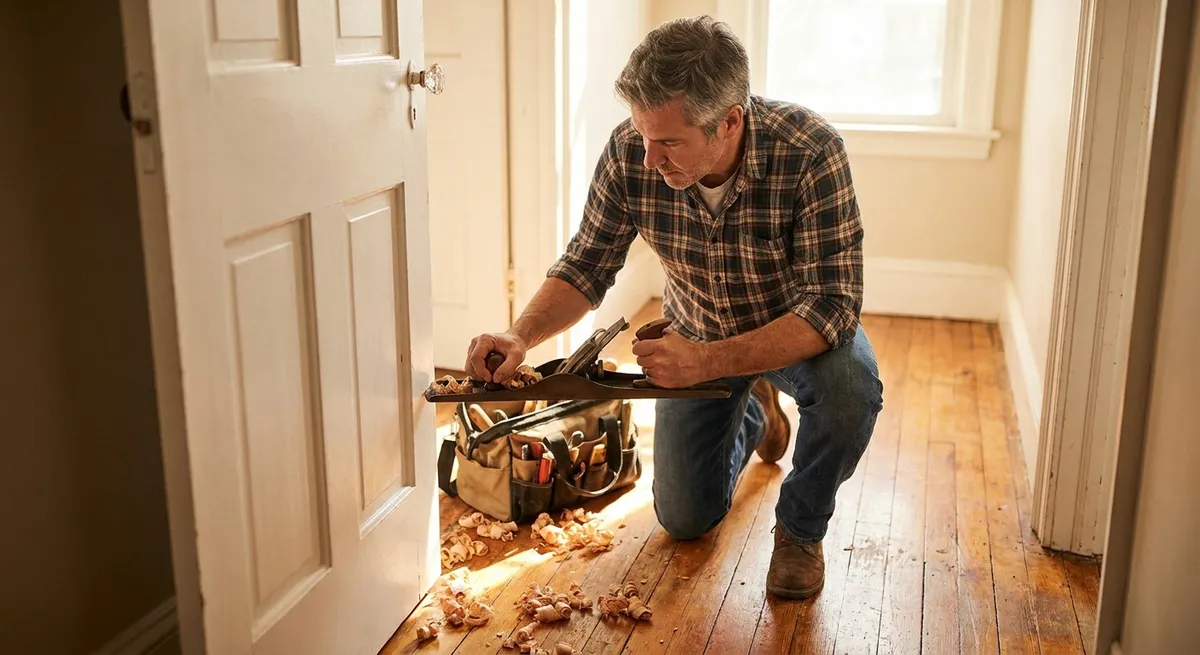
- Use a hand plane or sanding block to shave down the edge.
- Work with the grain to avoid splintering.
- Check your progress often. You can also use a straightedge to keep the edge even.
- Test fit the door. Put it back on the hinges temporarily (you don’t have to fully drive in all pins for a quick check) and see if it clears the frame smoothly. If it still rubs, remove a little more material and retest.
- Seal the exposed wood once you’re satisfied. Apply paint or a clear sealer to the newly trimmed edge to protect it from moisture; unsealed wood can swell and bring the problem back.
Planing is messier but offers good control. If you don’t own a hand plane, medium-grit sandpaper on a sanding block will work—just slower. Avoid aggressive power sanding unless you’re confident you won’t gouge the edge.
Step 4: Realign a Misbehaving Latch and Strike Plate
Sometimes the door swings fine but doesn’t latch properly. The latch might hit the strike plate too high, too low, or not at all. Fixing this is usually straightforward.
- Identify the misalignment. Close the door slowly and watch where the latch hits the strike plate. You can color the latch with a dry-erase marker or lipstick, then close the door gently—where the color transfers to the strike plate shows the contact point.
- Try the simple bend first (for small misalignments).
- Remove the strike plate screws.
- Use pliers to bend the lip of the strike plate slightly inward or outward so the latch can engage more easily.
- Reinstall and test.
- Adjust the strike plate position if needed.
- For up/down misalignment, remove the strike plate and chisel or file the mortise (recess in the jamb) slightly in the direction you need.
- For side-to-side adjustment, you may be able to widen the hole in the jamb slightly with a round file so the latch has more room to enter.
- Reinstall the strike plate. If you had to move it significantly, you might need wood filler for old screw holes and to drill new pilot holes so the screws hold well.
- Check both closing and latching. The door should close without force and the latch should click into place solidly when you push the door shut with a normal amount of pressure.
If the door latches only when you lift the handle or push up on the door, that often means the whole door is still sagging slightly—go back and confirm your hinge adjustments from earlier steps.
Step 5: Address Seasonal Sticking and Humidity Issues
If your door is fine in winter but swells and sticks every summer (or after heavy rain), dealing with moisture and airflow can prevent repeat problems.
- Improve ventilation around the door. Make sure the room has adequate air circulation. Use exhaust fans in nearby bathrooms or kitchens as intended, and avoid blocking supply or return vents with furniture.
- Control indoor humidity.
- Use a dehumidifier in damp basements or humid rooms.
- Keep indoor humidity ideally around 30–50% to reduce wood expansion.
- Seal exposed wood surfaces. Check the top and bottom edges of the door; these are often left unpainted or unsealed. Apply a coat of primer and paint or a suitable clear finish to help limit moisture absorption.
- Trim minimally if the issue is strictly seasonal. If the sticking only happens during a specific time of year, remove the least amount of material necessary to allow the door to function. Over-trimming can leave noticeable gaps once the door dries out.
- Monitor over a few weeks. After making adjustments, keep an eye on how the door behaves as humidity changes. If you notice the same pattern each year, you may need to fine-tune HVAC settings or consider a more robust dehumidification strategy for that area of the home.
Thinking about the environment around the door, not just the door itself, gives you a longer-lasting fix and helps prevent other moisture-related issues like warped trim or peeling paint.
Conclusion
A stuck interior door feels like a big repair job, but in most homes it comes down to a handful of fixable issues: loose hinges, minor misalignment, swollen wood, or a fussy latch. By working through these steps in order—tightening, adjusting, trimming, and sealing—you can usually restore a smooth, satisfying swing in an afternoon.
Start with the least invasive fixes, test as you go, and make small, controlled adjustments. With a few basic tools and some patience, you’ll not only solve the current problem but also understand how to keep every door in your home working the way it should.
Sources
- U.S. Department of Energy – Home Humidity Control - Explains how indoor humidity affects materials like wood doors and how to manage it
- Family Handyman – How to Fix a Sticking Door - Step-by-step reference for hinge, planing, and latch adjustments
- This Old House – How to Fix a Sticky Door - Practical tips and visuals on diagnosing door alignment problems
- Fine Homebuilding – Hanging and Adjusting Interior Doors - In-depth guidance on how doors should be hung and tuned for proper operation
Key Takeaway
The most important thing to remember from this article is that this information can change how you think about Home Repair.