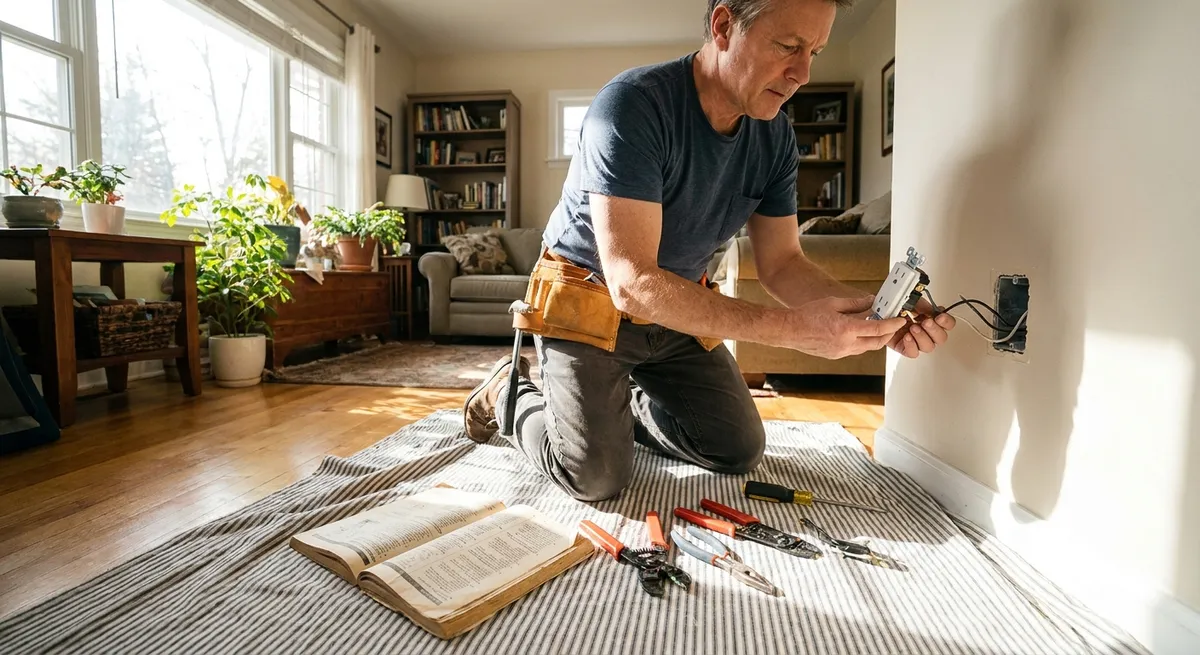
If you’re tired of extension cords and crowded power strips, adding a new electrical outlet can be a game‑changer. The good news: with basic tools, careful planning, and attention to safety, many DIYers can handle this upgrade. This guide walks you through the process step by step—from planning the circuit to testing your work—so you can add an outlet that’s safer, neater, and more convenient.
Important: If your local code or comfort level says “this is too much,” hire a licensed electrician. There’s no shame in calling in a pro for electrical work.
Before You Start: Safety, Codes, and Tools
Working with household wiring is serious business. A clean, code‑compliant outlet is almost invisible in day‑to‑day use—but a bad connection or overloaded circuit can cause shocks or fires.
First, get familiar with the basics of safety and legality:
- Check your local electrical code and permit requirements. Some areas allow homeowners to do their own wiring; others require a licensed electrician or a permit and inspection.
- Know your home’s wiring type. Most modern homes use NM‑B cable (often called Romex) with copper conductors. If you see aluminum wiring or knob‑and‑tube, stop and consult a pro.
- Understand circuit limits. A standard 15‑amp circuit typically uses 14‑gauge wire. A 20‑amp circuit uses 12‑gauge wire. Never connect smaller gauge wire to a higher‑amp circuit.
Basic tools and materials you’ll likely need:
- Non‑contact voltage tester and/or multimeter
- Stud finder
- Utility knife and wire stripper (rated for your wire gauge)
- Screwdrivers (flat and Phillips)
- Needle‑nose pliers
- Keyhole or drywall saw
- Fish tape or fiberglass fish rods
- NM cable (match the existing circuit gauge and type)
- Old‑work (remodel) electrical box, UL‑listed
- Standard 15A or 20A receptacle (match the circuit)
- Outlet cover plate
- Cable staples or approved supports
- Electrical tape and wire connectors (if splicing)
Step 1: Plan the Location and Confirm the Circuit Can Handle It
Before cutting into any walls, decide exactly where your new outlet will go and whether the existing circuit can support it.
- Choose a practical, code‑friendly spot.
- Avoid locations above baseboard heaters, directly behind sinks, or within shower/tub areas.
- Aim for 12–18 inches above finished floor, matching the other outlets in the room.
- Use a stud finder to find a cavity that’s free of studs, plumbing, or existing wires where you need to cut.
- Identify the source circuit.
- You’ll usually extend from an existing outlet on the same wall or from a nearby junction box.
- Turn on a lamp at that outlet, then flip breakers until it goes off to find the correct breaker.
- Check the load on the circuit.
- Kitchen, bathroom, laundry, and dedicated appliance circuits often run near capacity and may not be suitable to extend.
- If that circuit already powers many outlets or high‑draw devices (space heaters, hair dryers, microwaves), consider using another circuit or consult an electrician.
- Confirm you’re not extending from a dedicated or specialty circuit.
- Don’t add general outlets to circuits serving refrigerators, microwaves, dishwashers, laundry, sump pumps, or other dedicated appliances.
- GFCI‑protected bathroom and kitchen small‑appliance circuits have specific rules—check code or ask a pro.
- Plan the cable path.
- The cleanest approach is often from an existing outlet on the same wall cavity, either horizontally or vertically.
- Avoid exterior walls filled with insulation if possible; fishing wire there is harder, and you may have vapor barrier considerations.
Step 2: Turn Off Power and Open the Existing Box Safely
Once you’ve planned the layout, it’s time to make things safe to work on.
- Shut off the correct breaker.
- At the main panel, turn off the breaker feeding the source outlet.
- Label it if it wasn’t already clearly marked.
- Verify power is off—don’t skip this.
- Use a non‑contact voltage tester at the existing outlet: test hot slots, screws, and nearby surfaces.
- Remove the cover plate and outlet mounting screws, gently pull the outlet forward, and test all wires again.
- Inspect the wiring in the existing box.
- Confirm wire gauge, color, and condition. You should see hot (black/red), neutral (white), and ground (bare/green).
- If the box is already crammed full of wires or looks damaged, you may need to use a different source or have an electrician install a junction box elsewhere.
- Check box fill capacity.
- Electrical boxes have a maximum number of conductors they can legally and safely contain, based on volume.
- If you’re adding another cable, make sure the volume of the box and the number of wires won’t exceed its rating (this is often stamped inside the box). If it will, the existing box may need to be replaced with a deeper or larger one.
- Free up working room.
- Carefully straighten wires with needle‑nose pliers.
- Take a photo of the existing connections so you can restore or reference them later.
Step 3: Cut In the New Outlet Box and Run the Cable
Now you’ll create the opening for the new outlet and run cable between the two points.
- Mark the box location.
- Hold the old‑work (remodel) box against the wall where you want it. Trace around it lightly with a pencil.
- Use your stud finder again to confirm no stud is behind the outline; if there is, shift the box slightly.
- Cut the opening.
- Use a drywall saw or keyhole saw to carefully cut along your traced line.
- Keep the cut as clean and tight as possible; old‑work boxes rely on the drywall for support.
- Prepare the new box.
- Remove the cable clamp knockout in the new box.
- If the box doesn’t include built‑in clamps, use approved cable clamps or connectors.
- Run cable between boxes.
- Measure the distance plus some slack (typically add at least 12 inches for each box).
- If running straight through the same stud cavity, you may be able to fish cable directly through the wall opening.
- For longer runs, use fish tape:
- Feed from one box opening to the other.
- Attach the cable end securely with electrical tape.
- Pull gently and steadily until the cable appears at the other opening.
- Secure and protect the cable.
- Maintain at least 6–8 inches of cable inside each box for connections.
- In accessible framing spaces, staple NM cable within code requirements (often within 8–12 inches of the box and every 4.5 feet, but confirm local code).
- Avoid sharp bends; gentle curves protect the conductors inside.
Step 4: Wire the New Outlet and Tie Into the Existing Circuit
This is where your planning pays off—neat, solid connections are critical for safety and reliability.
- Strip and prepare wires.
- Use a cable ripper or utility knife to remove the outer sheath, exposing about 6–8 inches of individual conductors inside the box.
- Strip about 3/4 inch of insulation from the ends of hot (black), neutral (white), and ground (bare or green) wires.
- Install the cable into the new box.
- Feed the cable through the box clamp so the outer sheath enters at least 1/4 inch inside the box.
- Tighten clamps just enough to hold the cable firmly without crushing it.
- Insert the box into the wall opening and tighten the box’s mounting wings or clamps until snug.
- Connect the new receptacle.
- Attach the ground wire to the green grounding screw on the outlet; loop clockwise and tighten firmly.
- Connect the neutral (white) wire to the silver‑colored terminal.
- Connect the hot (black) wire to the brass‑colored terminal.
- Use the side screws rather than back‑stab connections; side screws are more secure and reliable.
- Tie in at the source box.
- You should now have an additional cable in the original box.
- Connect grounds together with a wirenut, including a pigtail (short ground wire) to attach to the device or metal box if required.
- Connect all neutrals together with a wirenut, again using a neutral pigtail if needed to reach the receptacle.
- Connect all hots together with a wirenut plus a hot pigtail to feed the original outlet.
- Keep wire nuts tight and give each conductor a gentle tug to confirm they’re secure.
- Tuck wires and mount devices.
- Carefully fold wires into each box, avoiding sharp kinks and keeping grounding conductors away from hot terminals.
- Mount the receptacles straight and snug, but don’t overtighten the screws; over‑tightening can crack the device or warp the box.
Step 5: Restore Power, Test, and Finish the Installation
Now you’ll make sure your new outlet works correctly and safely before calling the job done.
- Install cover plates.
- Once devices are securely mounted, add cover plates at both the existing and new outlets.
- Check that the plates sit flat against the wall; gaps could indicate the outlet isn’t seated properly.
- Restore power at the panel.
- Turn the breaker back on for the circuit you worked on.
- Keep your hands off the outlets themselves while you flip the breaker.
- Test for proper power and polarity.
- Use a plug‑in outlet tester (very inexpensive and widely available) to check wiring.
- Confirm: hot and neutral are not reversed, ground is present, and the tester shows a “correct wiring” pattern.
- Test under normal load.
- Plug a lamp or small device into the new outlet and the original one.
- Leave them running for a bit and feel the cover plate—there should be no unusual warmth.
- Document your work.
- Update any home electrical diagrams or notes you keep.
- Label the breaker panel clearly to show the new outlet is on that circuit. This helps you (and any future electrician) stay safe and efficient during future work.
Conclusion
Adding a new electrical receptacle is one of those upgrades that makes a daily difference: fewer cords, cleaner walls, and more flexible furniture layouts. With solid planning, respect for electrical safety, and careful workmanship, many DIYers can tackle this project successfully.
If at any point you’re unsure about box fill, circuit load, grounding, or local code, pause and get expert input. A quick consult with a licensed electrician—or having them handle the trickiest parts—can turn a risky guess into a safe, long‑lasting improvement to your home.
Sources
- U.S. Consumer Product Safety Commission – Home Electrical Safety Checklist – Covers basic household electrical safety practices and hazard recognition
- National Fire Protection Association (NFPA) – Electrical Safety in the Home – Explains common electrical fire risks and safe wiring habits
- U.S. Department of Energy – Wiring and Electrical – General guidance on residential wiring, codes, and efficiency considerations
- The Family Handyman – How to Add an Electrical Outlet – Practical, photo‑illustrated tutorial on adding outlets and extending circuits
- Lowe’s DIY Projects – How to Install an Electrical Outlet – Step‑by‑step outlet installation guide with tool lists and safety notes
Key Takeaway
The most important thing to remember from this article is that this information can change how you think about Home Repair.