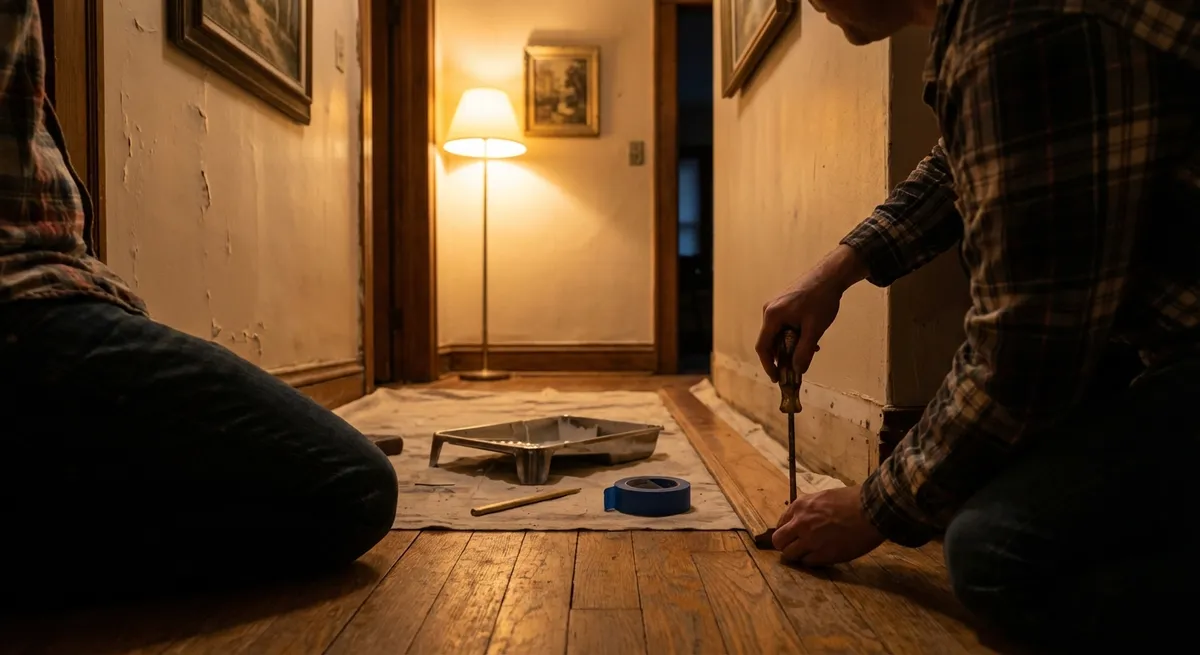
A lot of the most annoying issues at home aren’t dramatic disasters—they’re the small, everyday problems that slowly drive you nuts. A door that never quite closes, a cabinet that slams, a wall full of mystery holes from old picture frames. These “quiet” problems don’t look like much, but fixing them is one of the fastest ways to make your home feel solid, calm, and well cared for.
This guide walks you through five practical repairs that most DIYers can handle with basic tools. Each one tackles a different part of your home, and each set of steps is designed so you can follow along with confidence, even if you’re still building your skills.
Step 1: Fix a Door That Won’t Latch or Keeps Swinging Open
A door that won’t stay shut or swings by itself is more than annoying—it’s a sign something’s out of alignment. Before you think “new door,” try this simple sequence to diagnose and fix the problem.
- Inspect the hinges first. Open the door halfway and gently lift up on the handle. If you feel a lot of play or hear clicking, the hinges are likely loose. Look for visible gaps between hinge leaves and the jamb, or screws that aren’t tight.
- Tighten and upgrade hinge screws. Use a screwdriver (not a drill at first) to snug each screw on the hinges. If a screw spins without grabbing, replace it with a longer wood screw (2–2½" often works) so it bites into the framing, not just the jamb. Work one screw at a time so the hinge stays aligned.
- Check the strike plate alignment. Close the door slowly and watch how the latch hits the strike plate on the jamb. If it hits above or below the opening, the door has sagged or shifted. If it hits too far in or out, the latch and plate are misaligned front-to-back.
- Adjust the strike plate before cutting the door. For small misalignments, loosen the strike plate screws slightly and tap the plate up, down, or sideways with a screwdriver handle, then retighten. Test the door after each adjustment. If you need more movement, you can carefully file the opening of the plate a bit wider.
- Deal with gaps and drafts. If the latch works but you still feel a draft or see a big gap, add or upgrade weatherstripping along the jamb. Adhesive foam strips are easy to install: clean the surface, measure twice, cut once, and press firmly in place with the door closed to set the thickness.
- Fix a door that swings open by itself. If the latch works but the door always swings, your jamb or hinges may be slightly out of plumb. An easy fix: slightly bend the hinge pin on the top hinge. Remove the pin, tap a subtle curve into it on a hard surface, then reinstall. The added friction helps the door stay put.
- Test the door under “normal use.” Don’t just close it gently with your hand. Pull it shut from outside the room, walk away, and come back. If it still latches cleanly and doesn’t swing on its own, you’re done. If not, repeat minor adjustments rather than trying a big, risky change.
Step 2: Patch Nail Holes and Small Wall Dents So They Actually Disappear
Random nail holes and dents can make even a freshly painted room look tired. The trick is not just filling them—but doing it in a way that blends with the existing wall so they won’t flash under light.
- Prep the surface properly. Wipe the area with a dry cloth to remove dust. For glossy paint, lightly scuff around the hole or dent with fine sandpaper (180–220 grit) to help the patch material stick. Don’t skip this; adhesion is everything.
- Choose the right filler for the size. For tiny nail holes and hairline cracks, lightweight spackle works well and sands easily. For deeper dents or small gouges, use a slightly heavier spackle or joint compound that can be applied in thin layers without shrinking too much.
- Apply in thin, controlled layers. Use a flexible putty knife slightly wider than the damaged area. Press the filler into the hole or dent, then skim off the excess by drawing the knife at a shallow angle, leaving the patch slightly proud (raised) of the wall. For deeper spots, let the first layer dry fully, then repeat.
- Sand and feather the edges. Once completely dry (follow the product’s time, don’t rush it), sand lightly with fine paper. Focus on the edges so the patch transitions smoothly into the original wall. If you see a noticeable bump or ridge under light, add a bit more filler and repeat—it’s better to fix now than after paint.
- Spot-prime smartly. Unprimed patches almost always flash through paint, especially under glancing light. Use a small brush or mini roller to prime just the patched area and slightly beyond. If you’re working on a high-sheen wall (eggshell or semi-gloss), primer is non-negotiable.
- Blend the paint, don’t just dab it on. If you have leftover paint, use a small roller to feather the new paint into the old. Work in a slightly larger area than the patch, overlapping the existing paint edge so there’s no visible “bullseye.” If you don’t have the exact color, consider repainting the whole wall for a truly clean look.
- Check under different lighting. Look at the patched area in daylight and with lamps on. Any ridges or shiny spots usually show up in side lighting. If you see them, lightly sand and touch up again. The goal is a repair you can’t find even when you know where to look.
Step 3: Stop a Baseboard Draft Without Replacing Trim
Cold air sneaking in around baseboards or trim can make a room feel drafty even if your thermostat says it’s warm. Sealing gaps is straightforward and can make a noticeable difference in comfort and energy use.
- Identify the actual draft path. On a breezy day or with the HVAC running, run your hand along the baseboards and around window/door trim. A lit incense stick or a small strip of tissue can help reveal movement of air. Mark problem spots with painter’s tape or a pencil.
- Choose the right sealant. For gaps between trim and painted walls, use paintable acrylic latex caulk. For larger gaps between trim and flooring (especially if the floor moves seasonally), consider a more flexible product labeled for “high movement” or “indoor/outdoor” use. Avoid silicone where you plan to paint—it doesn’t take paint well.
- Prep the joint like a pro. Vacuum or brush out dust and debris from the gaps. If old, cracked caulk is present, cut it out with a utility knife and pry it free with a putty knife. Clean, dry surfaces are key to a durable seal.
- Apply smooth, continuous beads. Cut the caulk tube tip at a small angle with a small opening; you can always cut more off if needed. Run a steady bead along the joint without stopping every few inches. It doesn’t need to be perfect—smoothing will refine it—but avoid huge blobs that will smear everywhere.
- Tool the caulk immediately. With a damp finger or a caulk tool, press gently into the joint and smooth the bead in one continuous pass. Wipe excess onto a rag as you go. Aim for a neat, concave joint that just fills the gap without flooding onto the wall or trim.
- Let it cure before painting. Follow the product’s recommended dry time; some “fast paint” formulas are ready in 30 minutes, while others need several hours. Painting too soon can cause shrinking lines or cracking. Once dry, tape off as needed and paint the trim or wall for a seamless look.
- Retest for drafts. After everything is fully cured, repeat your air test. If you still feel a breeze in certain areas, look for gaps you missed—often at inside corners or around outlets and cable penetrations. Seal those too for a more complete fix.
Step 4: Quiet a Loose or Squeaky Floorboard Without Tearing Up Flooring
That one board that squeaks every time you step on it can make an entire hallway feel cheap. You can usually tighten things up from above or below with targeted fastening and a bit of care.
- Locate the exact trouble spot. Walk slowly over the area and mark where you feel movement or hear noise. Have someone else step on it while you watch to see if the board visibly flexes. Mark the worst spots with painter’s tape or a small pencil mark.
- Find the underlying joist. Use a stud/joist finder or, if you have access from below, measure joist spacing and transfer those measurements to the floor above. Squeaks happen when the subfloor moves against the joist or the finished flooring moves against the subfloor.
- For carpeted floors, use hidden fasteners. Special “squeak repair” screw kits let you drive screws through the carpet and subfloor into the joist, then snap the screw head off just below the surface. Follow the kit instructions closely so you don’t twist or tear the carpet.
- For hardwood or laminate, choose fasteners carefully. For real hardwood, you can sink trim-head screws or finish nails at an angle through the board into the subfloor or joist. Pre-drill to prevent splitting, and countersink slightly so you can fill the holes with color-matched wood filler. For laminate, avoid nailing through the surface; instead, focus on tightening from below if you have access.
- Tighten from below when possible. If you have an unfinished basement or accessible crawl space, screw the subfloor to the joists from underneath at the squeaky area. Use construction screws, not nails, to avoid future loosening. If there’s a visible gap between joist and subfloor, pull them together with screws and, if needed, a thin shim glued in place.
- Lubricate minor squeaks as a temporary fix. Where you can’t add fasteners, sprinkling powdered graphite or talc between boards can sometimes reduce noise. Work it into the joints and vacuum the excess. This won’t fix structural movement, but it can calm minor chatter.
- Test with daily-use pressure. Walk, turn, pivot, and shift your weight over the repaired area like you normally would. If you still hear a faint squeak, add another fastener within a few inches of the first or check for a neighboring board that’s sharing the movement.
Step 5: Replace a Wobbly Light Switch or Outlet Safely
Loose switches and outlets don’t just look sloppy—they can be unsafe if wires are stressed or connections are poor. With basic precautions, you can tighten or replace them yourself.
- Shut off the correct circuit. At the breaker panel, turn off the circuit that feeds the switch or outlet. Confirm power is off by plugging in a lamp or using a non-contact voltage tester. Never skip this verification; “it seems off” isn’t enough.
- Remove the cover plate carefully. Use a screwdriver to remove the plate screws, then gently lift the cover away. If it’s stuck to the wall by paint, lightly score around the edges with a utility knife so you don’t rip drywall paper or pull paint off in chunks.
- Check for simple mechanical looseness. With the cover off, gently wiggle the switch or outlet. Often, the device is just loose from the electrical box. Tighten the mounting screws at the top and bottom so the device sits flush and straight with the box.
- Inspect the wiring for obvious problems. If the device is badly damaged, burnt, or cracked, or if you see bare wires touching where they shouldn’t, stop and plan a full replacement of the device. Take a photo of the existing wiring before you disconnect anything; this is your reference for reassembly.
- Replace a worn device if needed. With power still off, loosen the terminal screws and remove the wires one at a time, connecting each to the same location on the new switch or outlet. For outlets, make sure you match hot (usually black) to brass screws and neutral (usually white) to silver screws. Ground wires should connect to the green screw.
- Secure and align everything. Fold wires neatly back into the box so they don’t pinch or force the device crooked. Tighten the mounting screws so the switch or outlet sits flat and level. Reinstall the cover plate and snug its screws—not so tight you crack the plate, just enough to sit flush.
- Restore power and test. Turn the breaker back on and test the switch or outlet with a lamp or device. Confirm that the device no longer wobbles under normal use. If you feel heat, see sparking, or anything seems off, switch the breaker off again and consult a licensed electrician.
Conclusion
Small, quiet repairs like these rarely make dramatic before-and-after photos, but they transform how your home feels to live in. Tight doors, solid floors, smooth walls, sealed trim, and stable switches all add up to a space that feels cared for and dependable.
Pick one of these projects and work through it step by step. As you get comfortable, share your progress—photos, short clips, or quick tips—with other DIYers. The more you tackle these “everyday” fixes, the more ready you’ll be when bigger projects come along.
Key Takeaway
The most important thing to remember from this article is that this information can change how you think about Home Repair.