Squeaky floors are annoying, but they’re also a great beginner-friendly home repair project. With a few basic tools and a bit of patience, you can track down the source of the noise and fix it without tearing your house apart. This guide walks you through simple, practical steps DIYers can use to quiet squeaks in both carpeted and hardwood floors.
Understand Why Your Floor Is Squeaking
Before you grab tools, it helps to know what you’re trying to fix. Most squeaks come from movement: wood rubbing on wood, or wood moving against nails or screws.
Common causes of squeaks include:
- Subfloor not firmly attached to floor joists
- Nails that have loosened and now rub in and out of the wood
- Gaps between subfloor panels
- Floorboards rubbing against each other
- Joists that have dried and shrunk slightly over time
Walk slowly over the noisy area and listen closely. Mark squeaky spots with painter’s tape or sticky notes. If you have access to the underside of the floor (like an unfinished basement or crawl space), have one person walk on the floor while another listens from below. This makes it much easier to see what’s moving and where the sound is coming from.
Step 1: Pinpoint the Squeak from Above and Below
Accurately locating the source saves you time and guesswork.
Mark noisy zones from above
Walk the room in soft shoes or socks. When you hear a squeak, stop and "rock" your weight back and forth on that spot. Use painter’s tape to mark the exact area.
Check below, if possible
If there’s an unfinished basement or crawl space, head underneath. Look for the underside of the marked area. Use a flashlight to find gaps, loose nails, or wood movement while someone walks upstairs.
Find the floor joists
- From below, joists are obvious: they’re the large framing members spaced 16–24 inches apart. - From above (if you can’t access underneath), use a stud finder set to “deep scan” and mark where the joists run across your squeaky area.
Press and tap test
Push up on the subfloor from below with your hand or a scrap of wood. If the squeak stops while someone stands above, you’ve found the problem area: the subfloor is loose at that joist.
Decide your access point
- If you can work from below, repairs are usually easier and more hidden. - If you can’t access from below (finished ceiling, no crawl space), you’ll fix the squeak from the top through the carpet or flooring.
Step 2: Fix Squeaks from Below with Shims and Screws
If you can get under the floor, start here. It’s the cleanest way to solve squeaks and works for most unfinished basements.
Gather materials
- Wood shims (thin, wedge-shaped pieces of wood) - Construction adhesive (optional but helpful) - 2½–3 inch wood screws - Drill/driver and drill bits - Flashlight or work light
Tighten loose subfloor with screws
- Locate where the subfloor sits on top of the joist near your marked squeak. - Drill a pilot hole from below through the joist into the subfloor (not through the finished flooring). - Drive a wood screw up into the subfloor snugly. Do not overtighten; you just want the subfloor pulled tight to the joist.
Use shims to fill gaps
- If you see a small gap between the top of the joist and the subfloor, apply a small amount of construction adhesive to a wood shim. - Gently tap the shim into the gap with a hammer until it’s snug. Do not pound it hard; too much pressure can lift the floor above and create a new problem. - Once the adhesive sets, you can cut off any excess shim with a utility knife or handsaw.
Secure bridging or blocking
Sometimes the squeak is in cross-bracing or blocks between joists. If these pieces move when someone walks above: - Add a screw through the blocking into the joist to stiffen it. - If necessary, add a new piece of blocking with screws on both sides to strengthen the area.
Test as you go
Have your helper walk or bounce gently on the floor above after each repair. If the sound improves but doesn’t disappear, adjust or add another screw a few inches away along the joist.
Step 3: Silence Squeaks Under Carpet Without Removing It
You can often fix a squeak under wall-to-wall carpet without pulling the carpet up. The goal is to re-secure the subfloor to the joists using screws that sit below the carpet surface.
Locate the joist through the carpet
- Use a stud finder to detect joists through the carpet and mark joist lines with painter’s tape on the carpet surface. - Confirm by gently pressing or rocking on the squeaky area; usually, the loudest noise is near a joist.
Use flooring-specific screw kits (recommended)
Commercial kits (like “Squeeeeek-No-More” or similar systems) are designed specifically for squeaks under carpet. They typically include special screws that break off below the surface so they don’t damage the carpet. - Follow the kit instructions to drive screws along the joist through the carpet and subfloor. - The screw head snaps off below the backing, leaving the carpet intact.
If you don’t have a kit (more advanced and risky)
This is less precise and you risk damaging the carpet, so use caution: - Use coarse-thread screws no longer than needed to go through subfloor into joist (often 2–2½ inches). - Gently spread carpet fibers with your fingers before driving the screw so the head is less likely to catch. - Drive screws slowly and stop as soon as the subfloor feels snug. - This method is best avoided if you’re not comfortable, or if your carpet is delicate.
Cover small holes in padding (if visible)
Usually, the screw holes are hidden by carpet fibers. If you notice any depression, gently brush and fluff the fibers around the area by hand to disguise it.
Re-test the floor
Walk the repaired area in different directions. If some squeaks persist, repeat the process with screws a few inches to one side along the same joist line.
Step 4: Tackle Squeaky Hardwood or Laminate from Above
For hardwood or laminate, you’ll work directly on the visible surface. The goal is still to stop movement, but you’ll care more about appearances.
- Identify loose boards vs. loose subfloor
- If an entire section moves slightly when you step, it’s likely the subfloor.
- If individual boards creak when flexed or when rubbed against each other, the boards themselves may be the issue.
Secure loose subfloor under hardwood
- Locate joists under the hardwood using a stud finder. - Pre-drill a small hole through the hardwood and subfloor into the joist at a slight angle. - Drive a trim-head or finish screw down until it just pulls the board tight. - Countersink the screw just below the surface and fill the hole with color-matched wood filler.
Reduce friction between hardwood boards
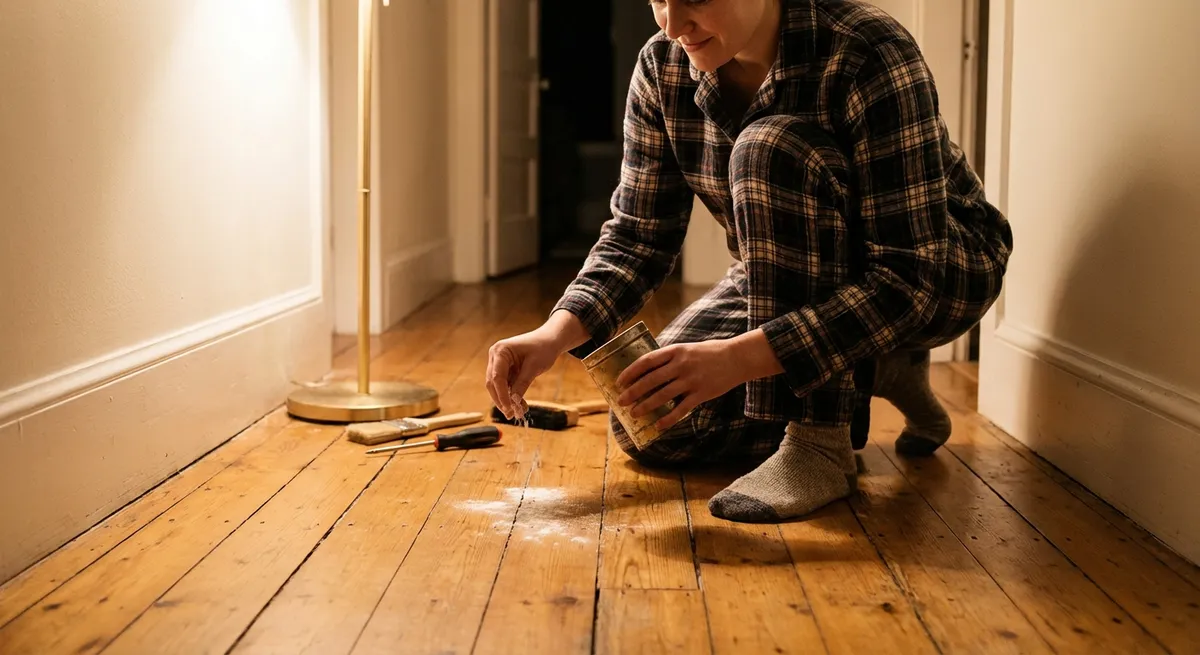
When boards squeak because they rub together, tension and friction are the culprits. - Sprinkle a small amount of powdered graphite, talcum powder, or a dry lubricant into the joint between squeaky boards. - Work it in by walking on the area or using a soft cloth to rub along the seam. - Wipe away any excess from the surface immediately.
Reattach loose tongue-and-groove boards
- For slightly separated boards, apply a small bead of wood glue in the joint. - Use a damp cloth to wipe away excess glue. - Place a heavy weight (like a stack of books on a board to spread the load) over the area while it dries.
Special note for laminate
Laminate floors “float” and are not meant to be screwed to the subfloor. Squeaks often come from uneven subfloors or poor underlayment. - Screwing through laminate can void warranties and cause damage. - Focus on checking for obvious soft spots or humps; if severe, you may need a partial lift and underlayment fix, which is a more advanced project.
Step 5: Prevent Future Squeaks with Simple Upgrades
Once you’ve done the hard work, a few preventative measures can keep your floors quieter for years.
Choose screws over nails for new work
Screws hold better over time and are less likely to loosen. If you ever open up floors or build new ones, use deck screws or subfloor screws instead of nails for attaching subfloor to joists.
Use construction adhesive under subfloor panels
When installing or replacing subflooring, apply a bead of construction adhesive on top of the joists before setting panels. This greatly reduces movement and squeaks.
Mind moisture levels
Wood expands and contracts with humidity: - Keep indoor humidity reasonably stable (generally around 30–50%). - Use a dehumidifier in damp basements and a humidifier in very dry winters if needed. - This helps prevent boards from shrinking, warping, or pulling away from fasteners.
Tighten fasteners periodically where accessible
In unfinished basements, do a quick yearly check: - Look for working or protruding screws/nails under frequently used areas like hallways or kitchens. - Add or tighten screws where you see movement or small gaps forming.
Address structural issues early
If you notice sagging joists, significant cracks, or wide gaps, that’s beyond normal squeaks. In those cases: - Avoid loading that area with heavy furniture. - Consult a licensed contractor or structural engineer for an evaluation. Fixing minor structural problems early can prevent expensive repairs later.
Conclusion
Silencing squeaky floors doesn’t require a full remodel or advanced carpentry skills. By tracking down where the movement happens and using basic tools—shims, screws, and sometimes a bit of lubricant—you can turn an irritating problem into a manageable DIY win. Whether you’re working from below in a basement, through carpet, or on finished hardwood, a methodical approach and a few careful fixes can make your home feel quieter, more solid, and more comfortable.
Sources
- [U.S. Department of Housing and Urban Development – Residential Rehabilitation Inspection Guide (Floor Systems)](https://www.hud.gov/program_offices/public_indian_housing/programs/ph/rhiip/uivmanual) - General guidance on inspecting and evaluating residential floor systems
- [University of Tennessee Extension – Preventing Problems in Wood Structures](https://extension.tennessee.edu/publications/Documents/W179.pdf) - Explains how wood movement, moisture, and fasteners affect floors over time
- [Fine Homebuilding – Stop Floor Squeaks from Above or Below](https://www.finehomebuilding.com/2008/06/05/stop-floor-squeaks-from-above-or-below) - Practical examples and techniques for locating and fixing squeaky floors
- [The Spruce – How to Fix Squeaky Floors](https://www.thespruce.com/how-to-fix-squeaky-floors-1824765) - Step-by-step homeowner-focused instructions for carpeted and hardwood floors
- [This Old House – How to Fix a Squeaky Floor](https://www.thisoldhouse.com/flooring/21015118/how-to-fix-a-squeaky-floor) - Demonstrates specific tools and repair methods for different flooring types
Key Takeaway
The most important thing to remember from this article is that this information can change how you think about Home Repair.