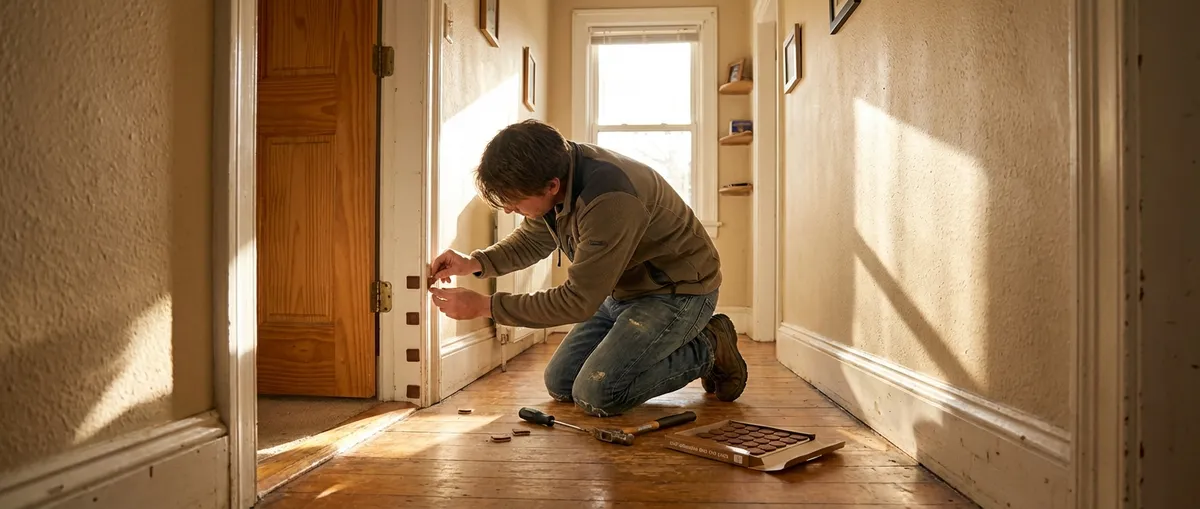
A slamming door is more than just annoying—it can crack trim, loosen hardware, and even damage walls over time. The good news: you don’t need a contractor to fix it. With a few basic tools and some simple adjustments, you can quiet a slamming door, make it close smoothly, and protect your home from unnecessary wear.
This guide walks you through five clear steps, from quick checks to longer-lasting fixes, so you can choose what fits your situation and skill level.
Step 1: Find the Real Reason Your Door Slams
Before you start adding gadgets or pads, figure out why the door is slamming. The fix is much easier once you know the cause.
First, close the door gently and watch what happens. Does it:
- Swing shut on its own from being slightly open?
- Slam hard as it hits the frame?
- Bounce off the latch and then slam again?
Next, check a few basics:
- Check for drafts. Light a match or use a stick of incense near the top and sides of the closed door. If the smoke moves strongly in one direction, you may have an air-pressure issue (like from a strong exhaust fan or open window) pulling the door shut.
- Look at the hinges. Are they loose? Rusty? Does the door sag at the latch side? A sagging door will hit the latch side harder and slam instead of latching smoothly.
- Inspect the latch and strike plate. Slowly close the door and watch where the latch hits the strike plate. If it scrapes, catches, or barely lines up, the latch can “grab and release,” causing a small slam.
- Check door frame and weatherstripping. Look for uneven gaps. A tight spot may make you push harder, then the door jumps forward and slams once it clears.
Once you’ve identified one or more of these issues, you’ll know which of the following steps to focus on most.
Step 2: Tighten and Adjust the Hinges
Loose or misaligned hinges are one of the most common reasons a door misbehaves. Fixing them often solves the slam without needing anything else.
Follow this process:
- Tighten existing screws.
- Use the correct screwdriver (usually a #2 Phillips) to snug each hinge screw on both the door and frame.
- Don’t overtighten to the point of stripping; firm and snug is enough.
- Check for sag.
- Stand back and look at the top of the door. The gap above the door should be fairly even from hinge side to latch side.
- If the gap is wider above the latch side, the door is sagging.
- Reinforce loose screw holes.
- If a screw just spins and won’t tighten, remove it.
- Push in a few wooden toothpicks or a short piece of wood skewer dipped in wood glue, then break them off flush.
- Reinsert the screw once the glue is tacky; this gives the screw fresh wood to “bite” into.
- Swap to longer hinge screws.
- For extra support, replace one screw in the top hinge (on the frame side) with a 2.5"–3" wood screw.
- Drive it carefully into the wall framing behind the jamb—this pulls the door up and toward the hinge side, helping correct sag.
- Lubricate moving parts.
- If the hinges squeak or feel stiff, add a drop or two of silicone-based or Teflon lubricant to the hinge pin.
- Avoid heavy oils that attract dust.
After these adjustments, test the door again. If it still slams but now hangs straight and closes smoothly, the remaining issue is likely speed, not alignment.
Step 3: Adjust the Latch and Strike Plate for a Softer Close
If the door slams in the last inch or so, the latch and strike plate may be misaligned or too tight. Fixing this helps the latch engage smoothly instead of snapping into place.
Here’s how to tune it:
- Mark the contact point.
- Color the latch (the angled piece that sticks out) with a dry-erase marker or a bit of painter’s tape.
- Slowly close the door until the latch just touches the strike plate, then open it back up.
- Look for the rub mark on the strike plate to see where they’re hitting.
- Shift the strike plate slightly.
- If the latch hits too high or low, loosen the screws on the strike plate.
- Tap it gently with a hammer and a block of wood to move it up, down, or sideways as needed.
- Retighten the screws and test the door.
- Fine-tune the latch depth.
- If the door must be forced for the latch to catch, the strike plate hole may be too shallow.
- Remove the strike plate and use a chisel or a utility knife to carefully deepen or widen the mortise (the recessed area) or the latch opening in the jamb.
- Reinstall the plate and test again.
- Bend the strike lip slightly (if needed).
- For a door that latches too harshly, you can very slightly bend the curved “lip” of the strike plate inward.
- Remove the strike plate, hold it with pliers, and bend just a little at a time. Reinstall and test.
- This gives the latch a more gradual path and softens the close.
Once this is dialed in, the door should close and latch with a steady push—without that final sharp slam.
Step 4: Add Simple Soft-Close Helpers (No Drilling Required)
If the door is aligned but still closes with too much force—especially in homes with strong drafts or kids running around—add simple soft-close helpers. These are small, low-commitment fixes you can do in minutes.
Options that work well:
- Felt or rubber bumpers on the frame.
- Stick small self-adhesive felt pads (like cabinet door bumpers) or low-profile rubber pads on the door stop where the door makes contact.
- Place them near the top and bottom, and test. Add a third in the middle if needed.
- This cushions the impact and reduces both noise and vibration.
- Foam weatherstripping.
- If there’s a slight gap, peel-and-stick foam weatherstripping along the latch side or top of the door frame can slow the door as it closes.
- Choose a low-compression foam so the door can still latch without forcing it.
- Start with a short section, test, then add more.
- Soft-close door pin or damper.
- Several brands make a small “soft-close” plunger that replaces (or slips into) the top hinge pin or mounts on the frame.
- These use a spring or hydraulic mechanism to slow the door in the last inch or two of travel.
- Installation usually involves removing one hinge pin or screwing a small device into the top of the frame.
- Adjust existing door closer (for entry doors).
- If you have a storm door or an exterior door with a closer, look for the adjustment screws at the end of the cylinder.
- One screw typically controls closing speed; another may control latching speed.
- Turn a quarter-turn at a time, testing between adjustments until the door closes firmly but not aggressively.
These solutions are ideal if you’re renting, don’t want to alter the door heavily, or just want a quick, reversible fix.
Step 5: Control Airflow and Room Pressure to Prevent Future Slamming
Sometimes the main problem is air, not hardware. Changes in air pressure can pull or push doors shut suddenly, especially in tight, energy-efficient homes.
Use these approaches to tame the airflow:
- Balance exhaust fans and HVAC.
- If doors slam when a bathroom fan, range hood, or dryer is running, you may be creating negative pressure.
- Try opening a nearby window slightly when those fans are on to equalize pressure.
- If it solves the problem, you’ve found the cause.
- Under-cut the door (when appropriate).
- If the gap under the door is very tight, air has trouble moving between rooms, and the door can “whip” closed when the HVAC kicks on.
- For interior doors that need more airflow, a carpenter can trim a small amount from the bottom of the door.
- This is best if you’re already planning to repaint or refinish the door.
- Add or adjust return air paths.
- In HVAC-heavy homes, every room needs a way for air to return to the main system.
- This can be via a return vent, a transfer grille, or a bigger gap under the door.
- If a specific room’s door slams only when the AC or heat runs, ask an HVAC pro about improving that room’s return airflow.
- Use simple door stops when needed.
- In high-traffic times (kids running around, parties, windows open), use a wedge-style door stop or hinge pin door stop to hold the door partially open.
- This keeps it from being caught by a sudden draft and slamming shut.
Solving airflow issues not only reduces slamming but can also improve comfort and HVAC efficiency throughout your home.
Conclusion
A slamming door is usually a small problem with a simple, DIY-friendly solution. By working through these five steps—finding the cause, tightening hinges, aligning the latch, adding soft-close helpers, and calming airflow—you can move from “annoying and loud” to “quiet and smooth” in an afternoon.
Start with the quickest checks (hinges and strike plate), then layer in pads or soft-close hardware if needed. You’ll protect your trim and walls, extend the life of your hardware, and make your home feel noticeably calmer—without calling in a pro.
Sources
- [U.S. Department of Energy – Air Sealing Your Home](https://www.energy.gov/energysaver/air-sealing-your-home) - Explains how air movement and pressure affect comfort and building performance
- [This Old House – How to Fix a Sticking Door](https://www.thisoldhouse.com/doors/21015018/how-to-fix-a-sticking-door) - Practical guidance on adjusting hinges, planing, and aligning doors
- [Family Handyman – How to Fix a Door That Won’t Latch](https://www.familyhandyman.com/project/how-to-fix-a-door-that-wont-latch/) - Step-by-step instructions for diagnosing and adjusting latch and strike plate issues
- [Energy Star – HVAC and Airflow Basics](https://www.energystar.gov/saveathome/heating_cooling) - Overview of how HVAC systems and airflow interact in homes
- [Lowe’s – How to Install Weatherstripping](https://www.lowes.com/n/how-to/install-weatherstripping) - Details on choosing and installing different types of weatherstripping to cushion and seal doors
Key Takeaway
The most important thing to remember from this article is that this information can change how you think about Home Repair.