A slow drip doesn’t just drive you nuts—it wastes water and money every single day. The good news: most common faucet leaks can be fixed in under an hour with basic tools and a bit of patience. This guide walks you through a clear, step‑by‑step process to diagnose and repair a leaky bathroom or kitchen faucet so you can get your sink back to normal without waiting on a plumber.
Know Your Faucet Before You Grab a Wrench
Before you start pulling things apart, it helps to understand what you’re working on. Most household faucets fall into four basic types: compression (hot and cold handles that turn many times), cartridge (single or double handle with smooth motion), ball (older single-handle kitchen faucets), and ceramic disc (newer, often higher-end faucets).
Look at your faucet and note:
- How many handles does it have?
- Does the handle move up/down and side-to-side (single handle), or do you twist two separate knobs?
- Can you find a brand name or logo (often on the base or handle)?
Take a quick photo of your faucet from a few angles before you start. This helps when reassembling and if you need to search for a specific replacement part later. Then locate the shutoff valves under the sink (small oval or lever handles on the water lines). Make sure you can turn them by hand; if they’re stuck, apply a little penetrating oil and gentle pressure rather than forcing them.
Step 1: Shut Off Water and Prep the Workspace
You do not want water spraying while the faucet is disassembled. Start by turning off the water and setting up a clean, controlled work area.
- Turn the hot and cold shutoff valves under the sink clockwise until they stop. If there’s no accessible shutoff, you may need to turn off the home’s main water valve.
- Open the faucet to relieve pressure and verify the water is off. Both hot and cold positions should run dry.
- Plug the sink drain with a stopper or stuff a rag into it. Tiny screws and clips can easily disappear down an open drain.
- Lay a small towel or thick rag in the sink basin. This protects the surface and gives you a non-slip spot to set parts.
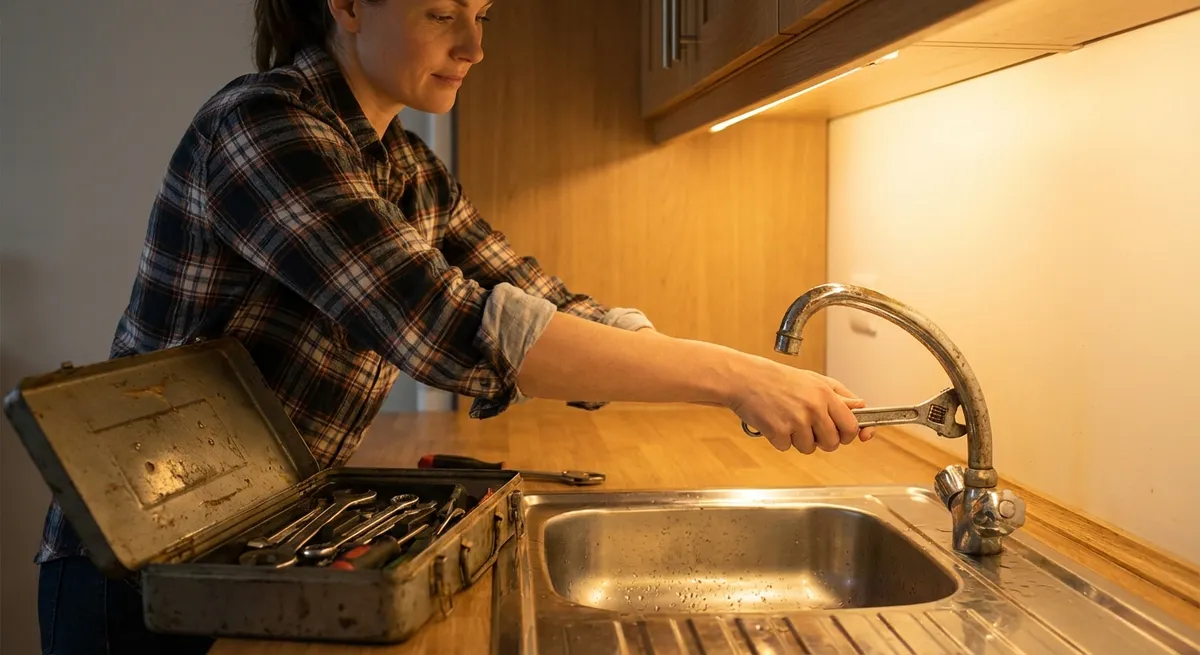
- Gather basic tools: adjustable wrench, Phillips/flathead screwdrivers, Allen (hex) keys, needle-nose pliers, a utility knife or pick, and a flashlight. If you have them, grab plumber’s grease and Teflon (PTFE) tape.
- Keep a small cup or magnetic tray nearby to hold screws and small pieces. Grouping parts in removal order makes reassembly easier.
Taking five minutes to set up properly prevents broken finishes, lost parts, and surprise leaks once you turn the water back on.
Step 2: Disassemble the Handle and Identify the Internal Parts
With the water safely off, you can get to the pieces that usually cause the leak: cartridges, O‑rings, seals, and washers.
- Locate the handle’s set screw. It’s often hidden under a decorative cap (hot/cold indicator) or on the underside/back of the handle. Carefully pry off the cap with a small flathead screwdriver or utility knife.
- Use the correct screwdriver or Allen key to remove the set screw. Keep it in your parts tray immediately.
- Gently lift off the handle. If it’s stuck from mineral buildup, wiggle it side to side or apply a little penetrating oil at the base and wait a few minutes before trying again.
- Under the handle, you’ll see a decorative collar, retaining nut, or clip. Carefully remove these, noting their order and orientation. Take a photo if you’re unsure.
- For cartridge or ceramic disc faucets, pull the cartridge straight up. For compression faucets, you’ll see a stem assembly that unscrews from the faucet body.
- Lay the internal parts out in the order you removed them—top to bottom—so you can reverse the process later.
Once opened, check for obvious issues: cracked plastic, torn rubber, or heavy mineral deposits (white/green buildup). These are common culprits in leaks and poor performance.
Step 3: Inspect, Clean, and Replace Worn Seals or Cartridges
Most faucet drips come from worn seals, O‑rings, or cartridges that no longer create a tight seal. In many cases, replacing these is quicker and more reliable than trying to “revive” badly worn parts.
- Examine rubber washers and O‑rings for cracks, flattening, or brittleness. Even small damage can cause a drip.
- Check the cartridge body (for cartridge faucets) for cracks, chips, or obvious warping. If it’s damaged or looks heavily worn, plan to replace it.
- For compression faucets, inspect the rubber seat washer at the end of the stem and the valve seat down in the faucet body. A gouged or pitted seat will keep leaking unless the seat is repaired or replaced.
- Use white vinegar and an old toothbrush to gently clean mineral deposits off metal and plastic surfaces. Soak parts in vinegar for 15–30 minutes if buildup is heavy, then rinse thoroughly.
- If you know your faucet’s brand/model, buy a matching replacement cartridge or repair kit (usually includes O‑rings and washers). If you’re not sure, take the old cartridge or stem to a hardware store and match it visually and by size.
- Lightly coat new O‑rings and moving rubber parts with plumber’s grease (not petroleum jelly). This helps them seal properly and last longer.
Whenever possible, replace worn components instead of reusing them. It’s a small cost that often prevents you from having to reopen the faucet a few weeks later.
Step 4: Reassemble the Faucet Carefully and Check Your Work
Putting the faucet back together correctly is just as important as taking it apart. Small mistakes—like a misaligned cartridge—can lead to new leaks or stiff handles.
- Insert the new or cleaned cartridge or stem into the faucet body in the same orientation as the old one. Most cartridges have alignment tabs or notches that fit into matching slots—do not force it if it doesn’t sit flat.
- Reinstall any retaining clips, nuts, or collars. Tighten snugly with a wrench but avoid over-tightening, which can crack plastic parts or deform seals. Hand-tight plus a gentle quarter-turn with a wrench is usually enough.
- Refit the handle onto the stem or cartridge. Make sure it moves smoothly through its full range without grinding or sticking.
- Reinstall the handle’s set screw and decorative cap. Make sure the cap snaps or presses flush so it doesn’t fall off later.
- If you removed or disturbed the faucet spout (common on some designs), check for O‑rings on the spout base, replace if worn, and lightly grease them before sliding the spout back on.
Take a final look: everything should appear straight, seated, and even. Any crooked parts can hint at misalignment inside, which can cause leaks when pressurized.
Step 5: Restore Water, Test for Leaks, and Tweak as Needed
With the faucet reassembled, it’s time to pressurize the system and see if your repair holds.
- Slowly open the hot and cold shutoff valves under the sink. Opening them too quickly can create a pressure surge that stresses new parts.
- With the faucet handle in the “off” position, check all visible joints and around the base of the faucet with a flashlight. Look and feel for any moisture.
- Turn the faucet on and let the water run for 30–60 seconds on both hot and cold (or through the full range for a single-handle faucet). This clears air and debris and confirms smooth operation.
- Turn the faucet off and watch the spout closely for at least 30–60 seconds. A tiny drip right after shutoff can be normal as remaining water clears, but continued dripping indicates an internal seal issue.
- Check under the sink again for any slow leaks at the supply connections or shutoff valves. Tighten slightly if needed, but don’t overtighten compression fittings.
- If a drip persists from the spout, double-check that the cartridge or stem is seated fully and that the correct parts were used. In some cases, the valve seat inside the faucet body may need resurfacing or replacement—a more advanced but still DIY-friendly fix with the right seat wrench.
If the faucet now shuts off cleanly and the area under the sink is dry, you’ve successfully stopped the leak. Monitor it over the next day or two to be sure nothing loosens with use.
Conclusion
A dripping faucet is one of the simplest but most satisfying home repairs you can tackle yourself. By turning off the water, disassembling the handle carefully, inspecting and replacing worn seals or cartridges, and testing your work patiently, you can solve a problem that wastes water and money every day. The next time you hear that slow, steady drip, you’ll know exactly what to do—and you won’t have to wait (or pay) for a pro to handle it.
Sources
- [U.S. Environmental Protection Agency – Fix a Leak Week](https://www.epa.gov/watersense/fix-leak-week) - Explains how household leaks waste water and offers basic guidance on identifying and fixing them
- [Family Handyman – How to Fix a Leaky Faucet](https://www.familyhandyman.com/project/how-to-fix-a-leaky-faucet/) - Step‑by‑step faucet repair walkthroughs with photos for different faucet types
- [The Spruce – How to Repair a Cartridge Faucet](https://www.thespruce.com/how-to-repair-a-cartridge-faucet-2718774) - Detailed instructions focused on cartridge-style faucets, common in many homes
- [Lowe’s – How to Fix a Leaking Faucet](https://www.lowes.com/n/how-to/fix-a-leaking-faucet) - Home improvement retailer guide with part identification tips and diagrams
- [American Water Works Association – Drip Calculator](https://www.drinktap.org/water-info/water-conservation/drip-calculator) - Tool showing how much water a small household drip can waste over time
Key Takeaway
The most important thing to remember from this article is that this information can change how you think about Home Repair.